| English | 释义 | 拼音 |
|---|---|---|
| electrostatic equilibrium/ɪˌlektrəʊˈstætɪk ˌiːkwɪˈlɪbrɪəm/ | 静电平衡 | jìng diàn píng héng |
| Faraday cage/ˈfærədeɪ keɪdʒ/ | 法拉第笼 | fǎ lā dì lóng |
Why is a metal car one of the safest places in a lightning storm?
- An enclosed metal car can protect occupants during a lightning strike by carrying current around them.
- A closed conductor shields an empty cavity from external static electric fields.
- The metal's free electrons rearrange in an instant to cancel the field inside.
- This lesson is about how conductors behave once the charges stop moving.
No field inside, in equilibrium
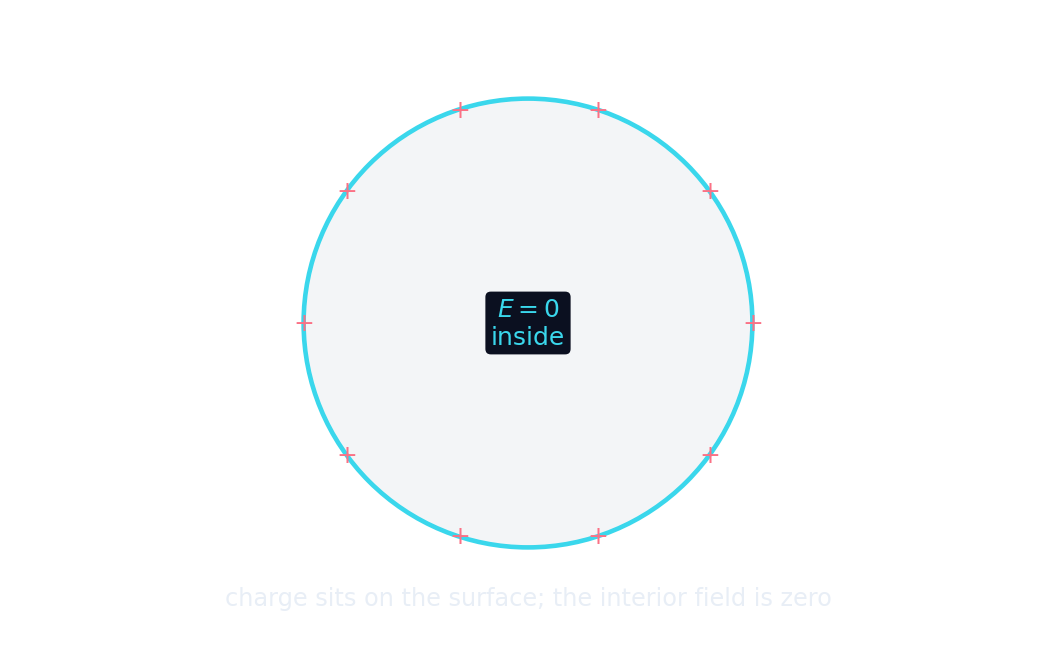
- Once charges settle (electrostatic equilibrium 静电平衡), the field inside a conductor is zero.
- If it weren't, the free charges would feel a force and keep moving — not settled.
- So $E = 0$ everywhere inside the metal.
- An empty, fully enclosed cavity has zero electrostatic field; charges placed in the cavity produce their own field. This external shielding is a Faraday cage 法拉第笼.
Inside a conductor in electrostatic equilibrium, the electric field is:
难度 1/5 · 今日首次完成可获 100 金币及少量额外奖励
If it were not zero, free charges would move — so at equilibrium $E = 0$ inside.
A fully closed conductor in electrostatic equilibrium shields an empty cavity from external static electric fields.
难度 1/5 · 今日首次完成可获 100 金币及少量额外奖励
At electrostatic equilibrium, induced surface charges cancel external static fields within an empty closed cavity. A charge placed in the cavity can produce a field there.
Excess charge lives on surfaces
- Because the inside field is zero, no net charge can sit inside.
- Excess charge lies on surfaces. With no charges in cavities, it all lies on the outer surface.
- Gauss's law confirms it: any interior Gaussian surface encloses zero charge.
- The charge spreads to make the whole conductor one potential.
Excess charge on a solid conductor sits:
难度 1/5 · 今日首次完成可获 100 金币及少量额外奖励
With zero interior field, all excess charge must lie on the surface.
The field just outside
- Just outside the surface, the field is perpendicular to it.
- A parallel field would push surface charges sideways — but they've stopped.
- Its size is $E = \dfrac{\sigma}{\varepsilon_0}$, set by the local surface charge density $\sigma$.
- Flat inside, purely perpendicular outside.
A charged conductor at equilibrium
Sort each statement about a conductor in electrostatic equilibrium.
Just outside a conductor's surface, the field is ____ to the surface.
难度 1/5 · 今日首次完成可获 100 金币及少量额外奖励
A parallel component would move surface charges, so $E$ is perpendicular.
Select 所有 true statements about a conductor in equilibrium.
难度 2/5 · 今日首次完成可获 140 金币及少量额外奖励
Zero interior field, surface charge, single potential. Charge never fills the volume.
Charge crowds at sharp points
- On a lumpy conductor, charge piles up where the surface curves sharply.
- Sharp points have the highest $\sigma$ and the strongest field.
- That is why lightning rods are pointed — the field there ionises the air first.
- Smooth, round shapes spread charge more evenly.
On a conductor, charge and field are strongest at:
难度 1/5 · 今日首次完成可获 100 金币及少量额外奖励
Charge crowds at sharp points, giving the highest $\sigma$ and field.
A closed conducting shell has an empty cavity and reaches electrostatic equilibrium after a charged rod touches its outside.
- The charge spreads over the cage's outer surface.
- In the empty cavity, $E = 0$: the shell shields it from external static fields.
"$E = 0$ inside" holds only in electrostatic equilibrium — after the charges have settled. During the split-second of rearranging, fields inside are not zero. And it applies to the conductor's material, not to a charge you place in a hollow cavity.
In electrostatic equilibrium a conductor has $E = 0$ inside, so all excess charge sits on the surface and the whole conductor is one potential. Just outside, $E = \sigma/\varepsilon_0$ and is perpendicular to the surface; charge crowds at sharp points.
Write from the data: locate the excess charge
- A conductor in equilibrium carries 12 microcoulomb of excess charge and has no charges in its cavities.
- Say where that charge sits and what the field is inside the metal.
A conductor in electrostatic equilibrium has 12 microcoulomb of excess charge and no charges in its cavities. Where is the excess charge, and what is the field inside the conducting material?
In equilibrium, excess charge moves until the field in the conductor is 0. That leaves the excess on the surface.
A conductor in electrostatic equilibrium has 12 microcoulomb of excess charge and no charges in its cavities. Where is the excess charge?
难度 1/5 · 今日首次完成可获 100 金币及少量额外奖励
Equilibrium forces the excess charge to the surface and makes the interior field 0.