| English | 释义 | 拼音 |
|---|---|---|
| field/fiːld/ | 场 | chǎng |
| electric field/ɪˈlektrɪk fiːld/ | 电场 | diàn chǎng |
| test charge/test tʃɑːdʒ/ | 检验电荷 | jiǎn yàn diàn hè |
| uniform/ˈjuːnɪfɔːm/ | 均匀 | jūn yún |
How does one charge feel another across empty space?
- A charge pushes another far away, with nothing visibly between them.
- We explain it with a field 场: charge fills the space around it with influence.
- Any other charge placed there feels a force from the local field.
- The field is the middle-man that carries the electric force.
Field = force per unit charge
- The electric field 电场 at a point is the force per unit positive test charge 检验电荷, small enough not to disturb the source charges.
- $\vec E = \dfrac{\vec F}{q}$, measured in newtons per coulomb (N/C).
- $E$ is a vector: it has a direction at every point.
- Once you know $E$, the force on any charge is just $\vec F = q\vec E$.
The electric field at a point is the:
难度 1/5 · 今日首次完成可获 100 金币及少量额外奖励
$\vec E = \vec F / q$ — the force a unit positive charge would feel.
Once you know the field $E$, the force on a charge $q$ is(是) $F =$ ____.
难度 1/5 · 今日首次完成可获 100 金币及少量额外奖励
$\vec F = q\vec E$ — multiply the field by the charge.
The field of a point charge
- A point charge $Q$ makes a field $E = \dfrac{k|Q|}{r^2}$ at distance $r$.
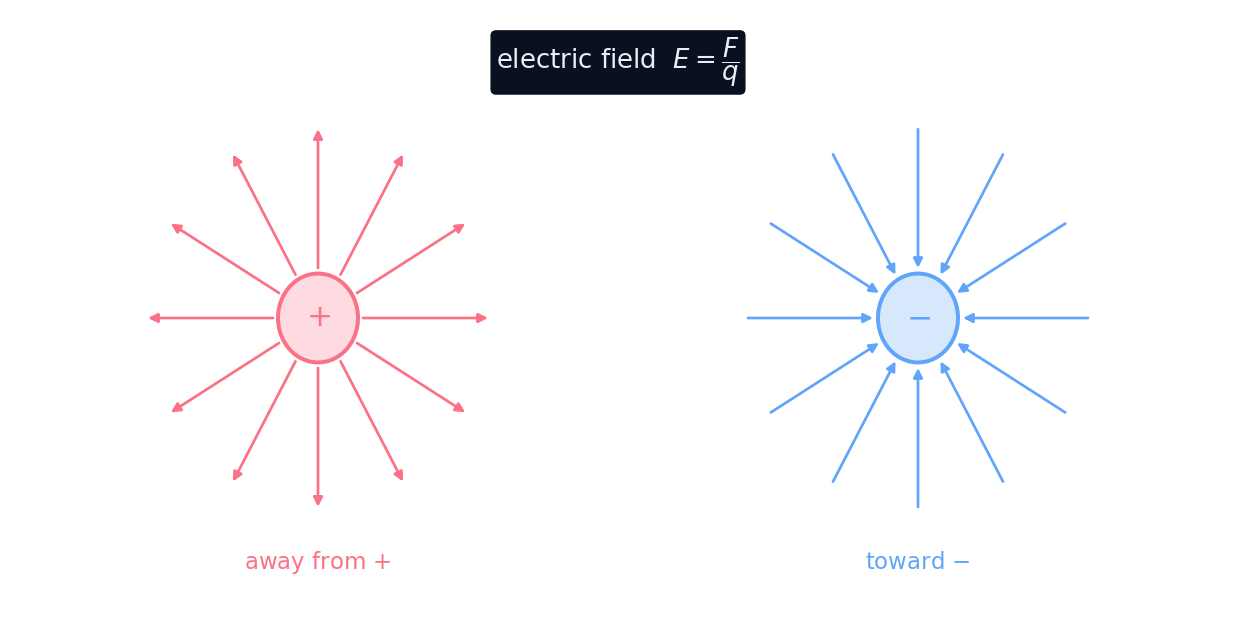
- It points away from a positive $Q$ and toward a negative $Q$.
- It is strongest near the charge and fades as $1/r^2$.
- Field lines show the direction; where they crowd, the field is stronger.
Map a charge's field
Change the sign and size of the charge and watch how its field lines rearrange.
Find the field (in N/C) $3\ \text{m}$ from a $+6\ \text{nC}$ charge. Use $k = 9\times10^9$.
难度 2/5 · 今日首次完成可获 140 金币及少量额外奖励
$E = \dfrac{(9\times10^9)(6\times10^{-9})}{3^2} = \dfrac{54}{9} = 6\ \text{N/C}$.
Reading field lines
- Lines start on positive charge or at infinity and end on negative charge or at infinity.
- They never cross — the field has one direction at each point.
- Closer lines mean a stronger field.
- The line's tangent gives the direction of $\vec E$ (and the force on a $+$ charge).
Two electric field lines can cross at a point.
难度 1/5 · 今日首次完成可获 100 金币及少量额外奖励
Lines never cross — the field has only one direction at each point.
Select 所有 true statements about field lines.
难度 2/5 · 今日首次完成可获 140 金币及少量额外奖励
Electrostatic field lines start on positive charge or at infinity and end on negative charge or at infinity. They crowd where the field is strong and never cross.
A uniform field
- Between large oppositely charged parallel plates, away from the edges, the field is approximately uniform 均匀.
- The lines are straight, evenly spaced, and point from $+$ to $-$.
- A uniform field gives a constant force, so a charge moves like a projectile.
- We will use this constant-field picture for capacitors.
Between large oppositely charged parallel plates, far from their edges, the field is approximately:
难度 1/5 · 今日首次完成可获 100 金币及少量额外奖励
Far from the edges, equal and opposite parallel plates produce nearly straight, evenly spaced field lines and an approximately uniform field.
Find the field $2\ \text{cm}$ from a $+5\ \text{nC}$ charge. Use $k = 9\times10^9$.
- $E = \dfrac{k|Q|}{r^2} = \dfrac{(9\times10^9)(5\times10^{-9})}{(0.02)^2}$.
- $E \approx 1.1\times10^{5}\ \text{N/C}$, pointing away from the charge.
The field $\vec E$ exists whether or not a test charge is there — it is a property of space made by the source charge. Don't say "no charge, no field": the source still fills space with $E$.
The electric field is the force per unit charge, $\vec E = \vec F / q$ (N/C), a vector pointing away from $+$ and toward $-$. A point charge makes $E = k|Q|/r^2$; field lines show its direction, and closer lines mean a stronger field.
Write from the data: find the field
- A +8 nanocoulomb point charge is the source. The point is 0.20 m away. Use k = 9 times 10 to the 9.
- Find the field and its direction.
Find the electric field 0.20 m from a +8 nanocoulomb charge. Use k = 9 times 10 to the 9. Include the direction.
9 times 10 to the 9 times 8 times 10 to the minus 9, divided by 0.04, is 1800. Field direction is the force on a positive test charge.
What is the field 0.20 m from a +8 nanocoulomb point charge? Use k = 9 times 10 to the 9.
难度 1/5 · 今日首次完成可获 100 金币及少量额外奖励
kQ over r squared is 72 divided by 0.04, which is 1800 newtons per coulomb, pointing away.