Fission, Fusion, and Nuclear Decay · 裂变、聚变与核衰变
| English | 中文 | Pinyin · 拼音 |
|---|---|---|
| nuclear fission/ˈnjuːklɪə ˈfɪʃn/ | 核裂变 | hé liè biàn |
| nuclear fusion/ˈnjuːklɪə ˈfjuːʒn/ | 核聚变 | hé jù biàn |
A pinch of matter, an ocean of energy
- The Sun turns four million tonnes of its matter into pure energy every second.
- A nuclear reactor powers a city from a few kilograms of fuel.
- The secret is mass turning into energy, through Einstein's $E = mc^2$.
- Because $c^2$ is enormous, a tiny mass releases a colossal amount of energy.
一撮物质,一片能量的海洋
- 太阳每秒把四百万吨自己的物质变成纯能量。
- 一座核反应堆用几千克燃料就能为一座城市供电。
- 秘密是质量变成能量,通过爱因斯坦的 $E = mc^2$。
- 因为 $c^2$ 巨大,极小的质量就释放出庞大的能量。
Mass becomes energy
- Einstein's relation $E = mc^2$ says mass and energy are two forms of the same thing.
- In a nuclear reaction, a little mass disappears and reappears as a burst of energy.
- Because $c^2 \approx 9\times10^{16}$, even a gram of mass would give a huge energy.
- Nuclear reactions release millions of times more energy per atom than chemical ones.
质量变成能量
- 爱因斯坦关系 $E = mc^2$ 说质量和能量是同一事物的两种形式。
- 在核反应中,一点质量消失,以一阵能量的形式重新出现。
- 因为 $c^2 \approx 9\times10^{16}$,即使一克质量也会给出巨大的能量。
- 核反应每个原子释放的能量比化学反应多几百万倍。
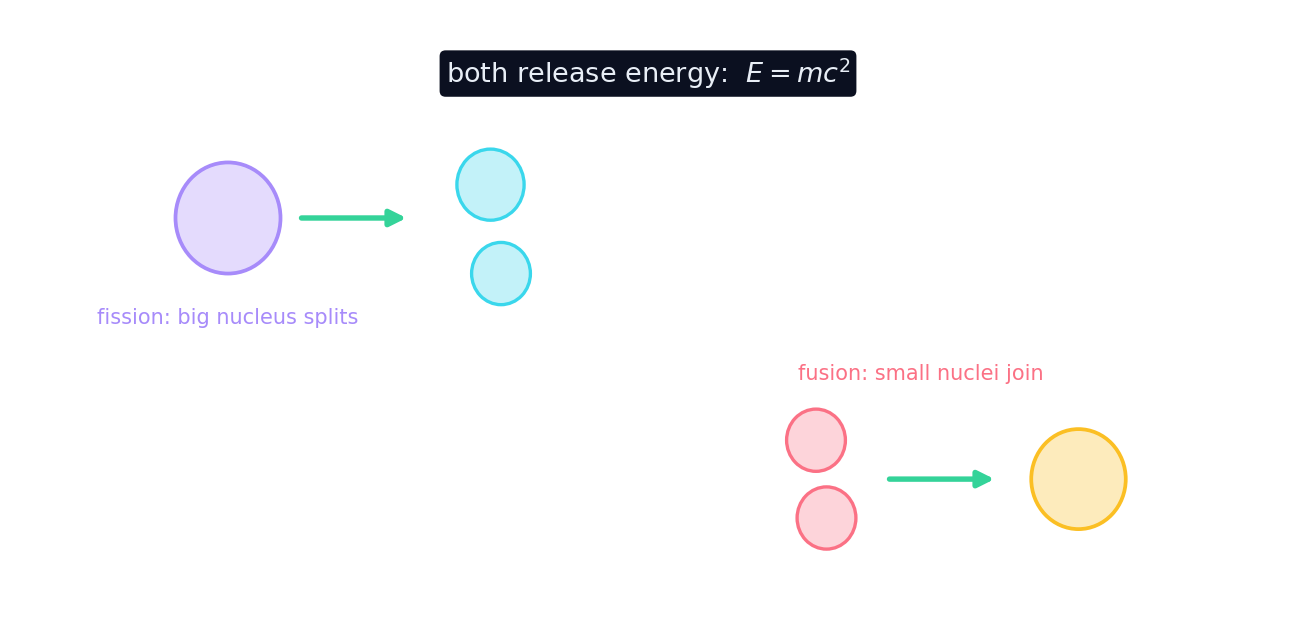 裂变(分裂)和聚变*(结合)都把一点质量转化为能量,$E = mc^2$。*
Which equation relates mass and energy? · 哪个方程关联质量和能量?
Einstein's $E = mc^2$ links mass and energy. · 爱因斯坦的 $E = mc^2$ 连接了质量和能量。
Why do nuclear reactions release so much more energy than chemical ones? · 为什么核反应比化学反应释放出多得多的能量?
Converting even a tiny mass gives huge energy because $c^2$ is so large. · 即使转化极小的质量也能产生巨大能量,因为 $c^2$ 如此之大。
Fission: splitting big nuclei
- Nuclear fission 核裂变 splits a large, heavy nucleus (like uranium) into smaller pieces.
- The fragments have slightly less total mass; the lost mass becomes energy.
- Each split also releases neutrons that can split more nuclei — a chain reaction.
- Fission powers nuclear reactors and atomic bombs.
裂变:分裂大核
- 核裂变把一个大而重的核(如铀)分裂成较小的碎片。
- 碎片的总质量略少;失去的质量变成能量。
- 每次分裂还释放中子,能分裂更多的核——一场链式反应。
- 裂变为核反应堆和原子弹提供动力。
Nuclear fission is the: · 核裂变是:
Fission splits a large, heavy nucleus into smaller pieces. · 裂变将一个大的重原子核分裂成较小的碎片。
Fusion: joining small nuclei
- Nuclear fusion 核聚变 joins small, light nuclei (like hydrogen) into a bigger one.
- Again a little mass is lost and released as energy — even more per kilogram than fission.
- Fusion powers the Sun and the stars, welding hydrogen into helium.
- It needs extreme heat and pressure, which is why fusion power on Earth is so hard.
聚变:结合小核
- 核聚变把小而轻的核(如氢)结合成一个更大的核。
- 又有一点质量损失,并作为能量释放——每千克甚至比裂变更多。
- 聚变为太阳和恒星提供动力,把氢焊接成氦。
- 它需要极端的高温和高压,这就是为什么地球上的聚变能源如此困难。
Fission, fusion or decay? · 裂变、聚变还是衰变?
Sort each nuclear process. · 对每种核过程进行分类。
Nuclear fusion powers the ____ and the stars. · 核聚变为 ____ 和恒星提供能量。
The Sun fuses hydrogen into helium, releasing its energy. · 太阳将氢聚变成氦,释放其能量。
Select all · 所有 true statements about nuclear reactions. · 选择关于核反应的所有正确陈述。
Fission splits, fusion joins, and both release energy from lost mass. Fusion releases energy too. · 裂变分裂,聚变结合,两者均从损失的质量中释放能量。聚变也释放能量。
Both fission (splitting) and fusion (joining) release energy, because in each the products have slightly less mass than the starting nuclei. The "lost" mass isn't destroyed — it becomes energy via $E = mc^2$. Don't assume only splitting releases energy; fusion of light nuclei releases even more.
裂变(分裂)和聚变(结合)都释放能量,因为每种情形里产物的质量都比起始核略少。"损失"的质量没有被毁灭——它通过 $E = mc^2$ 变成能量。别以为只有分裂释放能量;轻核的聚变释放得更多。
Both fission and fusion release energy because the products have slightly less mass. · 裂变和聚变都释放能量,因为产物的质量略少。
The lost mass becomes energy via $E = mc^2$ in both processes. · 损失的质量通过两个过程中的 $E = mc^2$ 转化为能量。
The Sun fuses hydrogen into helium. Where does its enormous energy come from?
- The helium nucleus has slightly less mass than the hydrogen that made it.
- That tiny lost mass becomes energy via $E = mc^2$ — and with $c^2$ so large, it is immense.
太阳把氢聚变成氦。它庞大的能量从哪来?
- 氦核的质量比生成它的氢略少。
- 那一点点损失的质量通过 $E = mc^2$ 变成能量——而 $c^2$ 如此之大,能量极其巨大。
Nuclear reactions convert mass into energy via $E = mc^2$, releasing millions of times more energy per atom than chemical reactions. Fission splits heavy nuclei (reactors, bombs); fusion joins light nuclei (the Sun). In both, the products have slightly less mass, and that mass becomes energy.
核反应通过 $E = mc^2$ 把质量转化为能量,每个原子释放的能量比化学反应多几百万倍。裂变分裂重核(反应堆、炸弹);聚变结合轻核(太阳)。两者产物的质量都略少,那份质量变成了能量。