An electric motor: current + magnet = spin
- Inside every electric motor, a current-carrying wire sits in a magnetic field — and gets pushed.
- Because a current is just moving charges, the field pushes the whole wire sideways.
- Reverse the current every half-turn and that push becomes continuous rotation.
- This "motor effect", and its reverse, power almost all our machines.
The motor effect
- A straight wire of length $L$ carrying current $I$ in a uniform field $B$ feels $F = BIL\sin\theta$, where $\theta$ is the angle between current and field.
- Like the force on a single charge, it is perpendicular to both the current and the field.
- Reverse the current or the field and the force flips direction.
- Bigger current, stronger field, or longer wire all give a bigger force.
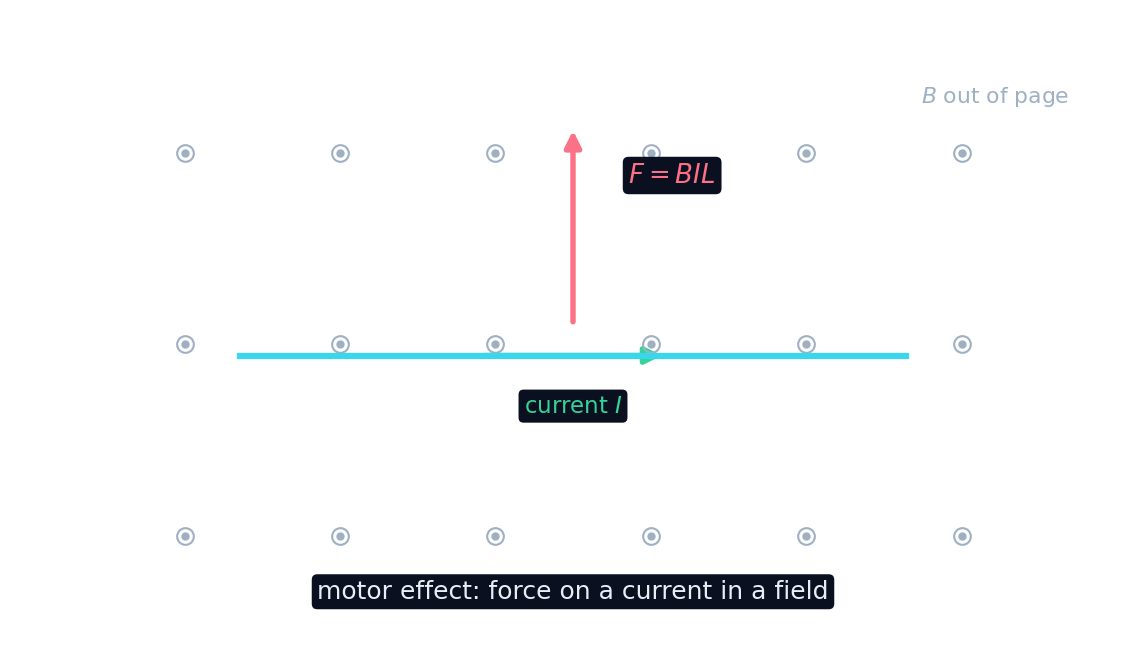
Force on a current
Change the field, current and length and watch the motor-effect force respond.
A straight $0.5\ \text{m}$ wire carries $4\ \text{A}$ perpendicular to a uniform $2\ \text{T}$ field. What force does it feel, in $\text{N}$?
难度 2/5 · 今日首次完成可获 140 金币及少量额外奖励
$F = BIL = 2 \times 4 \times 0.5 = 4\ \text{N}$.
A straight wire of length L carries current I perpendicular to a uniform field B. What is the force magnitude?
难度 1/5 · 今日首次完成可获 100 金币及少量额外奖励
$F = BIL$ — the motor-effect force on a current.
Reversing the current through the wire reverses the direction of the force.
难度 1/5 · 今日首次完成可获 100 金币及少量额外奖励
Reversing the current (or the field) flips the force direction.
Select 所有 changes that increase the motor-effect force on a wire.
难度 2/5 · 今日首次完成可获 140 金币及少量额外奖励
$F = BIL$ grows with field, current and length. Parallel current gives zero force.
The right-hand rule for a wire
- Use the same right-hand rule as for one charge: the current $I$ takes the place of $v$.
- Point your right hand's fingers along $I$, curl them toward $B$; your thumb gives the force.
- The current is the direction positive charge flows, so no sign flip is needed.
- (Fleming's left-hand rule, used in British courses, gives the same direction.)
Which use of the right-hand rule gives the force on a current-carrying wire?
难度 1/5 · 今日首次完成可获 100 金币及少量额外奖励
Fingers along $I$ (conventional current), curl toward $B$: the thumb gives the force, as for a positive charge. Swapping the order or using the electron flow reverses it.
A current makes its own field too
- The reverse is also true: a current-carrying wire creates a magnetic field around itself.
- Coil the wire and the fields add to make a strong electromagnet.
- Switch the current off and the field vanishes — a controllable magnet.
- Electromagnets lift scrap cars, ring doorbells and drive loudspeakers.
A coil of current-carrying wire acts as an ____.
难度 1/5 · 今日首次完成可获 100 金币及少量额外奖励
A coil's magnetic fields add to make a strong, switchable electromagnet.
Use your right hand, with your fingers along the conventional current — pointing them along the electron flow gives the opposite force. And the force needs the current to run across the field: a wire carrying current parallel to the field feels no force.
A wire of length $0.5\ \text{m}$ carries $4\ \text{A}$ perpendicular to a uniform $2\ \text{T}$ field.
- $F = BIL = 2 \times 4 \times 0.5 = 4\ \text{N}$.
Double the current to $8\ \text{A}$ and the force doubles to $8\ \text{N}$.
A current-carrying wire in a magnetic field feels the motor-effect force $F = BIL\sin\theta$, perpendicular to the current and field (right-hand rule: fingers along $I$, curl toward $B$). Reversing the current or field flips it. A current also creates a field — the basis of the electromagnet.
Write from the data: find the motor force
- A 0.20 m wire carries 6 A at right angles to a 5 T field.
- Find the force on the wire.
A straight wire 0.20 m long carries 6 A at right angles to a magnetic field of 5 T. What force does the wire feel, in newtons?
5 times 6 is 30, and 30 times 0.20 is 6.
A straight wire 0.20 m long carries 6 A perpendicular to a uniform 5 T magnetic field. What force does it feel?
难度 1/5 · 今日首次完成可获 100 金币及少量额外奖励
Field times current times length is 6 N. Other options — 4 N (the lesson force); 6 A (the current used as the force).