Kirchhoff's Loop Rule · 基尔霍夫回路定律
| English | 中文 | Pinyin · 拼音 |
|---|---|---|
| Kirchhoff's loop rule/ˈkɜːkhɒfs luːp ruːl/ | 基尔霍夫回路定律 | jī ěr huò fū huí lù dìng lǜ |
Walk a full loop and you end up at the same height
- Hike around a mountain trail that returns to the start — your net change in height is zero.
- Trace a charge around a full circuit loop and its net change in potential is zero too.
- This simple truth is Kirchhoff's loop rule 基尔霍夫回路定律.
- It lets you crack circuits too tangled for the series/parallel shortcuts alone.
绕一整圈回来,你还在同样的高度
- 沿一条最终回到起点的山间小径徒步——你的净高度变化是零。
- 让一个电荷绕电路的一整圈,它电势的净变化也是零。
- 这个简单的真理就是基尔霍夫电压定律。
- 它让你能攻克那些单靠串并联捷径解不了的复杂电路。
The loop rule
- Around any complete loop, the voltage gains and drops sum to zero: $\sum V = 0$.
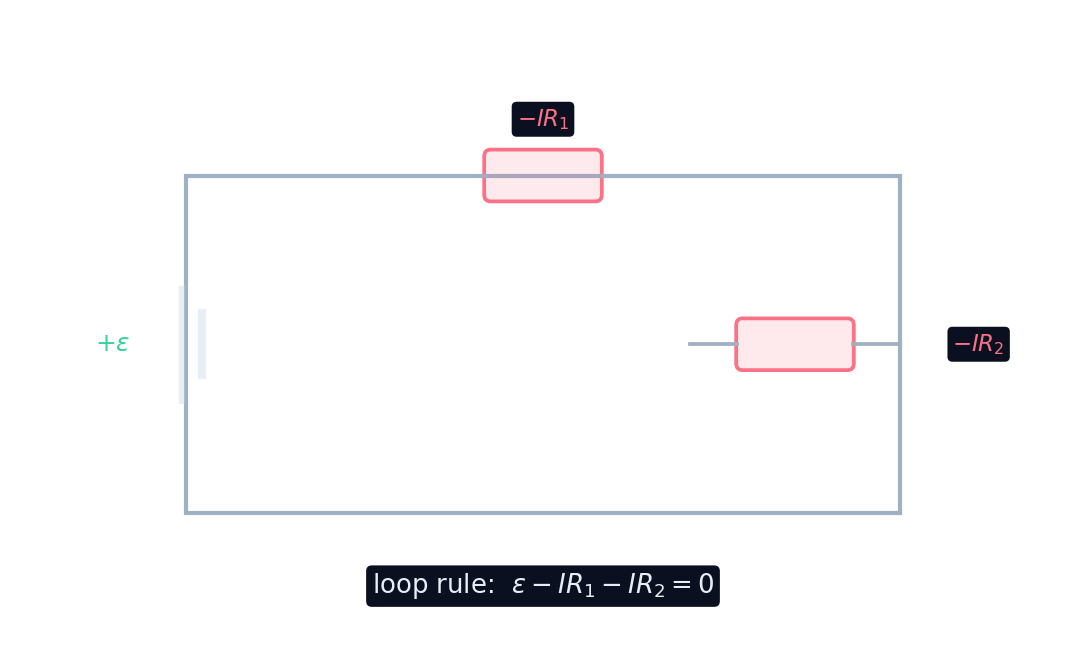
- A battery is a gain (+EMF); each resistor is a drop ($-IR$).
- It is really conservation of energy: energy gained per charge equals energy given up.
- Add them up going once around, and the total must return to zero.
回路定律
- 绕任何一个完整回路,电压的增益和降落之和为零:$\sum V = 0$。
- 电池是一个增益(+电动势);每个电阻是一个降落($-IR$)。
- 它其实是能量守恒:每个电荷获得的能量等于它放出的能量。
- 绕一圈把它们加起来,总和必须回到零。
Kirchhoff's loop rule is a statement of the conservation of: · 基尔霍夫回路定律是关于守恒的表述:
Voltages sum to zero because energy per charge is conserved around a loop. · 电压总和为零,因为沿回路的单位电荷能量守恒。
Around any complete loop, the sum of the voltage gains and drops equals . · 围绕任何完整回路,电压升高的总和与降低的总和等于。
$\sum V = 0$ around a loop. · $\sum V = 0$围绕回路。
Gains and drops
- Cross a battery from − to + and you gain its EMF (energy added per charge).
- Cross a resistor in the current's direction and you lose $IR$ (energy given to heat).
- The supply voltage is shared out among the components as drops.
- For a simple loop: $\varepsilon = IR_1 + IR_2 + \cdots$ — the EMF equals the total of the drops.
增益与降落
- 从 − 到 + 穿过电池,你获得它的电动势(每个电荷增加的能量)。
- 沿电流方向穿过电阻,你失去 $IR$(交给热的能量)。
- 电源电压作为降落分摊到各元件上。
- 对简单回路:$\varepsilon = IR_1 + IR_2 + \cdots$——电动势等于降落之和。
Crossing a battery from − to + in a loop, the potential: · 在回路中从电池的−极穿过到+极,电位:
A battery adds energy per charge, a rise equal to its EMF. · 电池为单位电荷增加能量,升高等于其电动势。
In a simple single-loop circuit, the battery's EMF equals the sum of the resistor voltage drops. · 在简单的单回路电路中,电池的电动势等于电阻电压降的总和。
$\varepsilon = IR_1 + IR_2 + \cdots$ — the loop rule for a single loop. · $\varepsilon = IR_1 + IR_2 + \cdots$ — 单回路的回路定律。
Using it to solve circuits
- Write $\sum V = 0$ for each independent loop, then solve for the unknown currents.
- The loop rule handles multi-battery and bridge circuits that series/parallel cannot.
- Combined with the junction rule (next lesson), it solves any DC circuit.
- Keep the signs consistent: gains positive, drops negative, going one way round.
用它解电路
- 对每个独立回路写出 $\sum V = 0$,然后解出未知的电流。
- 回路定律能处理串并联做不到的多电池和桥式电路。
- 与节点定律(下一节)结合,它能解任何直流电路。
- 保持符号一致:绕一个方向,增益为正、降落为负。
Kirchhoff's loop rule · 基尔霍夫回路定律
Around any closed loop, the voltage gains equal the voltage drops. Sort each crossing. · 围绕任何闭合回路,电压升高等于电压降。对每次穿越进行排序。
A $9\ \text{V}$ battery drives current through $R_1 = 2\ \Omega$ and $R_2 = 1\ \Omega$ in series. Using the loop rule, what is the current, in $\text{A}$? · 一个$9\ \text{V}$电池驱动电流通过串联的$R_1 = 2\ \Omega$和$R_2 = 1\ \Omega$。使用回路定律,电流是多少,单位为$\text{A}$?
$9 - 2I - I = 0 \Rightarrow 9 = 3I \Rightarrow I = 3\ \text{A}$.
Select all · 所有 correct statements about the loop rule. · 选择所有关于回路定律的正确陈述。
The loop rule ($\sum V = 0$, gains + / drops −) works for any loop, not just single-resistor ones. · 回路定律 ($\sum V = 0$,升高 + / 降低 −) 适用于任何回路,不仅限于单电阻电路。
The loop rule is about energy per charge, so mind the signs: a battery adds voltage (+EMF), a resistor removes it ($-IR$). Go consistently one way around the loop. Mixing up the direction of a drop is the most common loop-rule error.
回路定律讲的是每个电荷的能量,所以要注意符号:电池增加电压(+电动势),电阻移除它($-IR$)。一致地绕一个方向。弄错降落的方向是回路定律最常见的错误。
A $9\ \text{V}$ battery drives current through two resistors in series, $R_1 = 2\ \Omega$ and $R_2 = 1\ \Omega$. Find the current.
- Loop rule: $9 - I(2) - I(1) = 0 \Rightarrow 9 = 3I$.
- $I = \dfrac{9}{3} = 3\ \text{A}$ — the same result as adding the resistances.
一节 $9\ \text{V}$ 电池驱动电流通过两个串联电阻,$R_1 = 2\ \Omega$ 和 $R_2 = 1\ \Omega$。求电流。
- 回路定律:$9 - I(2) - I(1) = 0 \Rightarrow 9 = 3I$。
- $I = \dfrac{9}{3} = 3\ \text{A}$——与把电阻相加的结果相同。
Kirchhoff's loop rule: around any closed loop, $\sum V = 0$ — the battery's gain (+EMF) equals the sum of the resistor drops ($IR$). It is energy conservation for charge, and (with the junction rule) it solves any circuit. Keep the signs consistent.
基尔霍夫电压定律:绕任何闭合回路,$\sum V = 0$——电池的增益(+电动势)等于电阻降落之和($IR$)。它是电荷的能量守恒,(与节点定律一起)能解任何电路。保持符号一致。