| English | 释义 | 拼音 |
|---|---|---|
| entropy/ˈentrəpi/ | 熵 | shāng |
| second law of thermodynamics/ˈsekənd lɔː ɒv ˌθɜːməʊdaɪˈnæmɪks/ | 热力学第二定律 | rè lì xué dì èr dìng lǜ |
A shattered cup never leaps back together
- Drop a cup and it shatters. Wait forever and the pieces will never spontaneously reassemble.
- Milk stirred into coffee never un-mixes. Heat never flows from cold to hot on its own.
- Nature has a preferred direction: things run from order toward disorder.
- The measure of that disorder is entropy 熵, and its total cannot decrease in an isolated system.
Entropy measures disorder
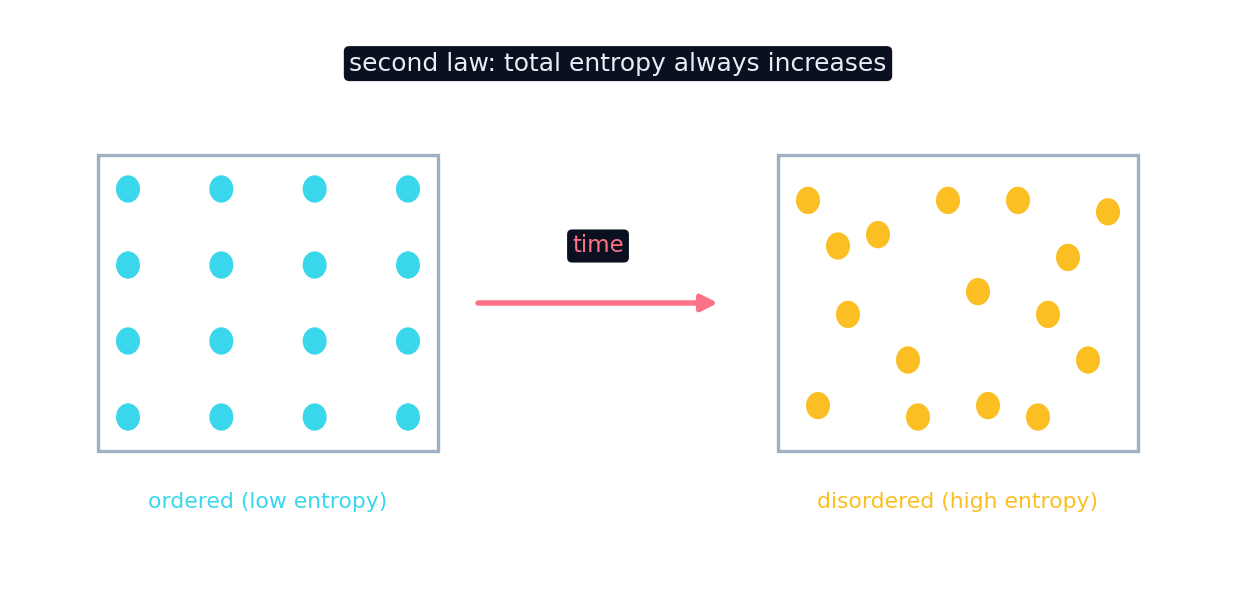
- Entropy is a measure of how spread-out and disordered a system's energy is.
- A neat, ordered arrangement has low entropy; a jumbled, spread-out one has high entropy.
- There are vastly more disordered arrangements than ordered ones, so disorder is overwhelmingly likely.
- Left alone, systems drift toward their most probable (most disordered) state.
Entropy is a measure of a system's:
难度 1/5 · 今日首次完成可获 100 金币及少量额外奖励
Entropy measures how spread-out and disordered a system's energy is.
The second law
- The second law of thermodynamics 热力学第二定律: the total entropy of a system and its surroundings cannot decrease; it increases in irreversible processes and stays constant in an ideal reversible process.
- That is why heat flows hot → cold, not the reverse — it spreads energy out.
- You can lower entropy locally (a fridge, a living cell), but only by raising it more elsewhere.
- The second law gives time its direction — the "arrow of time".
The second law of thermodynamics says the total entropy of the universe:
难度 1/5 · 今日首次完成可获 100 金币及少量额外奖励
Total entropy cannot decrease: it increases in irreversible processes and stays constant in an ideal reversible process.
Heat flows from hot to cold because that spreads energy out and increases total entropy.
难度 1/5 · 今日首次完成可获 100 金币及少量额外奖励
Spreading energy raises entropy, which is why the natural flow is hot → cold.
No perfect engines
- A cyclic heat engine cannot turn all the heat it takes from a single hot reservoir into work.
- Some energy always spreads out as low-grade waste heat.
- This is why car engines and power plants are never $100\%$ efficient.
- The second law sets a hard ceiling that no clever design can beat.
The second law of thermodynamics
Irreversible spontaneous processes increase total entropy. Sort each process.
A cyclic heat engine taking heat from a single hot reservoir cannot be ____% efficient.
难度 1/5 · 今日首次完成可获 100 金币及少量额外奖励
Some energy always spreads out as waste heat, so $100\%$ efficiency is impossible.
Select 所有 consequences of the second law of thermodynamics.
难度 2/5 · 今日首次完成可获 140 金币及少量额外奖励
The second law gives heat flow, engine limits and time's arrow. A cup reassembling would lower total entropy — forbidden.
The second law is about the total entropy of a system and its surroundings. You can create order locally — a freezer makes ice, cells build structure — but the surroundings must gain at least as much entropy as the system loses. Real freezers generate extra entropy, so the total rises.
A freezer making ice violates the second law because it lowers entropy.
难度 1/5 · 今日首次完成可获 100 金币及少量额外奖励
It lowers entropy locally but dumps more disorder (waste heat) into the room, so total entropy still rises.
Why does a hot cup of tea never spontaneously get hotter by drawing heat from the cooler room?
- It would decrease the total entropy (concentrate energy), which the second law forbids.
- Heat instead flows tea → room, spreading energy out and raising total entropy.
Entropy measures disorder, and the second law of thermodynamics says the total entropy of an isolated system never decreases. It increases for irreversible processes and is constant for ideal reversible ones. This sets the direction of natural processes (hot → cold), forbids perfect engines, and gives time its arrow. Local order costs more disorder elsewhere.
Write from the data given
- In one complete cycle, an engine takes in 200 J of heat and does 60 J of work.
- Find the waste heat, and say why the engine is not perfect.
In one complete cycle, an engine takes in 200 J of heat from a hot reservoir and does 60 J of work. How much waste heat leaves, and why can a cyclic engine not convert all that heat into work?
200 minus 60 is 140, which is the heat that did not become work.
In one complete cycle, an engine takes in 200 J of heat and does 60 J of work. How much energy leaves as waste heat?
难度 1/5 · 今日首次完成可获 100 金币及少量额外奖励
Heat in minus work done is 140 J of waste heat.