| English | 释义 | 拼音 |
|---|---|---|
| kinetic theory/kɪˈnetɪk ˈθɪəri/ | 分子运动论 | fēn zǐ yùn dòng lùn |
| kelvin/ˈkelvɪn/ | 开尔文 | kāi ěr wén |
Heat a gas — and you just make its particles fly faster
- Warm up a gas and nothing visible changes, yet its tiny particles start racing around faster.
- Temperature measures the average translational kinetic energy of the gas particles.
- The gas also pushes on its container — pressure — because particles keep hitting the walls.
- The kinetic theory 分子运动论 explains both from one picture: countless particles in constant motion.
A gas is mostly empty space
- A gas is a swarm of tiny particles, far apart, in constant random motion.
- They fly in straight lines until they collide with each other or the walls.
- Between collisions they barely feel any force — the space is mostly empty.
- This simple model predicts real gas behaviour remarkably well.
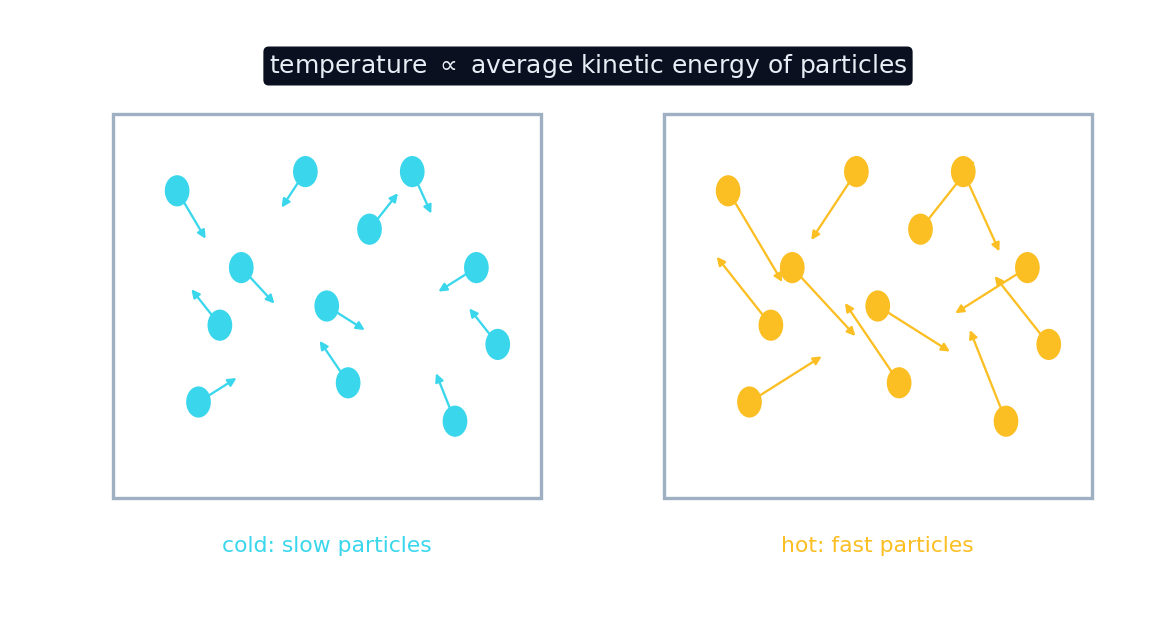
Faster at higher temperature
Raise the temperature and watch the particle-speed distribution shift to higher speeds.
A hotter gas has particles that move ____ on average.
难度 1/5 · 今日首次完成可获 100 金币及少量额外奖励
Higher temperature means more average kinetic energy, so faster particles.
Temperature is average kinetic energy
- Temperature is proportional to the average kinetic energy of the particles.
- Hotter gas ⇒ faster particles ⇒ more kinetic energy per particle.
- On the kelvin 开尔文 scale, doubling the temperature doubles the average kinetic energy.
- At absolute zero ($0\ \text{K}$) particle motion is at its absolute minimum.
In kinetic theory, the temperature of a gas is a measure of the particles':
难度 1/5 · 今日首次完成可获 100 金币及少量额外奖励
Temperature is proportional to the average kinetic energy of the particles.
Doubling the Celsius temperature of a gas doubles the average kinetic energy of its particles.
难度 1/5 · 今日首次完成可获 100 金币及少量额外奖励
False. Average kinetic energy is proportional to the kelvin temperature. Going from 20 °C to 40 °C is only 293 K to 313 K, an increase of about 7%.
Pressure comes from collisions
- Each particle bouncing off a wall gives it a tiny push.
- Pressure is the total force of all those collisions, spread over the wall's area.
- More particles, faster particles, or a smaller box all mean more collisions and higher pressure.
- So temperature and pressure both trace back to particle motion.
What causes the pressure a gas exerts on its container?
难度 1/5 · 今日首次完成可获 100 金币及少量额外奖励
Each collision with a wall gives a tiny push; together they make the pressure.
Select 所有 changes that can increase the pressure of an ideal gas, keeping other variables fixed.
难度 2/5 · 今日首次完成可获 140 金币及少量额外奖励
More or faster particles, or less space, all mean more frequent, harder collisions. Cooling lowers pressure.
Temperature must be measured in kelvin for the kinetic-theory relations. "Doubling the temperature doubles the average kinetic energy" is only true on the kelvin scale — never in $^\circ\text{C}$. Convert to kelvin first: $T_K = T_C + 273$.
Convert $27\ ^\circ\text{C}$ to kelvin (use $T_K = T_C + 273$).
难度 2/5 · 今日首次完成可获 140 金币及少量额外奖励
$T_K = 27 + 273 = 300\ \text{K}$.
A sealed rigid box of gas is heated so its kelvin temperature doubles.
- The average kinetic energy of the particles also doubles.
- The particles hit the walls harder and more often, so the pressure roughly doubles too.
Kinetic theory models a gas as many tiny particles in constant random motion. Temperature (in kelvin) is proportional to their average kinetic energy, and pressure comes from their collisions with the walls. Hotter and more crowded both mean higher pressure.
Write from the data given
- A gas sample is at 47 degrees Celsius.
- Convert that temperature to kelvin.
A gas is at 47 degrees Celsius. What is that temperature in kelvin? Use T kelvin equals T Celsius plus 273.
47 plus 273 is 320.
A gas is at 47 degrees Celsius. Use kelvin temperature = Celsius temperature + 273. What is its temperature in kelvin?
难度 1/5 · 今日首次完成可获 100 金币及少量额外奖励
Adding 273 to 47 gives 320. Other options — 300 kelvin (the lesson conversion of 27 degrees); 47 kelvin (the Celsius number left unchanged).