Thumb over the hose — the water shoots out
- Put your thumb over the end of a garden hose and the water suddenly sprays far and fast.
- You narrowed the opening, and the outlet jet can speed up; restricting the hose can also reduce its total volume flow rate.
- Moving fluids obey conservation laws: mass and energy are both preserved.
- These give two powerful rules — continuity and Bernoulli's principle.
Continuity: what goes in must come out
- For steady incompressible flow through a full pipe with no branches or leaks, the volume passing each cross-section per second is constant.
- Continuity: $A_1 v_1 = A_2 v_2$ — area times speed is constant along the pipe.
- So a narrow section forces a faster flow, and a wide one a slower flow.
- It is just conservation of mass: no fluid piles up or vanishes.
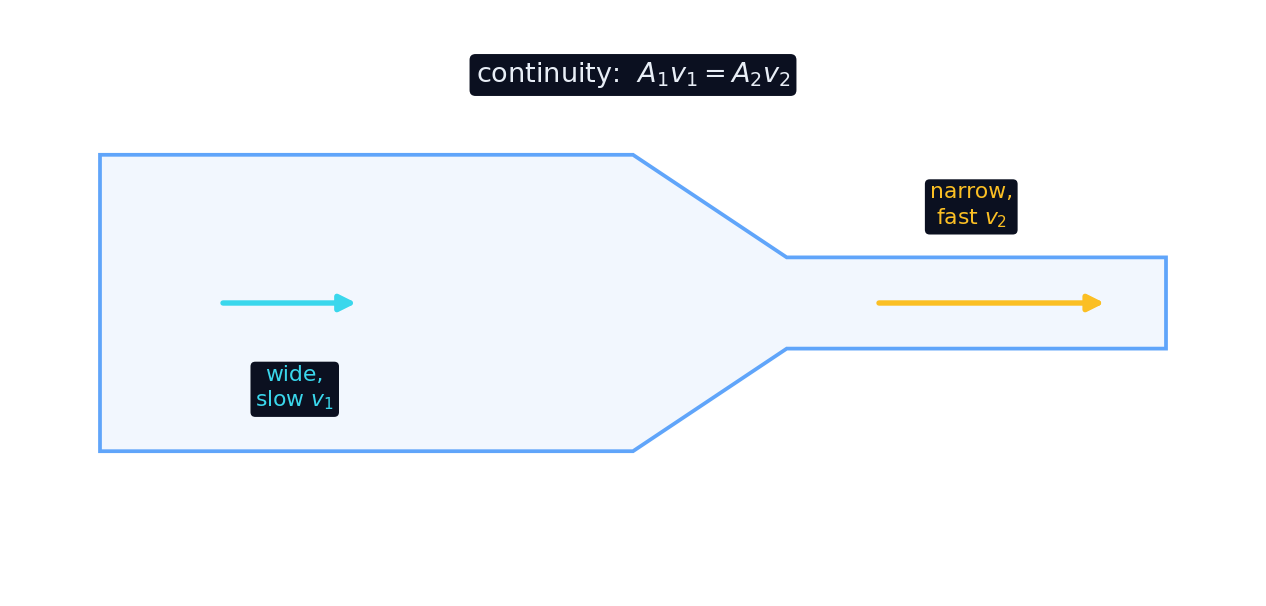
Follow the flow through a pipe
Step through a narrowing pipe and see how the flow speeds up where the pipe is narrow.
Water at $2\ \tfrac{\text{m}}{\text{s}}$ flows from a pipe of area $6\ \text{cm}^2$ into one of area $2\ \text{cm}^2$. What is the new speed, in $\tfrac{\text{m}}{\text{s}}$?
难度 2/5 · 今日首次完成可获 140 金币及少量额外奖励
$A_1 v_1 = A_2 v_2 \Rightarrow 6 \times 2 = 2 v_2 \Rightarrow v_2 = 6\ \tfrac{\text{m}}{\text{s}}$.
The continuity equation $A_1 v_1 = A_2 v_2$ is a statement of the conservation of:
难度 1/5 · 今日首次完成可获 100 金币及少量额外奖励
No fluid piles up or disappears — it is conservation of mass.
In steady incompressible flow through a full pipe with no branches or leaks, fluid moves faster through a narrower section.
难度 1/5 · 今日首次完成可获 100 金币及少量额外奖励
Continuity ($A_1 v_1 = A_2 v_2$) forces a higher speed where the area is smaller.
Bernoulli: faster flow, lower pressure
- Bernoulli's principle comes from conserving energy in a flowing fluid.
- Along one streamline in steady incompressible flow with negligible viscosity and no pump or turbine, $P+\tfrac12\rho v^2+\rho gh$ is constant. At equal heights, faster flow has lower pressure.
- It is the energy trade-off: speeding up the flow costs pressure energy.
- If heights differ, include the $\rho gh$ term; speed alone does not determine which point has lower pressure.
Along one streamline in steady incompressible flow with negligible viscosity and no pump or turbine, compare points at equal height. Where the fluid flows faster, its pressure is:
难度 1/5 · 今日首次完成可获 100 金币及少量额外奖励
Bernoulli gives $P+\tfrac12\rho v^2+\rho gh=constant$. At equal heights the height terms cancel; larger speed then requires lower pressure.
Bernoulli's principle comes from conserving ____ in a flowing fluid.
难度 1/5 · 今日首次完成可获 100 金币及少量额外奖励
It is the energy conservation law for a flowing fluid.
For steady incompressible flow along one streamline, with negligible viscosity, no pump, no branches and no leaks, compare points at equal height. Select all correct statements.
难度 2/5 · 今日首次完成可获 140 金币及少量额外奖励
Continuity (mass) speeds flow in narrow pipes; Bernoulli (energy) links faster flow to lower pressure.
Conservation laws explain everyday flow
- An aeroplane wing speeds air over the top, lowering the pressure there, producing lift.
- A spinning ball curves because it makes the air faster on one side than the other.
- A chimney draws better in wind, because fast air over the top lowers the pressure.
- Both continuity and Bernoulli are conservation laws wearing fluid clothing.
Bernoulli's principle is often stated backwards. Under the stated Bernoulli conditions and at equal heights, faster flow ⇒ lower pressure. And continuity ($A_1 v_1 = A_2 v_2$) means fluid speeds up in a narrow pipe — the opposite of the intuition that "less room means slower".
Water flows at $2\ \tfrac{\text{m}}{\text{s}}$ through a pipe of area $6\ \text{cm}^2$, then into a narrow section of area $2\ \text{cm}^2$.
- Continuity: $A_1 v_1 = A_2 v_2 \Rightarrow 6 \times 2 = 2 \times v_2$.
- $v_2 = \dfrac{12}{2} = 6\ \tfrac{\text{m}}{\text{s}}$ — three times faster in the narrow part.
Flowing fluids conserve mass and energy. Continuity ($A_1 v_1 = A_2 v_2$) means a narrower pipe gives a faster flow. Under its ideal-flow assumptions along one streamline at equal heights, Bernoulli's principle says faster flow means lower pressure. Together they explain lift, curveballs and much of everyday fluid flow.
Write from the data: find the narrow-pipe speed
- Water at 1 m/s flows from a pipe of area 12 cm squared into one of area 3 cm squared.
- Find the speed in the narrow pipe.
Water flows at 1 m/s through a pipe of area 12 cm squared, then into a pipe of area 3 cm squared. What is the speed in the narrower pipe?
For steady incompressible flow through a pipe with no branches or leaks, $A_1v_1=A_2v_2$. Rearrange: $v_2=A_1v_1/A_2=(12/3)(1)=4\ \tfrac{\text{m}}{\text{s}}$. The areas use the same units, so their ratio is 4. Lower pressure at higher speed requires the Bernoulli assumptions and equal height.
Water flows at 1 m/s through a pipe of area 12 cm squared, then into a pipe of area 3 cm squared. What is the speed in the narrower pipe?
难度 1/5 · 今日首次完成可获 100 金币及少量额外奖励
For steady incompressible flow through a pipe with no branches or leaks, $A_1v_1=A_2v_2$. Rearrange: $v_2=A_1v_1/A_2=(12/3)(1)=4\ \tfrac{\text{m}}{\text{s}}$. The areas use the same units, so their ratio is 4. Lower pressure at higher speed requires the Bernoulli assumptions and equal height.