Internal Structure and Density · 内部结构与密度
| English | 中文 | Pinyin · 拼音 |
|---|---|---|
| density/ˈdensɪti/ | 密度 | mì dù |
| fluid/ˈfluːɪd/ | 流体 | liú tǐ |
A marble outweighs a beach ball
- A tiny steel marble can be heavier than a huge beach ball. How?
- The marble packs a lot of mass into a small space; the ball spreads a little mass over a big one.
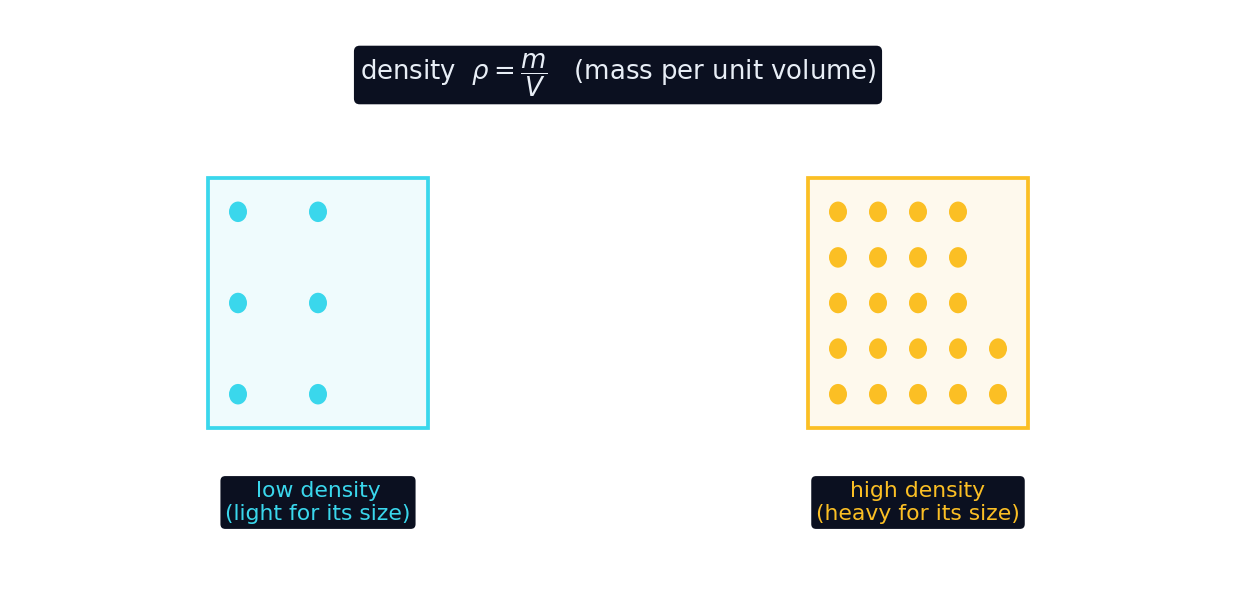
- What matters is mass per unit volume — the density 密度.
- Density explains what floats, what sinks, and how fluids behave.
一颗弹珠比一个沙滩球还重
- 一颗小小的钢弹珠可以比一个巨大的沙滩球还重。怎么会?
- 弹珠把很多质量塞进很小的空间;球把一点点质量摊在很大的空间上。
- 重要的是单位体积的质量——密度。
- 密度解释了什么浮、什么沉,以及流体如何表现。
Defining density
- Density is mass divided by volume: $\rho = \dfrac{m}{V}$.
- Its units are $\tfrac{\text{kg}}{\text{m}^3}$ (or $\tfrac{\text{g}}{\text{cm}^3}$).
- It measures how tightly matter is packed, not how much there is in total.
- Water is about $1000\ \tfrac{\text{kg}}{\text{m}^3}$; lead is over $11\,000$; air is only about $1.2$.
密度的定义
- 密度是质量除以体积:$\rho = \dfrac{m}{V}$。
- 它的单位是 $\tfrac{\text{kg}}{\text{m}^3}$(或 $\tfrac{\text{g}}{\text{cm}^3}$)。
- 它量度物质被塞得多紧,而不是总共有多少。
- 水约为 $1000\ \tfrac{\text{kg}}{\text{m}^3}$;铅超过 $11\,000$;空气只有约 $1.2$。
Dense sinks, light floats · 密度大的下沉,密度小的上浮
Change an object's density and the liquid, and see whether it floats or sinks. · 改变物体的密度和液体,观察其是漂浮还是下沉。
A block has mass $600\ \text{g}$ and volume $200\ \text{cm}^3$. What is its density, in $\tfrac{\text{g}}{\text{cm}^3}$? · 一物块质量为$600\ \text{g}$,体积为$200\ \text{cm}^3$。其密度是多少$\tfrac{\text{g}}{\text{cm}^3}$?
$\rho = m/V = 600/200 = 3\ \tfrac{\text{g}}{\text{cm}^3}$.
Density is defined as: · 密度的定义是:
$\rho = m/V$ — mass per unit volume. · $\rho = m/V$——单位体积的质量。
Solids, liquids, and gases
- In a solid, particles are packed tightly and fixed, so solids are usually dense.
- In a liquid, particles touch but can slide, so liquids are dense but flow.
- In a gas, particles are far apart, so gases have very low density.
- A fluid 流体 is anything that flows — both liquids and gases.
固体、液体和气体
- 在固体中,粒子紧密堆积且固定,所以固体通常致密。
- 在液体中,粒子相互接触但能滑动,所以液体致密却能流动。
- 在气体中,粒子相距很远,所以气体密度很低。
- 流体是任何能流动的东西——液体和气体都是。
To find mass from density and volume, use $m = \rho \times \_\_$. · 要通过密度和体积求质量,使用公式$m = \rho \times \_\_$。
Rearranging $\rho = m/V$ gives $m = \rho V$. · 重新排列公式$\rho = m/V$可得$m = \rho V$。
Water has density $1\ \tfrac{\text{g}}{\text{cm}^3}$. What is the mass of $250\ \text{cm}^3$ of water, in grams? · 水的密度为$1\ \tfrac{\text{g}}{\text{cm}^3}$。$250\ \text{cm}^3$的水的质量是多少克?
$m = \rho V = 1 \times 250 = 250\ \text{g}$.
Select all · 所有 true statements about density and states of matter. · 选择所有关于密度和物质状态的正确陈述。
Gases are low-density, both liquids and gases flow (fluids), solids are packed. Density is per volume, not total mass. · 气体密度低,液体和气体都能流动(流体),固体粒子排列紧密。密度是单位体积的质量,而非总质量。
Using density
- Rearrange to find any one quantity: $m = \rho V$ or $V = \dfrac{m}{\rho}$.
- Density lets you find a mass without weighing, if you know the material and volume.
- Comparing densities tells you instantly which object will float in which fluid.
- It is the starting point for pressure, buoyancy and fluid flow.
使用密度
- 变形以求任一量:$m = \rho V$ 或 $V = \dfrac{m}{\rho}$。
- 如果你知道材料和体积,密度让你不用称重就能求出质量。
- 比较密度能立刻告诉你哪个物体会在哪种流体中浮起。
- 它是压强、浮力和流体流动的起点。
A large, heavy object always has a high density. · 一个大而重的物体总是具有高密度。
Density is mass per volume. A large object can be low-density if its mass is spread over a big volume. · 密度是单位体积的质量。一个大物体如果质量分散在大体积中,其密度可能很低。
Density is not the same as mass or weight. A huge object can be low-density (a beach ball); a small one can be high-density (a marble). Always divide mass by volume — a big heavy object is not automatically "dense".
密度与质量或重力不相同。一个巨大的物体可以是低密度的(沙滩球);一个小物体可以是高密度的(弹珠)。总要把质量除以体积——又大又重的物体不会自动"致密"。
A block has a mass of $600\ \text{g}$ and a volume of $200\ \text{cm}^3$. Find its density.
- $\rho = \dfrac{m}{V} = \dfrac{600}{200} = 3\ \tfrac{\text{g}}{\text{cm}^3}$.
That is three times denser than water ($1\ \tfrac{\text{g}}{\text{cm}^3}$), so it will sink in water.
一个方块质量 $600\ \text{g}$、体积 $200\ \text{cm}^3$。求它的密度。
- $\rho = \dfrac{m}{V} = \dfrac{600}{200} = 3\ \tfrac{\text{g}}{\text{cm}^3}$。
那是水($1\ \tfrac{\text{g}}{\text{cm}^3}$)的三倍致密,所以它会在水中下沉。
Density is mass per unit volume, $\rho = \dfrac{m}{V}$ (in $\tfrac{\text{kg}}{\text{m}^3}$). It measures how tightly matter is packed, not the total amount. Solids and liquids are dense; gases are not. A fluid is anything that flows.
密度是单位体积的质量,$\rho = \dfrac{m}{V}$(单位 $\tfrac{\text{kg}}{\text{m}^3}$)。它量度物质被塞得多紧,而非总量。固体和液体致密;气体不致密。流体是任何能流动的东西。