| English | 释义 | 拼音 |
|---|---|---|
| simple harmonic motion/ˈsɪmpl hɑːˈmɒnɪk ˈməʊʃn/ | 简谐运动 | jiǎn xié yùn dòng |
Pull a swing back and it always returns
- Pull a child's swing to one side and let go — it rushes back, overshoots, and swings the other way.
- The farther you pull it, the harder it is tugged back toward the middle.
- Any motion with this "always pulled back, in proportion" rule is simple harmonic motion 简谐运动 (SHM).
- It is the physics of springs, pendulums, guitar strings and atoms in a solid.
The defining rule
- Ideal undamped SHM happens when the net restoring force is proportional to the displacement from equilibrium, and points back toward it.
- In symbols: $F = -kx$ — the minus sign means "back toward the middle".
- Push it further out (bigger $x$) and the pull-back force grows in step.
- This single condition produces the smooth back-and-forth of every oscillator.
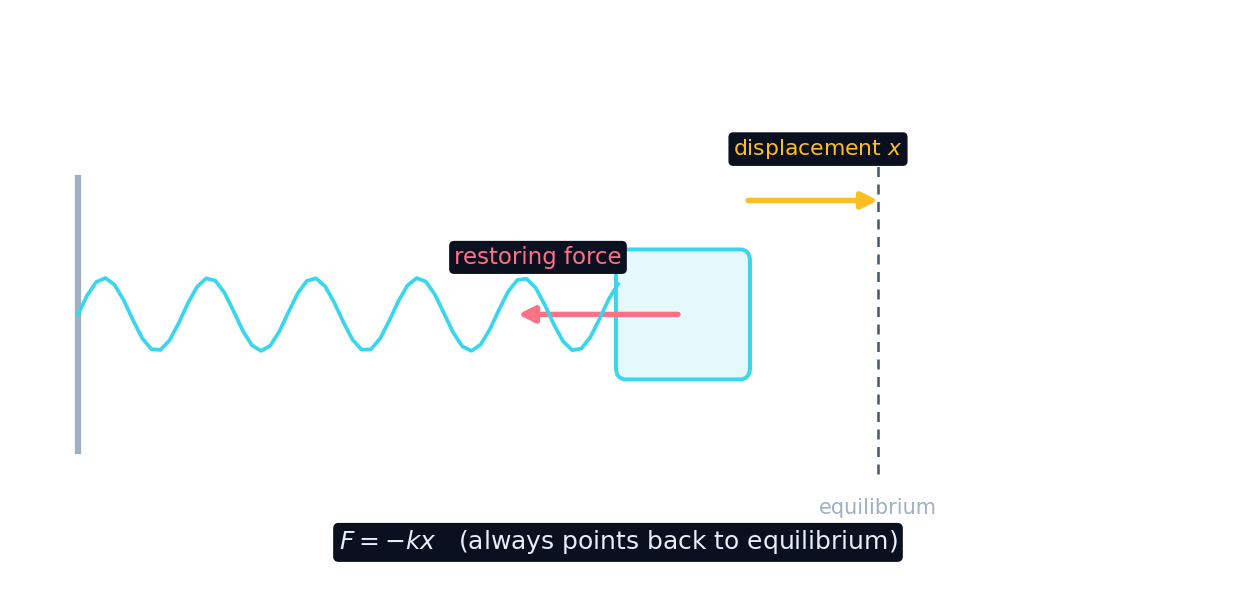
Restoring force grows with displacement
Stretch the spring and see the restoring force grow in proportion — the heart of SHM.
A spring has $k = 50\ \tfrac{\text{N}}{\text{m}}$. What is the size of the restoring force at a displacement of $0.2\ \text{m}$, in $\text{N}$?
难度 2/5 · 今日首次完成可获 140 金币及少量额外奖励
$|F| = kx = 50 \times 0.2 = 10\ \text{N}$, pointing back toward equilibrium.
What defines simple harmonic motion?
难度 1/5 · 今日首次完成可获 100 金币及少量额外奖励
SHM needs $F = -kx$: a restoring force proportional to displacement, pointing back to equilibrium.
In $F = -kx$, the minus sign means the force points ____ toward equilibrium.
难度 1/5 · 今日首次完成可获 100 金币及少量额外奖励
The force always opposes the displacement — it points 反向 toward the middle.
Equilibrium and overshoot
- The oscillator has an equilibrium point where the net force is zero.
- Displaced, it is pulled back — but it arrives at equilibrium moving, so it overshoots.
- Then the restoring force slows it, stops it, and pulls it back again.
- The result is an endless, smooth oscillation about the middle.
Why does an SHM oscillator not simply stop at the equilibrium point?
难度 1/5 · 今日首次完成可获 100 金币及少量额外奖励
At equilibrium the force is zero but the speed is greatest, so the oscillator overshoots and swings on.
Where SHM shows up
- An ideal mass on a Hookean spring with no damping is the textbook example: $F_{net}=-kx$, with $x$ measured from equilibrium.
- A pendulum swings with SHM too, as long as the angle stays small.
- Atoms vibrating in a crystal, and a plucked string, are SHM as well.
- Whenever a system is nudged from a stable balance, SHM tends to appear.
A pendulum is simple harmonic motion only for small swing angles.
难度 1/5 · 今日首次完成可获 100 金币及少量额外奖励
The restoring force is proportional to displacement only at small angles; large swings are not SHM.
Select 所有 systems that undergo simple harmonic motion (at least approximately).
难度 2/5 · 今日首次完成可获 140 金币及少量额外奖励
Springs, small-angle pendulums and strings all have restoring forces $\propto$ displacement. Constant-speed driving does not.
A pendulum is only approximately SHM — the restoring force is proportional to displacement only for small angles. Swing it too far and the motion is no longer simple harmonic. The mass-on-a-spring is the cleaner ideal.
A spring pulls back with $F = -kx$, where $k = 50\ \tfrac{\text{N}}{\text{m}}$. Find the restoring force at a displacement of $0.2\ \text{m}$.
- $F = -kx = -50 \times 0.2 = -10\ \text{N}$.
The $10\ \text{N}$ force points back toward equilibrium, opposite the displacement.
Simple harmonic motion is oscillation where the restoring force is proportional to displacement and points back to equilibrium: $F = -kx$. The object overshoots equilibrium and swings endlessly. Ideal undamped Hookean spring systems give exact SHM; pendulums are SHM only for small angles.
Write from the data: find the restoring force
- A spring has k = 80 N/m and is stretched 0.15 m.
- Find the size of the restoring force.
An ideal horizontal spring has k = 80 N/m and is stretched by 0.15 m from equilibrium. What is the restoring-force magnitude and direction?
For the ideal horizontal spring, $F=-kx=-(80\ \tfrac{\text{N}}{\text{m}})(0.15\ \text{m})=-12\ \text{N}$. Its magnitude is 12 N, and its direction is opposite the positive displacement, toward equilibrium.
An ideal horizontal spring has k = 80 N/m and is stretched 0.15 m from equilibrium. What is the restoring-force magnitude?
难度 1/5 · 今日首次完成可获 100 金币及少量额外奖励
For the ideal horizontal spring, $F=-kx=-(80\ \tfrac{\text{N}}{\text{m}})(0.15\ \text{m})=-12\ \text{N}$. Its magnitude is 12 N, and its direction is opposite the positive displacement, toward equilibrium.