Rotational Equilibrium and Newton's First Law in Rotational Form · 转动平衡与牛顿第一定律的转动形式
| English | 中文 | Pinyin · 拼音 |
|---|---|---|
| rotational equilibrium/rəʊˈteɪʃənl ˌiːkwɪˈlɪbrɪəm/ | 转动平衡 | zhuǎn dòng píng héng |
A seesaw balances — but not where you'd guess
- A heavy adult and a light child can balance a seesaw perfectly.
- The trick: the light child sits farther from the pivot.
- Balance is not about equal forces — it is about equal torques.
- This is Newton's first law, rewritten for rotation.
跷跷板平衡了——但不在你猜的地方
- 一个重的大人和一个轻的孩子可以让跷跷板完美平衡。
- 诀窍:轻的孩子坐得离支点更远。
- 平衡不在于力相等——而在于力矩相等。
- 这就是牛顿第一定律,为转动重写的版本。
The condition for rotational equilibrium
- An object is in rotational equilibrium 转动平衡 when the net torque is zero: $\sum \tau = 0$.
- The total anticlockwise torque equals the total clockwise torque.
- Combined with $\sum F = 0$ (no linear acceleration), the object is in full equilibrium.
- Nothing starts to spin and nothing starts to move.
转动平衡的条件
- 当合力矩为零时,物体处于转动平衡:$\sum \tau = 0$。
- 总逆时针力矩等于总顺时针力矩。
- 再加上 $\sum F = 0$(没有线加速度),物体就处于完全平衡。
- 什么都不会开始旋转,什么都不会开始移动。
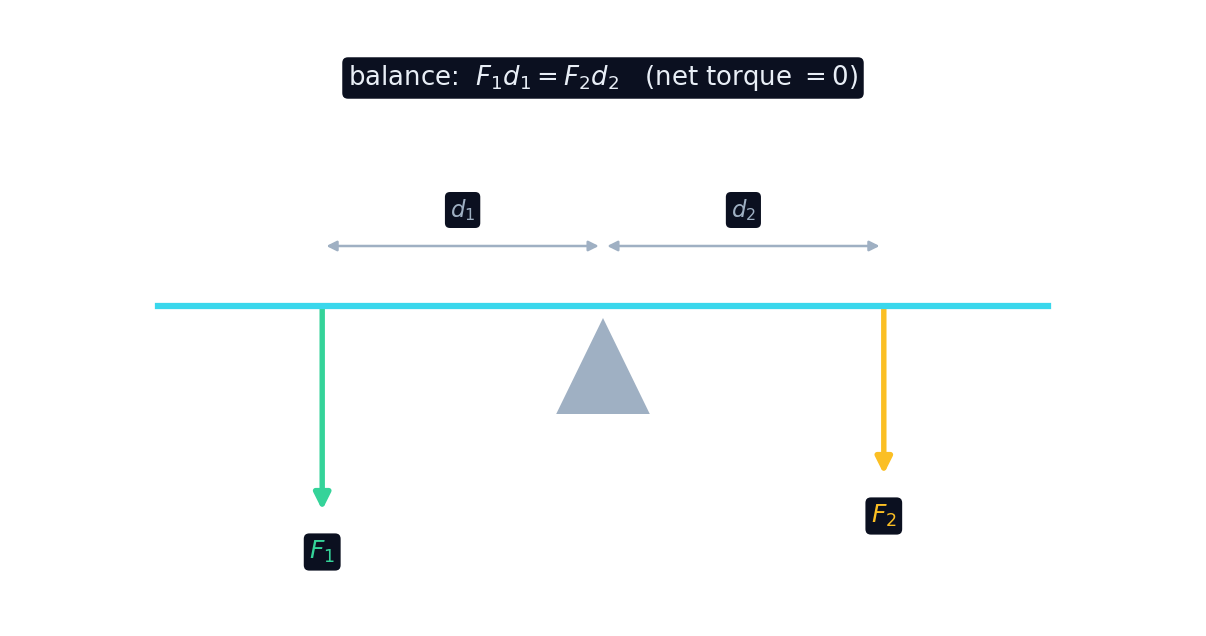
Balance the torques · 平衡力矩
Adjust the forces and distances until the clockwise and anticlockwise torques cancel. · 调整力和距离,直到顺时针和逆时针力矩相互抵消。
What is the condition for rotational equilibrium? · 转动平衡的条件是什么?
Rotational equilibrium means $\sum \tau = 0$ — the turning effects balance. · 转动平衡意味着$\sum \tau = 0$ — 转动效应达到平衡。
In rotational equilibrium, the total clockwise torque equals the total ____ torque. · 在转动平衡中,总顺时针力矩等于总____力矩。
The clockwise and anticlockwise torques must be equal for $\sum\tau = 0$. · 要使$\sum\tau = 0$成立,顺时针和逆时针力矩必须相等。
Rotational equilibrium is the rotational form of which of Newton's laws? · 转动平衡是牛顿哪条定律的转动形式?
Zero net torque ⇒ no change in rotation — the first law (inertia) written for rotation. · 合力矩为零 ⇒ 转动状态不变 — 这是针对转动的第一定律(惯性)。
Trading force for distance
- Because torque is force times distance, a small force far out can balance a large force close in.
- $F_1 d_1 = F_2 d_2$ is the balance condition for a simple beam.
- A light child at the end balances a heavy adult near the middle.
- This is the whole principle of levers, cranes and balance scales.
用力换距离
- 因为力矩是力乘以距离,远处的小力可以平衡近处的大力。
- $F_1 d_1 = F_2 d_2$ 是简单横梁的平衡条件。
- 末端的轻孩子平衡了靠近中间的重大人。
- 这就是杠杆、起重机和天平的全部原理。
A $300\ \text{N}$ child sits $2\ \text{m}$ from a seesaw pivot. How far from the pivot must a $400\ \text{N}$ child sit to balance it, in metres? · 一个$300\ \text{N}$的孩子坐在距跷跷板支点$2\ \text{m}$处。另一个$400\ \text{N}$的孩子必须坐在距支点多远的地方才能使其平衡,单位为米?
$300 \times 2 = 400 \times d_2 \Rightarrow d_2 = 600/400 = 1.5\ \text{m}$.
For an object to be in full · 充分 equilibrium, select all · 所有 that must be true. · 要使物体处于完全平衡状态,选择所有必须成立的选项。
Full equilibrium needs $\sum F = 0$ and $\sum \tau = 0$, so neither linear nor angular acceleration. Shape is irrelevant. · 完全平衡需要$\sum F = 0$和$\sum \tau = 0$,因此既无直线加速度也无角加速度。形状无关紧要。
Why it keeps structures standing
- Bridges, shelves and cranes must be in rotational equilibrium, or they would rotate and fall.
- Engineers add up every torque about a chosen pivot and set the sum to zero.
- A clever pivot choice makes an unknown force vanish from the equation.
- Getting the torques to balance is what keeps a loaded structure still.
它为何让结构屹立
- 桥梁、架子和起重机必须处于转动平衡,否则它们会旋转并倒下。
- 工程师把绕选定支点的每一个力矩加起来,令其和为零。
- 巧妙地选择支点,能让一个未知力从方程中消失。
- 让力矩相平衡,正是让承重结构保持静止的原因。
Rotational equilibrium needs the torques to balance, not the forces. Two equal forces can still spin an object if they act at different distances or in the same turning sense. Always compare $\sum \tau$, using each force's lever arm.
转动平衡需要力矩相平衡,而不是力。两个相等的力,如果作用在不同距离或朝同一转动方向,仍能使物体旋转。始终比较 $\sum \tau$,用上每个力的力臂。
Two equal forces acting at different distances from a pivot always keep an object balanced. · 两个相等的力作用在距支点不同距离处,总是使物体保持平衡。
Balance needs equal torques, not equal forces. Different lever arms give different torques. · 平衡需要相等的力矩,而不是相等的力。不同的杠杆臂会产生不同的力矩。
A child of weight $300\ \text{N}$ sits $2\ \text{m}$ from a seesaw's pivot. Where must a $400\ \text{N}$ child sit to balance it?
- Balance: $F_1 d_1 = F_2 d_2 \Rightarrow 300 \times 2 = 400 \times d_2$.
- $d_2 = \dfrac{600}{400} = 1.5\ \text{m}$ from the pivot, on the other side.
一个 $300\ \text{N}$ 的孩子坐在距跷跷板支点 $2\ \text{m}$ 处。一个 $400\ \text{N}$ 的孩子必须坐在哪里才能平衡?
- 平衡:$F_1 d_1 = F_2 d_2 \Rightarrow 300 \times 2 = 400 \times d_2$。
- $d_2 = \dfrac{600}{400} = 1.5\ \text{m}$,在支点另一侧。
Rotational equilibrium means zero net torque: $\sum \tau = 0$, so the clockwise and anticlockwise torques balance ($F_1 d_1 = F_2 d_2$ for a beam). It is Newton's first law for rotation, and — with $\sum F = 0$ — keeps seesaws, bridges and cranes still.
转动平衡意味着合力矩为零:$\sum \tau = 0$,所以顺时针和逆时针力矩相平衡(横梁的 $F_1 d_1 = F_2 d_2$)。它是转动版的牛顿第一定律,并且——加上 $\sum F = 0$——让跷跷板、桥梁和起重机保持静止。