Newton's Second Law in Rotational Form · 牛顿第二定律的转动形式
Twist harder to spin faster — but big wheels resist
- Give a bike wheel a hard flick and it spins up quickly; a heavy flywheel barely responds to the same twist.
- More torque spins things up faster; more rotational inertia fights the change.
- There is one equation that ties torque, inertia and angular acceleration together.
- It is Newton's second law — dressed for rotation.
拧得越用力转得越快——但大轮子会抵抗
- 用力一拨自行车轮,它很快转起来;同样一拧,沉重的飞轮却几乎不动。
- 更大的力矩让东西转得更快;更大的转动惯量抵抗这种改变。
- 有一个方程把力矩、惯量和角加速度联系在一起。
- 它就是牛顿第二定律——为转动而装扮。
The rotational second law
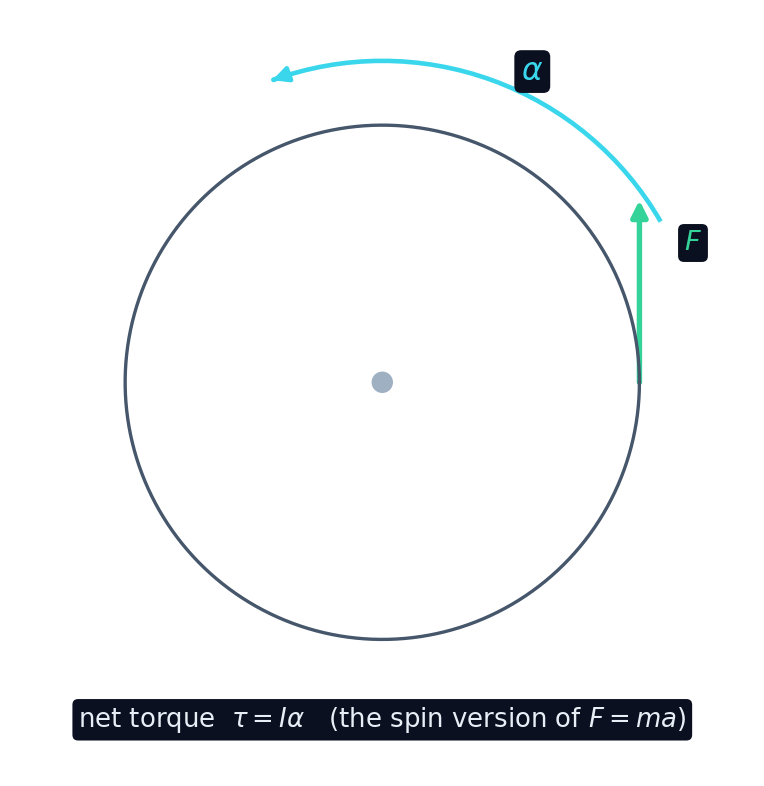
- Net torque equals rotational inertia times angular acceleration: $\sum \tau = I\alpha$.
- Rearranged: $\alpha = \dfrac{\sum \tau}{I}$ — the spin-up a torque produces.
- Bigger torque ⇒ bigger $\alpha$; bigger $I$ ⇒ smaller $\alpha$.
- It is the exact twin of $\vec F = m\vec a$, with rotational quantities swapped in.
转动第二定律
- 合力矩等于转动惯量乘以角加速度:$\sum \tau = I\alpha$。
- 变形:$\alpha = \dfrac{\sum \tau}{I}$——力矩所产生的转动加速。
- 更大的力矩 ⇒ 更大的 $\alpha$;更大的 $I$ ⇒ 更小的 $\alpha$。
- 它是 $\vec F = m\vec a$ 的精确孪生,只是换上了转动量。
A net torque of $12\ \text{N·m}$ acts on a wheel with $I = 3\ \text{kg}\cdot\text{m}^2$. What is the angular acceleration, in $\tfrac{\text{rad}}{\text{s}^2}$? · 一个净力矩$12\ \text{N·m}$作用于具有$I = 3\ \text{kg}\cdot\text{m}^2$的轮子上。角加速度是多少,单位为$\tfrac{\text{rad}}{\text{s}^2}$?
$\alpha = \sum\tau / I = 12/3 = 4\ \tfrac{\text{rad}}{\text{s}^2}$.
What net torque gives a wheel of $I = 2\ \text{kg}\cdot\text{m}^2$ an angular acceleration of $5\ \tfrac{\text{rad}}{\text{s}^2}$? Answer in $\text{N·m}$. · 要给予具有$I = 2\ \text{kg}\cdot\text{m}^2$的轮子$5\ \tfrac{\text{rad}}{\text{s}^2}$的角加速度,需要多大的净力矩?答案单位为$\text{N·m}$。
$\tau = I\alpha = 2 \times 5 = 10\ \text{N·m}$.
The rotational second law is net torque $= I\_\_$ (fill in the angular quantity). · 转动第二定律是净力矩$= I\_\_$(填入转动量)。
$\sum\tau = I\alpha$ — inertia times angular acceleration. · $\sum\tau = I\alpha$ ——惯性乘以角加速度。
The full analogy
- Force $\to$ torque $\tau$; mass $\to$ rotational inertia $I$; acceleration $\to$ angular acceleration $\alpha$.
- Every straight-line law has a rotational partner obtained by this swap.
- $F = ma$ becomes $\tau = I\alpha$; momentum $mv$ becomes angular momentum $I\omega$.
- Learn one column and you get the other for free.
完整的类比
- 力 $\to$ 力矩 $\tau$;质量 $\to$ 转动惯量 $I$;加速度 $\to$ 角加速度 $\alpha$。
- 每条直线定律都有一个由这种替换得到的转动伙伴。
- $F = ma$ 变成 $\tau = I\alpha$;动量 $mv$ 变成角动量 $I\omega$。
- 学会一栏,另一栏就免费到手。
In the rotational second law $\tau = I\alpha$, which quantity plays the role of mass? · 在转动第二定律$\tau = I\alpha$中,哪个量扮演质量的角色?
Rotational inertia $I$ is the rotational analog of mass — the resistance to angular acceleration. · 转动惯量$I$是质量的转动类比物 — 抵抗角加速度的能力。
Match each rotational quantity to its linear analog. · 将每个转动量与其对应的直线类比量匹配。
$\tau \leftrightarrow F$, $I \leftrightarrow m$, $\alpha \leftrightarrow a$ turns $F = ma$ into · 生成 $\tau = I\alpha$. · $\tau \leftrightarrow F$、$I \leftrightarrow m$、$\alpha \leftrightarrow a$ 将$F = ma$转换为$\tau = I\alpha$。
Why heavy wheels are sluggish
- A large $I$ (mass far from the axis) means a given torque produces only a small $\alpha$.
- Flywheels use this on purpose — they resist changes in spin, smoothing an engine's rotation.
- To spin up a heavy wheel quickly you need a large torque.
- Same torque, larger inertia ⇒ slower to get going, and slower to stop.
为什么重轮子迟钝
- 大的 $I$(质量远离轴)意味着给定的力矩只产生很小的 $\alpha$。
- 飞轮就是故意利用这一点——它们抵抗旋转的改变,平滑引擎的转动。
- 要快速让重轮子转起来,你需要很大的力矩。
- 同样的力矩、更大的惯量 ⇒ 起转更慢,停下也更慢。
Newton's second law for rotation · 转动的牛顿第二定律
A torque produces angular acceleration in proportion to rotational inertia: torque = I times alpha. · 力矩产生角加速度,其大小与转动惯量成正比:力矩 = I × α。
For the same net torque, a larger rotational inertia gives a smaller angular acceleration. · 对于相同的净力矩,较大的转动惯量会导致较小的角加速度。
$\alpha = \tau / I$: a larger $I$ in the denominator means a smaller $\alpha$. · $\alpha = \tau / I$:分母中的较大$I$意味着较小的$\alpha$。
The rotational second law uses net torque, not force, and rotational inertia, not mass. Do not plug plain mass into $\tau = I\alpha$ — you must use $I = \sum mr^2$, which depends on how the mass is arranged.
转动第二定律用的是合力矩,而不是力,以及转动惯量,而不是质量。不要把普通质量代入 $\tau = I\alpha$——你必须用 $I = \sum mr^2$,它取决于质量如何排布。
A net torque of $12\ \text{N}\cdot\text{m}$ acts on a wheel of rotational inertia $I = 3\ \text{kg}\cdot\text{m}^2$.
- $\alpha = \dfrac{\sum \tau}{I} = \dfrac{12}{3} = 4\ \tfrac{\text{rad}}{\text{s}^2}$.
Double the rotational inertia and the same torque gives only $2\ \tfrac{\text{rad}}{\text{s}^2}$.
一个 $12\ \text{N}\cdot\text{m}$ 的合力矩作用在转动惯量 $I = 3\ \text{kg}\cdot\text{m}^2$ 的轮子上。
- $\alpha = \dfrac{\sum \tau}{I} = \dfrac{12}{3} = 4\ \tfrac{\text{rad}}{\text{s}^2}$。
把转动惯量加倍,同样的力矩只给出 $2\ \tfrac{\text{rad}}{\text{s}^2}$。
Newton's second law for rotation: $\sum \tau = I\alpha$, so $\alpha = \sum\tau / I$. It mirrors $F = ma$ with torque for force, rotational inertia for mass, and angular acceleration for acceleration. A large $I$ makes an object sluggish to spin up or slow down.
转动版牛顿第二定律:$\sum \tau = I\alpha$,所以 $\alpha = \sum\tau / I$。它对应 $F = ma$,以力矩替换力、转动惯量替换质量、角加速度替换加速度。大的 $I$ 使物体起转和停下都迟钝。