| English | 释义 | 拼音 |
|---|---|---|
| graph/ɡræf/ | 图像 | tú xiàng |
| slope/sləʊp/ | 斜率 | xié lǜ |
| velocity/vəˈlɒsɪti/ | 速度 | sù dù |
| acceleration/əkˌseləˈreɪʃn/ | 加速度 | jiā sù dù |
| area/ˈeərɪə/ | 面积 | miàn jī |
| displacement/dɪˈspleɪsmənt/ | 位移 | wèi yí |
One motion, four disguises
- A ball rolls down a ramp. That single motion can be told four ways.
- In words ("it speeds up steadily"), in a table of times and positions, in an equation, and in a graph 图像.
- Physicists switch between these fluently — each reveals something the others hide.
- The graph is often the most powerful: its shape is the story.
Position–time graphs
- Plot position against time: the vertical value is where the object is.
- The slope 斜率 (gradient) at any point is the velocity 速度.
- A straight, sloping line ⇒ constant velocity; a curve ⇒ velocity is changing.
- A horizontal line ⇒ the object is at rest (slope zero).
On a position–time graph, what does the slope of the line represent?
难度 1/5 · 今日首次完成可获 100 金币及少量额外奖励
Slope is rise over run $= \Delta x / \Delta t$, which is the 速度.
A horizontal line on a position–time graph means the object is at rest.
难度 1/5 · 今日首次完成可获 100 金币及少量额外奖励
A horizontal line has zero slope, so the velocity is zero — the object is at rest.
Velocity–time graphs
- Now plot velocity against time — a different graph of the same trip.
- The slope is the acceleration 加速度.
- The area 面积 between the line and the time axis is the displacement 位移.
- A line below the axis means negative velocity; its area counts as negative displacement.
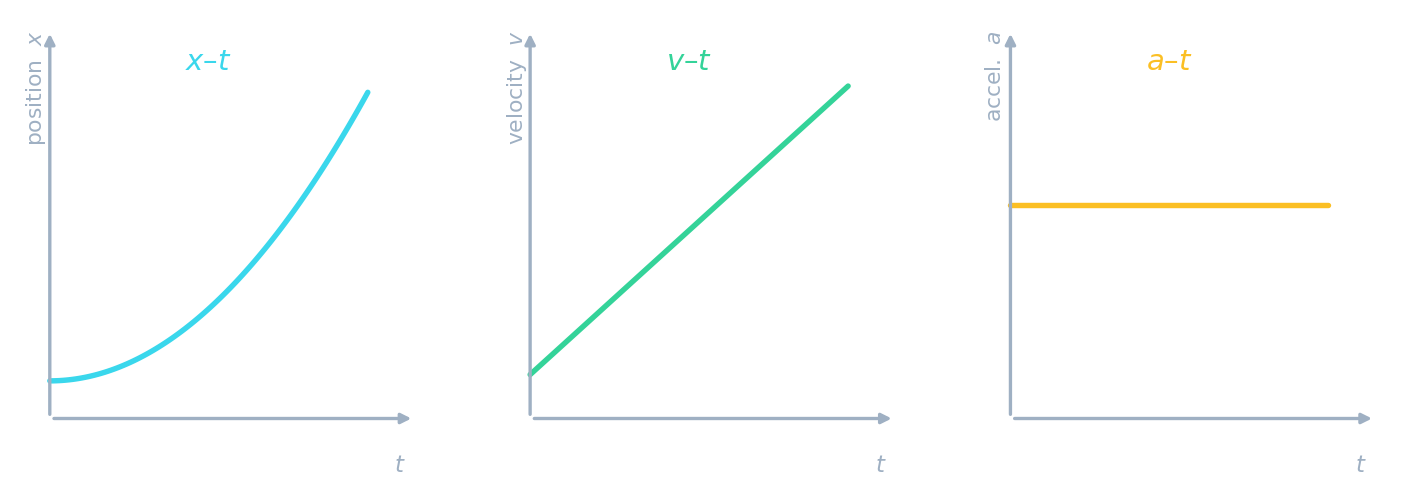
Slope and area on the graphs
Set a negative acceleration and see the velocity line fall while the position graph curves over.
On a velocity–time graph, what does the area between the line and the time axis represent?
难度 1/5 · 今日首次完成可获 100 金币及少量额外奖励
面积 $=$ 速度 $\times$ 时间 $= \Delta x$, the 位移.
Reading area and slope
- Slope needs a rise over run; area needs the shape under the line.
- Under a straight v–t line, the area is a trapezium: $s=\tfrac12(u+v)t$. If one end has zero velocity, this becomes a triangle, $s=\tfrac12 vt$.
- Below-axis area is subtracted; that is how an object can return toward its start.
- Always read the axis labels first: slope and area mean different things on different graphs.
On a v–t graph the velocity rises in a straight line from $0$ 到 $12\ \tfrac{\text{m}}{\text{s}}$ 次 $6\ \text{s}$. What is the displacement, in metres?
难度 2/5 · 今日首次完成可获 140 金币及少量额外奖励
Area of the triangle $= \tfrac12 \times 6 \times 12 = 36\ \text{m}$.
When acceleration is constant: SUVAT
- With constant acceleration, the following equations link $s,\ u,\ v,\ a,\ t$ (the "SUVAT" set):
- $v = u + at$
- $s = ut + \tfrac12 a t^2$
- $v^2 = u^2 + 2as$
- Pick the equation that contains your three knowns and the one unknown you want.
Match each graph feature to what it represents.
难度 2/5 · 今日首次完成可获 140 金币及少量额外奖励
Slope of x–t is velocity; slope of v–t is acceleration; area under v–t is displacement.
Which SUVAT equation has no time $t$ in it? $v^2 = u^2 + 2a\_\_$.
难度 1/5 · 今日首次完成可获 100 金币及少量额外奖励
$v^2 = u^2 + 2as$ links velocity, acceleration and displacement without needing the time.
Slope and area are not interchangeable. On a velocity–time graph the slope is acceleration and the area is displacement. On a position–time graph the slope is velocity and the area does not give displacement or velocity. Read the axes before you calculate.
A cart starts from rest and its velocity rises in a straight line to $12\ \tfrac{\text{m}}{\text{s}}$ over $6\ \text{s}$.
- The v–t graph is a triangle: base $6\ \text{s}$, height $12\ \tfrac{\text{m}}{\text{s}}$.
- Displacement $=$ area $= \tfrac12 \times 6 \times 12 = 36\ \text{m}$.
Read motion from graphs: on a position–time graph, slope = velocity; on a velocity–time graph, slope = acceleration and area = displacement. When acceleration is constant, the SUVAT equations ($v=u+at$, $s=ut+\tfrac12at^2$, $v^2=u^2+2as$) do the rest.
Write from the data: find the triangle area
- On a velocity-time graph the velocity rises in a straight line from 0 to 8 m/s over 5 s.
- Find the displacement.
On a velocity-time graph the velocity rises in a straight line from 0 to 8 m/s over 5 s. What displacement does that triangle show?
Displacement is the signed area under a velocity-time graph. Here the area is a triangle above the axis: $s=\tfrac12 t(v-u)=\tfrac12(5\ \text{s})(8\ \tfrac{\text{m}}{\text{s}})=20\ \text{m}$.
On a velocity-time graph the velocity rises in a straight line from 0 to 8 m/s over 5 s. What displacement does that triangle show?
难度 1/5 · 今日首次完成可获 100 金币及少量额外奖励
Displacement is the signed area under a velocity-time graph. Here the area is a triangle above the axis: $s=\tfrac12 t(v-u)=\tfrac12(5\ \text{s})(8\ \tfrac{\text{m}}{\text{s}})=20\ \text{m}$.