| English | 释义 | 拼音 |
|---|---|---|
| Point of view/pɔɪnt ɒv vjuː/ | 叙述视点 | xù shù shì diǎn |
"Why will you say that I am mad?"
- Edgar Allan Poe's "The Tell-Tale Heart" (1843) begins with a voice arguing with you, the reader, insisting it is sane, before it has told you anything that happened. Every later detail reaches you through that voice.
- Every story or poem has a narrator (in prose) or speaker (in poetry) who relates the events and builds a relationship with the reader. Identifying who is telling, and how they see things, changes what every detail means.
In a poem, what is the voice that speaks called?
难度 1/5 · 今日首次完成可获 100 金币及少量额外奖励
Prose has a narrator, poetry a speaker; neither is automatically the author.
Read the opening
TRUE!—nervous—very, very dreadfully nervous I had been and am; but why will you say that I am mad? The disease had sharpened my senses—not destroyed—not dulled them. Above all was the sense of hearing acute. I heard all things in the heaven and in the earth. I heard many things in hell. How, then, am I mad? Hearken! and observe how healthily—how calmly I can tell you the whole story.
- Acute = very sharp; hearken = listen. The narrator is about to describe a murder he committed.
What point of view does "The Tell-Tale Heart" use?
难度 1/5 · 今日首次完成可获 100 金币及少量额外奖励
"I" tells the story, and he is the main character.
Perspective and point of view
| Term | Means | In "The Tell-Tale Heart" |
|---|---|---|
| Point of view 叙述视点 | the position the narrator tells from | first person: "I", inside the events, the murderer himself |
| Perspective | how the narrator sees their situation | he believes his sharp senses prove he is sane |
- One is a place to see from; the other is a way of seeing. Exam prompts use the two words exactly, so you should too.
Perspective, point of view, or a mistake?
Sort each phrase by the term it actually uses.
Match each statement to the term it describes.
难度 2/5 · 今日首次完成可获 140 金币及少量额外奖励
Point of view is the position; perspective is the way of seeing.
The narrator is not the author
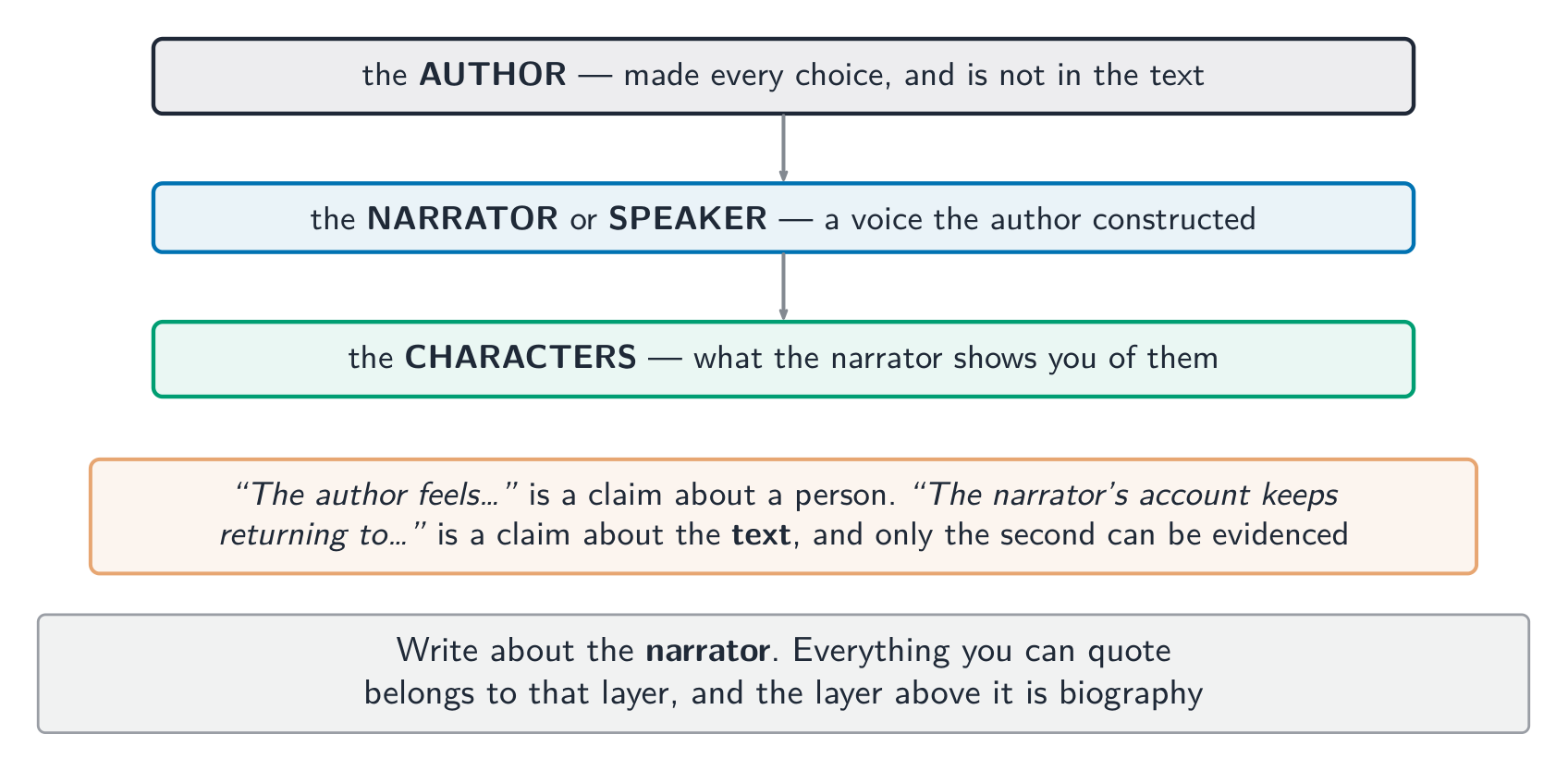
- Poe did not murder anyone. The "I" is a character Poe created. Writing "Poe says he heard things in hell" gives a character's words to a real person outside the text.
- Write the narrator, the speaker or the character's name. Keep the author's name for choices about the writing: "Poe lets the narrator's dashes show his panic."
Which sentence is correct?
难度 1/5 · 今日首次完成可获 100 金币及少量额外奖励
The words belong to the narrator, a character Poe created.
Reading the narrator against himself
- The narrator says he is calm, but the dashes, exclamations and repetitions ("very, very dreadfully") show the opposite. He says hearing "many things in hell" proves he is healthy; the reader takes it as proof that he is not.
- When the reader trusts the narrator less than the narrator trusts himself, the narrator is unreliable, and the gap between what he says and what we see becomes the story's meaning.
An unreliable narrator is one whose account the reader has reason to doubt.
难度 1/5 · 今日首次完成可获 100 金币及少量额外奖励
The dashes and the claim about hell make us doubt the narrator's insistence that he is calm and sane.
Model paragraph
Poe's first-person narrator undermines his own argument in the act of making it. He insists that he can tell the story "healthily—how calmly", yet the passage is broken by dashes and exclamations, so the reader hears panic in the very sentences meant to prove calm. His evidence also works against him: claiming to have "heard many things in hell" is offered as proof of sharp senses, but it convinces the reader of the madness he denies. Because the whole story comes through this voice, the reader learns to read every detail twice, once as the narrator presents it and once as the evidence of his mind.
- Why it scores: it names the point of view, quotes details of how the narrator speaks, and explains how his perspective shapes the reader's relationship with the text.
Never write "the author feels" about a speaker or narrator. It costs credit on every AP essay. Name the narrator, the speaker or the character.
Write three sentences about this speaker: "I am the happiest woman in the town, / I tell the neighbours every day; / I smile until my face is sore, / and nobody has asked me why." Identify the point of view, the perspective, and one way the language makes the reader doubt the speaker.
Refer to "the speaker", never "the poet".
Narrators and speakers relate the events and build a relationship with the reader. Point of view is the position they tell from; perspective is how they see their situation. The narrator is not the author. Compare what a narrator says with what the language shows; the gap can reveal an unreliable narrator.