| English | 释义 | 拼音 |
|---|---|---|
| power series/ˈpaʊə ˈsɪəriːz/ | 幂级数 | mì jí shù |
| radius of convergence/ˈreɪdɪəs ɒv kənˈvɜːdʒəns/ | 收敛半径 | shōu liǎn bàn jìng |
| interval of convergence/ˈɪntəvl ɒv kənˈvɜːdʒəns/ | 收敛区间 | shōu liǎn qū jiān |
| endpoint | 端点 | duān diǎn |
| Ratio Test/ˈreɪʃɪəʊ test/ | 比值判别法 | bǐ zhí pàn bié fǎ |
Where can you trust a series approximation?
- Suppose you approximate a function with a power series 幂级数 centered at $x=2$. Nearby inputs may work, while distant inputs may make the series diverge. A power series is a sum $\sum c_n(x-a)^n$; the numbers $c_n$ do not depend on $x$.
- The radius of convergence 收敛半径 gives a distance from the center $a$. The interval of convergence 收敛区间 lists all real inputs where the series converges. Find both before using the series as a function.
A radius measures distance, not an endpoint 端点
- For a finite positive radius $R$, the series converges absolutely when $|x-a|<R$ and diverges when $|x-a|>R$. The interior is $(a-R,a+R)$, with width $2R$.
- The endpoints are $a-R$ and $a+R$. The radius alone does not decide whether either endpoint is included. The center is always included: at $x=a$, all positive-power terms vanish, leaving only a possible constant term.
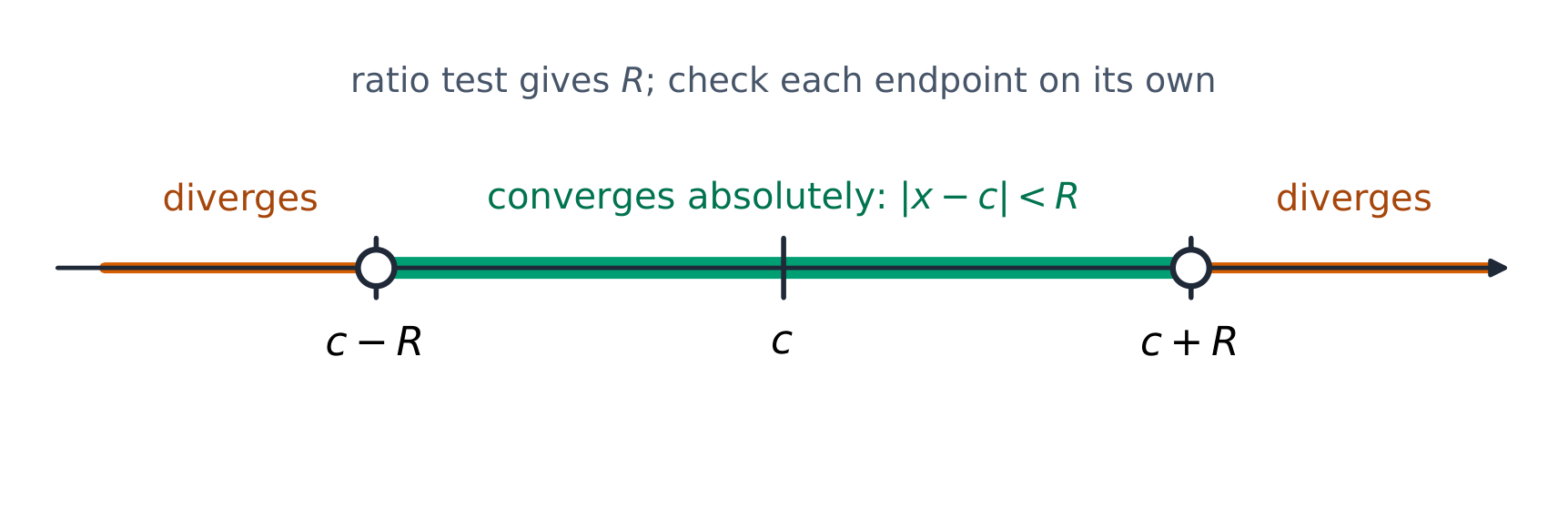
A power series has finite positive radius R and center a. Where is absolute convergence guaranteed?
难度 1/5 · 今日首次完成可获 100 金币及少量额外奖励
The open interior is within distance R of a; the endpoints need separate tests.
A power series with finite real coefficients converges at its center.
难度 1/5 · 今日首次完成可获 100 金币及少量额外奖励
All positive-power terms vanish at the center; a constant term, if present, is finite.
Apply the Ratio Test 比值判别法 to the whole term
- Let $u_n(x)=c_n(x-a)^n$. When the limit exists, calculate $L(x)=\lim_{n\to\infty}\left|\dfrac{u_{n+1}(x)}{u_n(x)}\right|$. Values below $1$ give absolute convergence; values above $1$ give divergence; $L=1$ is inconclusive.
- Keep the factor involving $x$ while simplifying. Solve $L(x)<1$ for a distance from the center. If dividing terms is not defined at the center, substitute the center directly into the original series instead.
When applicable, which test uses the limit of the absolute ratio of consecutive terms to find a power-series radius?
难度 1/5 · 今日首次完成可获 100 金币及少量额外奖励
Apply the ratio test to the complete terms, retaining their x-dependent factor.
The absolute ratio limit for a power series is $4|x+2|$. What is its radius of convergence?
难度 2/5 · 今日首次完成可获 140 金币及少量额外奖励
Solve $4|x+2|<1$ to get $|x+2|<1/4$. The radius is $1/4=0.25$.
Worked example: a shifted center
- Consider $\displaystyle\sum_{n=1}^{\infty}\dfrac{(x-2)^n}{3^n n}$. The center is $a=2$. For $x\ne2$, the absolute ratio simplifies as follows.
- Solving $\dfrac{|x-2|}{3}<1$ gives $|x-2|<3$, or $-1<x<5$. Thus $R=3$, not $5$ and not the interval width $6$. At $x=2$, every term is $0$, so convergence is immediate.
The ratio calculation gives the open interior $(-1,5)$. It has not yet given the full interval. Substitute $x=-1$ and $x=5$ into the original series to finish the problem.
A power-series ratio calculation gives |x−2|/3<1. What is its radius of convergence?
难度 2/5 · 今日首次完成可获 140 金币及少量额外奖励
The allowed distance from 2 is less than 3. The width is 6.
支持 $\sum_{n=1}^{\infty}(x-2)^n/(3^n n)$, what is the center?
难度 2/5 · 今日首次完成可获 140 金币及少量额外奖励
The power is built from x−2, so the center is 2.
A finite convergence interval has candidate endpoints −1 and 5. What is its radius?
难度 2/5 · 今日首次完成可获 140 金币及少量额外奖励
The radius is half the distance between candidate endpoints: $R=[5-(-1)]/2=6/2=3$. Their midpoint is $[-1+5]/2=2$; endpoint inclusion does not alter $R$.
Test both ends of the shifted example
- At $x=-1$, the series becomes $\sum\dfrac{(-1)^n}{n}$. The positive terms $1/n$ decrease to $0$, so the alternating-series test gives convergence. At $x=5$, the series becomes the divergent harmonic series $\sum\dfrac{1}{n}$.
- Include $-1$ and exclude $5$: the full interval is $[-1,5)$, while the radius remains $3$. Square brackets mean the endpoint is included; round brackets mean it is excluded.
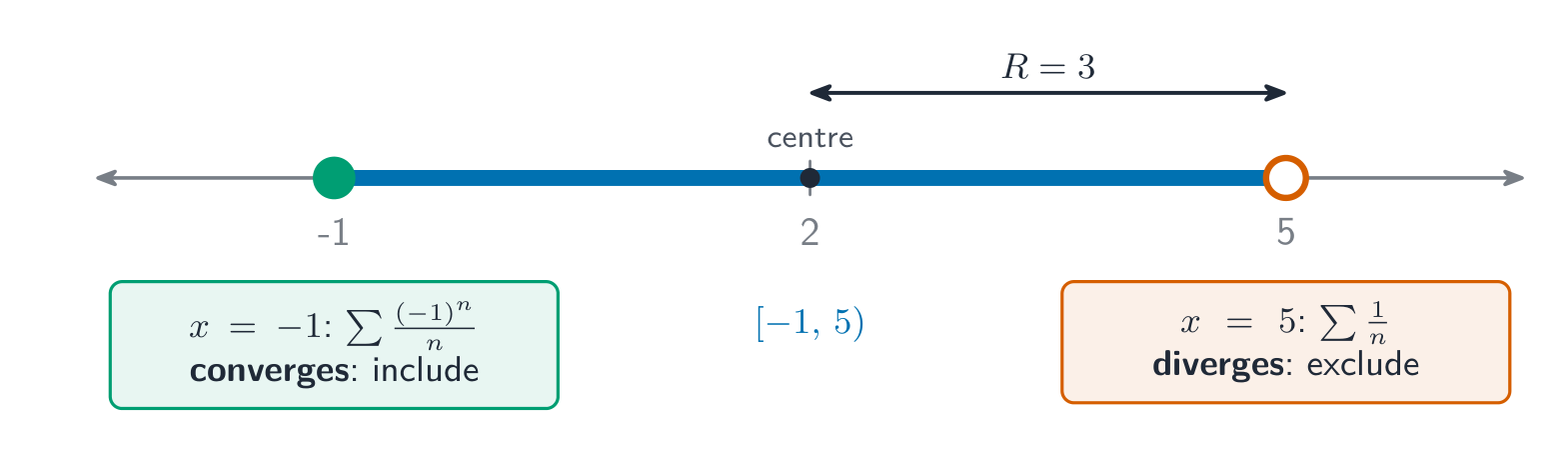
For a finite positive radius found from the ratio limit, the two boundary substitutions give $L=1$. This does not mean divergence. Test the resulting numerical series at each end with another test; the two conclusions can differ.
If the ratio limit at an endpoint is 1, the series must diverge there.
难度 1/5 · 今日首次完成可获 100 金币及少量额外奖励
A ratio limit of 1 is inconclusive; another test is needed.
A series converges for −1<x<5. At x=−1 it converges; at x=5 it diverges. Which is its full interval?
难度 1/5 · 今日首次完成可获 100 金币及少量额外奖励
Include the convergent left endpoint and exclude the divergent right endpoint.
Substitute $x=-1$ 生成 $\sum_{n=1}^{\infty}(x-2)^n/(3^n n)$. Which numerical series results?
难度 1/5 · 今日首次完成可获 100 金币及少量额外奖励
The factor $(x-2)/3$ becomes $-1$, giving terms $(-1)^n/n$.
Same radius, different endpoint results
- Write $t=(x-2)/3$ and start every sum at $n=1$. Each family below has the same center $2$ and radius $3$, because the absolute ratio limit is $|t|$.
- At the left endpoint $t=-1$; at the right endpoint $t=1$. Use the actual substituted terms, not the shape of the open interior, to decide the brackets.
| Terms being summed | Left endpoint | Right endpoint | Full interval |
|---|---|---|---|
| $t^n$ | Diverges: terms do not approach $0$ | Diverges: terms are $1$ | $(-1,5)$ |
| $t^n/n$ | Converges by the alternating-series test | Diverges: harmonic | $[-1,5)$ |
| $t^n/n^2$ | Converges absolutely | Converges: $p$-series, $p=2$ | $[-1,5]$ |
| $(-1)^n t^n/n$ | Diverges: harmonic | Converges by the alternating-series test | $(-1,5]$ |
Finite-radius power-series families
For the default sum of tⁿ/n with t=(x−2)/3, the radius is 3 and the interval is [−1, 5). Changing the coefficient family changes the actual endpoint series; changing the center or scale moves the interval.
Let $t=(x-2)/3$. Which is the interval of convergence of $\sum_{n=1}^{\infty}t^n/n^2$?
难度 1/5 · 今日首次完成可获 100 金币及少量额外奖励
At t=1 the p-series with p=2 converges; at t=−1 it converges absolutely.
The series $\sum_{n=1}^{\infty}((x-2)/3)^n$ includes both candidate endpoints because they are finite numbers.
难度 1/5 · 今日首次完成可获 100 金币及少量额外奖励
At the endpoints the terms are 1 or alternate between−1 and 1. They do not tend to 0.
Two power series with the same center and radius must include exactly the same endpoints.
难度 1/5 · 今日首次完成可获 100 金币及少量额外奖励
The coefficient sequence determines the numerical series at the boundaries.
A second example reverses the included end
- For $\displaystyle\sum_{n=1}^{\infty}\dfrac{(-1)^n(x+1)^n}{2^n n}$, the absolute ratio limit is $|x+1|/2$. Hence $a=-1$, $R=2$ and the candidate endpoints are $-3$ and $1$.
- At $x=-3$, the two factors $(-1)^n$ multiply to $1$, giving the divergent harmonic series. At $x=1$, the alternating harmonic series converges. The interval is $(-3,1]$; the left endpoint is not always the included one.
支持 $\sum_{n=1}^{\infty}(-1)^n(x+1)^n/(2^n n)$, what happens at $x=-3$?
难度 1/5 · 今日首次完成可获 100 金币及少量额外奖励
The factors $(-1)^n$ multiply to $1$, leaving the divergent harmonic series.
Radius zero and infinite radius
- For $\sum_{n=1}^{\infty}n!(x-2)^n$, the absolute ratio is $(n+1)|x-2|$, which grows without bound for $x\ne2$. Only $x=2$ converges, so $R=0$ and the convergence set is $\{2\}$.
- For $\sum_{n=1}^{\infty}\dfrac{(x-2)^n}{n!}$, the absolute ratio $|x-2|/(n+1)$ tends to $0$ for every fixed real $x$. Thus $R=\infty$ and the interval is $(-\infty,\infty)$. These cases do not have two distinct finite endpoints to test.
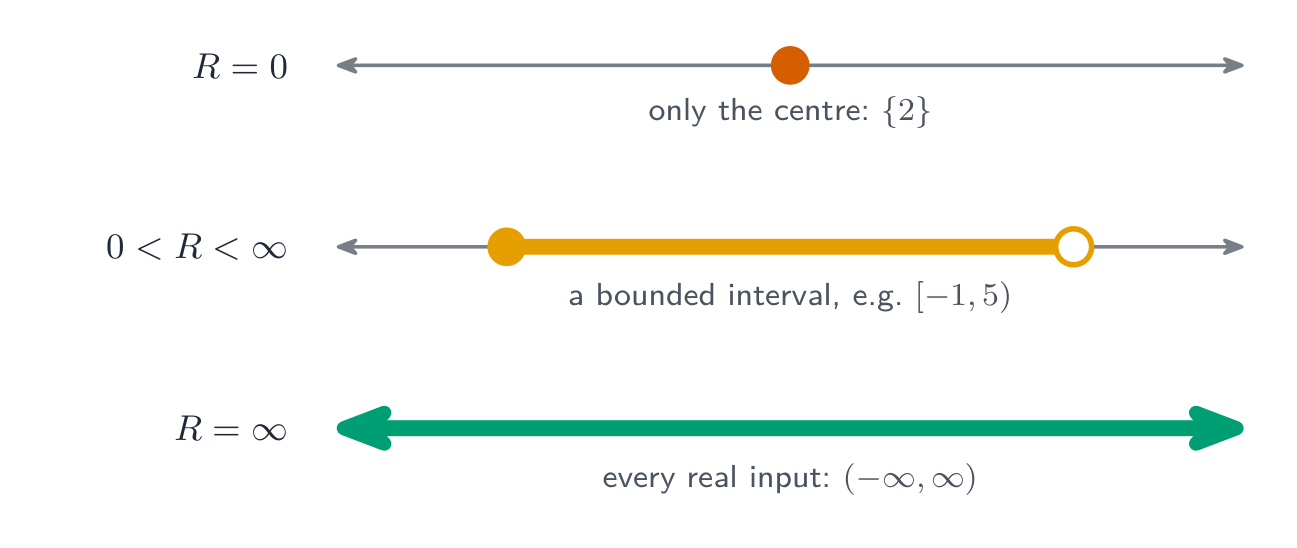
Select every possible radius of convergence.
难度 2/5 · 今日首次完成可获 140 金币及少量额外奖励
A radius is non-negative and may be zero, finite positive or infinite.
The series $\sum_{n=1}^{\infty}n!(x-2)^n$ converges only at $x=2$. What is its radius?
难度 2/5 · 今日首次完成可获 140 金币及少量额外奖励
A single convergence point gives radius 0.
支持 $\sum_{n=1}^{\infty}(x-2)^n/n!$, the absolute ratio limit is $0$ for every fixed real $x$. Which convergence set is correct?
难度 1/5 · 今日首次完成可获 100 金币及少量额外奖励
The series converges absolutely for every real input, so R is infinite.
Operations preserve the radius
- For $R>0$, inside the open convergence interval the power series is the Taylor series of the function it represents. Its coefficients match the derivatives of that function at the center.
- Term-by-term differentiation or integration keeps the same radius. The endpoint conclusions can change, so each new series needs its own boundary tests.
Term-by-term differentiation preserves the radius of convergence, but can change the endpoint results.
难度 1/5 · 今日首次完成可获 100 金币及少量额外奖励
The interior radius stays the same; test the derivative series at each finite endpoint again.
Worked comparison after two operations
- The original series $\sum_{n=1}^{\infty}x^n/n$ has interval $[-1,1)$. Its derivative is $\sum_{n=1}^{\infty}x^{n-1}$. At both ends the derivative-series terms fail to tend to $0$, so its interval is $(-1,1)$.
- Integrating the original series from $0$ to $x$ gives $\sum_{n=1}^{\infty}\dfrac{x^{n+1}}{n(n+1)}$. At both ends, the absolute terms are at most $1/n^2$, so the comparison test gives interval $[-1,1]$. All three radii remain $1$.
The derivative series of $\sum_{n=1}^{\infty}x^n/n$ is(是) $\sum_{n=1}^{\infty}x^{n-1}$. What is its convergence interval?
难度 1/5 · 今日首次完成可获 100 金币及少量额外奖励
At both x=−1 and x=1, the derivative-series terms do not tend to 0.
Build a complete argument
- For fresh practice, identify the center, simplify the ratio and solve the interior inequality. State the radius as a non-negative distance, not as the full width or an endpoint value.
- When the radius is finite and positive, write out each endpoint series and justify its result with a suitable test. Then state the interval with the corresponding brackets.
Find the center, radius and full interval for $\sum_{n=1}^{\infty}(x+2)^n/(4^n n^2)$. Justify both endpoints.
The radius is 4, not the width 8; both boundary series converge absolutely.
Find the radius and interval for $\sum_{n=1}^{\infty}(-1)^n(x-1)^n/(2^n n)$. Explain which end is included.
An alternating coefficient can reverse which endpoint is included.
Compare $\sum_{n=1}^{\infty}n!(x+3)^n$ and $\sum_{n=1}^{\infty}(x+3)^n/n!$. State each radius and convergence set, explaining the center.
Radius zero and infinite radius do not require two distinct finite endpoint tests.
Keep radius and interval separate
- A finite positive radius gives an open interior; endpoint tests finish the full interval. The ratio test at $L=1$ gives no conclusion.
- Radius $0$ gives only the center; radius $\infty$ gives every real input. For a finite positive radius, the center lies midway between the candidate endpoints.
- Differentiating or integrating keeps the radius, but may change which endpoints are included.
Review: a power series centered at 2 has candidate endpoints −1 and 5. Its full interval includes only the left endpoint. What is its radius?
难度 2/5 · 今日首次完成可获 140 金币及少量额外奖励
Endpoint inclusion changes the brackets, not the distance 3 from the center.