| English | 释义 | 拼音 |
|---|---|---|
| Absolute convergence/ˈæbsəluːt kənˈvɜːdʒəns/ | 绝对收敛 | jué duì shōu liǎn |
| Conditional convergence/kənˈdɪʃənl kənˈvɜːdʒəns/ | 条件收敛 | tiáo jiàn shōu liǎn |
The same signs can lead to different classifications
- Two models of error corrections use $a_n=(-1)^n/n$ and $c_n=(-1)^n/n^2$. Both alternate and both have terms tending to zero.
- Their magnitude series are different: $\sum1/n$ diverges, while $\sum1/n^2$ converges. Classification requires more than looking at the signs or the term limit.
Define the two kinds of convergence
- Absolute convergence 绝对收敛 means that $\sum|a_n|$ converges. This also guarantees convergence of $\sum a_n$.
- Conditional convergence 条件收敛 means that $\sum a_n$ converges but $\sum|a_n|$ diverges. A divergent signed series is neither absolutely nor conditionally convergent.
A series is absolutely convergent when...
难度 1/5 · 今日首次完成可获 100 金币及少量额外奖励
Convergence of the magnitude series also guarantees convergence of the original series.
Conditional convergence requires $\sum a_n$ to converge and $\sum|a_n|$ to...
难度 1/5 · 今日首次完成可获 100 金币及少量额外奖励
Both parts of the definition are required.
If a term is −0.25, what is its absolute value?
难度 2/5 · 今日首次完成可获 140 金币及少量额外奖励
Absolute values are non-negative magnitudes.
Separate the two questions
- A useful procedure is to test $\sum|a_n|$ first. If it converges, the original series is absolutely convergent; a second convergence proof is unnecessary.
- If the magnitude series diverges, test the signed series separately. A convergent signed series is conditional; a divergent signed series is simply divergent.
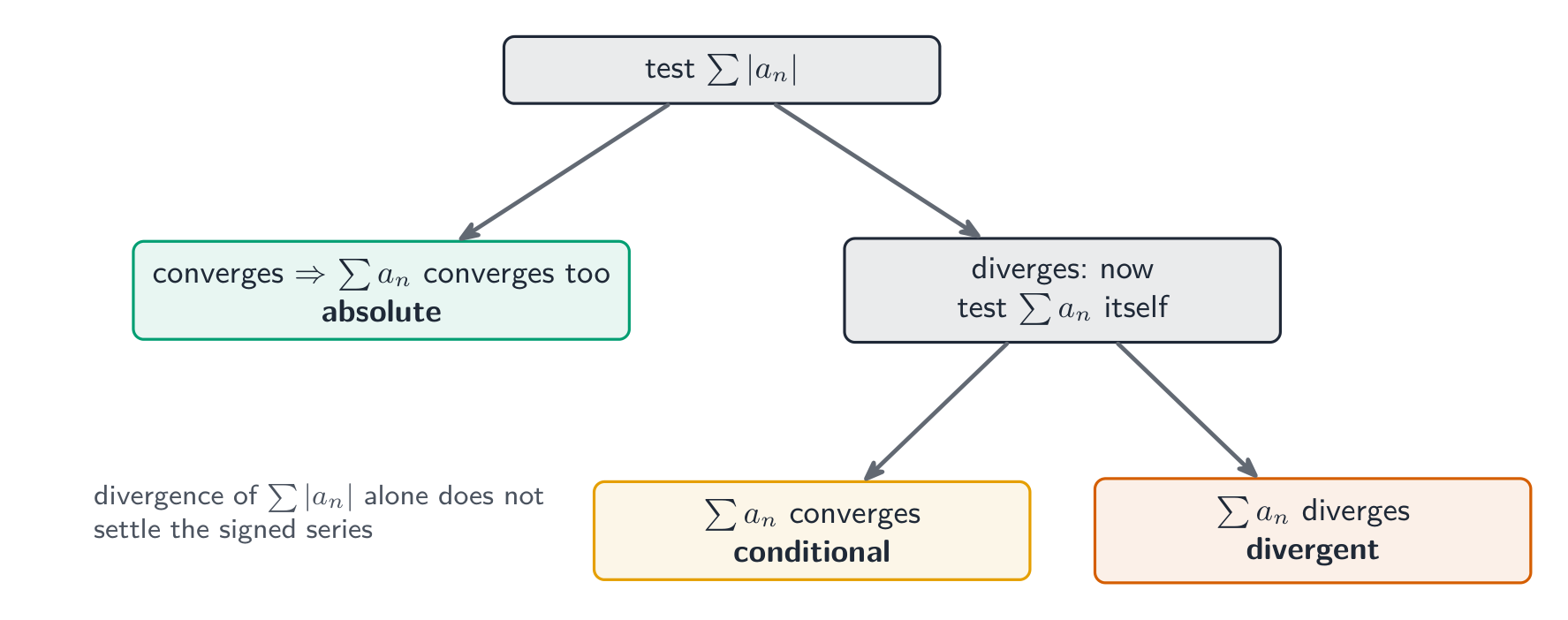
In the two-stage classification procedure, which series is tested first?
难度 1/5 · 今日首次完成可获 100 金币及少量额外奖励
A conclusive magnitude-series test can establish absolute convergence immediately.
If the magnitude series diverges, the signed series must diverge.
难度 1/5 · 今日首次完成可获 100 金币及少量额外奖励
The alternating harmonic series is a counterexample: its magnitude series diverges but its signed series converges.
Why absolute convergence guarantees convergence
- For real terms, the positive part $a_n^+=\max(a_n,0)$ and negative part $a_n^-=\max(-a_n,0)$ both lie between $0$ and $|a_n|$. If $\sum|a_n|$ converges, comparison makes both series of parts converge.
- Since $a_n=a_n^+-a_n^-$, the signed partial sums then approach the difference of two finite limits. This proves convergence of the original series.
Absolute convergence implies convergence of the signed series.
难度 1/5 · 今日首次完成可获 100 金币及少量额外奖励
For real terms, the series of positive and negative parts are each bounded by the convergent magnitude series.
Work a conditional example completely
- For $\sum_{n=1}^{\infty}(-1)^n/n$, the magnitude series is harmonic and diverges. Therefore the series is not absolutely convergent.
- Its magnitudes $1/n$ are positive, decreasing and tend to zero, so the signed series converges by the Alternating Series Test. Both facts together establish conditional convergence.
Signed and magnitude sums: three classifications
Default negative-first alternating harmonic terms give a convergent signed series but divergent magnitude series. Compare p>1 absolute convergence and nonzero-limit divergence.
Classify $\sum_{n=1}^{\infty}(-1)^n/n$.
难度 1/5 · 今日首次完成可获 100 金币及少量额外奖励
The signed series passes the Alternating Series Test; the magnitude series is divergent harmonic.
支持 $a_n=(-1)^n/n$, find $S_2=-1+1/2$.
难度 2/5 · 今日首次完成可获 140 金币及少量额外奖励
The signed first two-term sum is −1/2.
支持 $a_n=(-1)^n/n$, starting at $n=1$, add the absolute values of its first two terms.
难度 2/5 · 今日首次完成可获 140 金币及少量额外奖励
$a_1=-1$, $a_2=1/2$, so $|a_1|+|a_2|=1+1/2=3/2$. The signed partial sum is instead $-1+1/2=-1/2$.
Work an absolute example without an extra test
- For $\sum_{n=1}^{\infty}(-1)^n/n^2$, the magnitude series is $\sum1/n^2$, a convergent p-series with power $2$.
- Therefore the signed series converges absolutely. It is not conditional merely because the signs alternate; absolute convergence already guarantees its convergence.
Every convergent alternating series is conditionally convergent.
难度 1/5 · 今日首次完成可获 100 金币及少量额外奖励
The series Σ(−1)^n/n² is absolutely convergent.
支持 $\sum(-1)^n/n^2$, the convergent magnitude p-series proves...
难度 1/5 · 今日首次完成可获 100 金币及少量额外奖励
A separate Alternating Series Test is unnecessary once absolute convergence is established.
A divergent magnitude series leaves two possibilities
- For $a_n=(-1)^n n/(n+1)$, the magnitudes tend to $1$. The signed terms do not approach zero, so the original series diverges by the nth Term Test.
- This is not conditional convergence. The harmonic signed example and this divergent example both have divergent magnitude series; that single fact cannot distinguish them.
A divergent signed series can be called conditionally convergent if its magnitude series diverges too.
难度 1/5 · 今日首次完成可获 100 金币及少量额外奖励
Conditional convergence requires convergence of the signed series.
查找 $\lim_{n\to\infty}n/(n+1)$.
难度 2/5 · 今日首次完成可获 140 金币及少量额外奖励
The signed terms with these magnitudes cannot tend to zero.
A zero term limit alone proves conditional convergence.
难度 1/5 · 今日首次完成可获 100 金币及少量额外奖励
It does not even establish signed-series convergence.
A shifted tail can give conditional convergence too
- For $\sum_{n=1}^{\infty}(-1)^{n-1}2/\sqrt{n+3}$, removing signs and setting $k=n+3$ gives $2\sum_{k=4}^{\infty}1/\sqrt k$. This p-series tail diverges, so there is no absolute convergence.
- The positive magnitudes decrease to zero, so the signed series converges by the Alternating Series Test. The series is therefore conditionally convergent.
Interpret another test's conclusion correctly
- A Ratio Test limit below $1$ proves absolute convergence. A Ratio Test limit equal to $1$ does not prove conditional convergence; the test is inconclusive.
- Both $(-1)^n/n$ and $(-1)^n/n^2$ have absolute-ratio limit $1$, but their classifications differ. Use the magnitude p-series and, when needed, the Alternating Series Test.
A Ratio Test result L=1 establishes conditional convergence.
难度 1/5 · 今日首次完成可获 100 金币及少量额外奖励
The Ratio Test is inconclusive; both absolute and conditional examples can have L=1.
Keep rearrangement separate from classification
- Regrouping or rearranging an absolutely convergent series preserves its sum. For a conditionally convergent series, a rearrangement may change the sum or fail to converge; the absolute-convergence guarantee does not apply.
- Classify terms in their stated order. Changing finitely many finite terms, or multiplying by a fixed nonzero constant, preserves the classification. Multiplication by zero gives an all-zero, absolutely convergent series directly.
Rearranging a conditionally convergent series can change its sum.
难度 1/5 · 今日首次完成可获 100 金币及少量额外奖励
The same-sum rearrangement guarantee requires absolute convergence.
Multiplying every term by zero gives an absolutely convergent all-zero series.
难度 1/5 · 今日首次完成可获 100 金币及少量额外奖励
Its magnitude series and signed partial sums are all zero.
A fixed nonzero constant multiplier preserves absolute, conditional or divergent classification.
难度 1/5 · 今日首次完成可获 100 金币及少量额外奖励
Both the signed and magnitude partial sums are scaled by a nonzero constant in the corresponding sense.
Changing finitely many finite terms can change a conditionally convergent series into an absolutely convergent one.
难度 1/5 · 今日首次完成可获 100 金币及少量额外奖励
A finite change affects neither convergence of the signed series nor convergence of its magnitude series.
Any rearrangement of an absolutely convergent series has the same sum.
难度 1/5 · 今日首次完成可获 100 金币及少量额外奖励
This is the rearrangement guarantee for absolute convergence.
Practise all three outcomes
- Classify $\sum(-1)^{n-1}/n^{3/2}$ and $\sum(-1)^n/\sqrt{n+1}$, starting at $n=1$. Name the test for the magnitude series and justify the signed-series conclusion where needed.
- Then classify $\sum_{n=1}^{\infty}(-1)^n(2n+1)/(n+4)$. Check the term limit before assuming that alternation makes it converge.
Match each series to its convergence classification.
难度 2/5 · 今日首次完成可获 140 金币及少量额外奖励
Check the magnitude series and, when needed, the signed series separately.
Classify $\sum_{n=1}^{\infty}(-1)^{n-1}/n^{3/2}$. Give the decisive test.
Compare the magnitude test and the signed-series conclusion with the model.
Classify $\sum_{n=1}^{\infty}(-1)^n/\sqrt{n+1}$. Give both required arguments.
Compare the magnitude test and the signed-series conclusion with the model.
Classify $\sum_{n=1}^{\infty}(-1)^n(2n+1)/(n+4)$. Name the decisive test.
Compare the magnitude test and the signed-series conclusion with the model.
State the final category with its evidence
- For absolute convergence, give a convergence argument for $\sum|a_n|$. For conditional convergence, give both signed-series convergence and magnitude-series divergence.
- For divergence, give a valid test for the signed series. A nonzero term limit is already decisive; there is no need to force every example through the two-stage procedure.
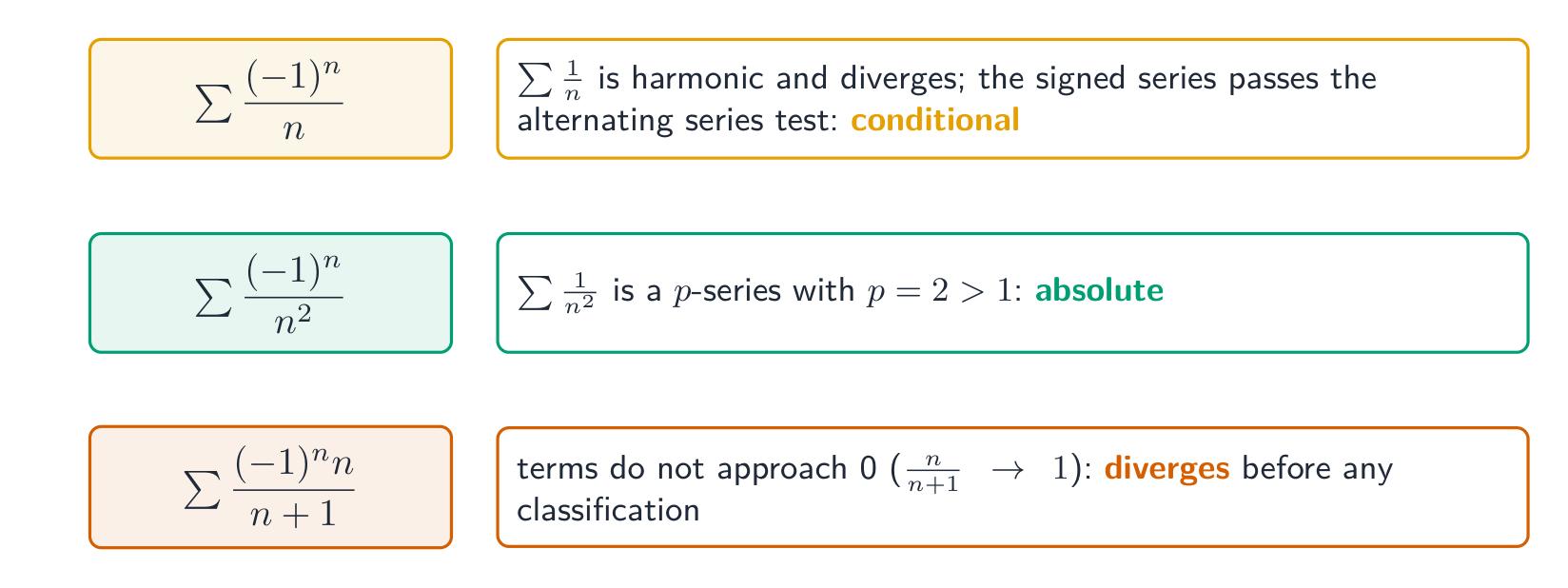
Absolute convergence guarantees signed-series convergence. Conditional convergence requires a convergent signed series and a divergent magnitude series. Divergence of the magnitude series alone does not decide the signed series. Keep these three outcomes separate.