| English | 释义 | 拼音 |
|---|---|---|
| Partial fractions/ˈpɑːʃl ˈfrækʃnz/ | 部分分式 | bù fèn fēn shì |
| linear factor/ˈlɪnɪə ˈfæktə/ | 一次因式 | yī cì yīn shì |
Break one hard fraction into easy ones
- Some rational functions can't be integrated directly, but split apart they become simple logs.
- Partial fractions 部分分式 rewrites one fraction as a sum of smaller fractions.
- Each piece has a single linear factor 一次因式 in its denominator — easy to integrate as a $\ln$.
- It's the reverse of adding fractions over a common denominator.
Set up the decomposition
- Start with a rational function whose denominator factors into distinct linear factors.
- $\dfrac{1}{(x-1)(x+2)}=\dfrac{A}{x-1}+\dfrac{B}{x+2}$ for constants $A,B$ to be found.
- Each distinct linear factor $(x-r)$ gets its own term $\dfrac{\text{constant}}{x-r}$.
- (The numerator's degree must be less than the denominator's — divide first if not.)
One simple fraction after splitting
y = a / (x − b)
The graph shows the simple fraction $1/(x-1)$, with one vertical asymptote. Partial fractions combines such pieces; integrating this piece gives $\ln|x-1|+C$.
The partial-fraction form of $\dfrac{1}{(x-1)(x+2)}$ is...
难度 1/5 · 今日首次完成可获 100 金币及少量额外奖励
One constant over each distinct linear factor.
If the numerator degree is not less than the denominator degree, you must divide first.
难度 1/5 · 今日首次完成可获 100 金币及少量额外奖励
Partial fractions needs a proper fraction.
This lesson handles denominators that factor into distinct ____ factors.
难度 1/5 · 今日首次完成可获 100 金币及少量额外奖励
Distinct linear factors $(x-r)$.
Solve for the constants
- Multiply both sides by the common denominator to clear fractions.
- Then find $A,B$ by matching coefficients or by plugging in the roots (a fast shortcut).
- For $\dfrac{1}{(x-1)(x+2)}$: at $x=1$, $1=A(3)\Rightarrow A=\tfrac13$; at $x=-2$, $1=B(-3)\Rightarrow B=-\tfrac13$.
- Now the integral is a sum of simple pieces.
支持 $\dfrac{1}{(x-1)(x+2)}=\dfrac{A}{x-1}+\dfrac{B}{x+2}$, find $A$ (plug $x=1$).
难度 2/5 · 今日首次完成可获 140 金币及少量额外奖励
Clear the denominators first: $1=A(x+2)+B(x-1)$. This polynomial identity holds at $x=1$, giving $1=3A$ and $A=1/3$.
Integrate the pieces
- Each $\dfrac{A}{x-r}$ integrates to $A\ln|x-r|$.
- $\displaystyle\int\dfrac{1}{(x-1)(x+2)}\,dx=\tfrac13\ln|x-1|-\tfrac13\ln|x+2|+C$.
- So a messy rational integral becomes a combination of logarithms.
- Combine or leave the logs as the answer prefers.
Each partial-fraction piece $\dfrac{A}{x-r}$ integrates to...
难度 1/5 · 今日首次完成可获 100 金币及少量额外奖励
$\int A/(x-r)\,dx=A\ln|x-r|+C$, on an interval excluding $x=r$.
$\displaystyle\int\dfrac{5}{(x-1)(x+4)}\,dx$ (with $A=1$, $B=-1$) equals...
难度 1/5 · 今日首次完成可获 100 金币及少量额外奖励
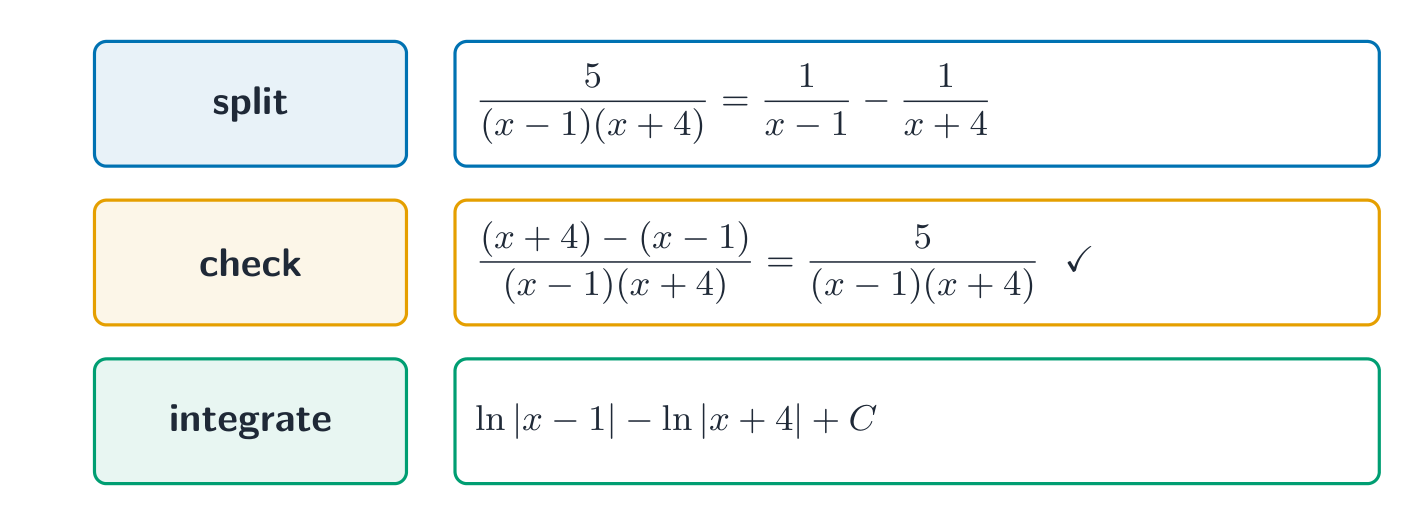
With $A=1$, $B=-1$, the integrand is $1/(x-1)-1/(x+4)$. Integrating each piece gives $\ln|x-1|-\ln|x+4|+C$.
Partial fractions needs the numerator degree less than the denominator's — if not, do long division first. And it requires the denominator to actually factor into linear pieces; a repeated factor $(x-r)^2$ or an irreducible quadratic needs extra terms (beyond this lesson's distinct linear case). Each distinct factor gets exactly one constant.
Evaluate $\displaystyle\int\dfrac{5}{(x-1)(x+4)}\,dx$.
- Decompose: $\dfrac{5}{(x-1)(x+4)}=\dfrac{A}{x-1}+\dfrac{B}{x+4}$. Clearing denominators gives $5=A(x+4)+B(x-1)$. At $x=1$: $5=5A\Rightarrow A=1$; at $x=-4$: $5=-5B\Rightarrow B=-1$.
- $\displaystyle\int\Big(\tfrac{1}{x-1}-\tfrac{1}{x+4}\Big)\,dx=\ln|x-1|-\ln|x+4|+C$.
Partial fractions splits a rational function with distinct linear factors into a sum $\frac{A}{x-r_1}+\frac{B}{x-r_2}+\cdots$; find the constants (match coefficients or plug in roots), then integrate each piece to a $\ln$. Requires numerator degree $<$ denominator degree — divide first otherwise.