| English | 释义 | 拼音 |
|---|---|---|
| estimate/ˈestɪmət/ | 估计值 | gū jì zhí |
| difference quotient/ˈdɪfrəns ˈkwəʊʃənt/ | 差商 | chā shāng |
Measuring a slope you can't compute exactly
- With only a graph or a table, you can still estimate 估计值 $f'(a)$.
- From a graph, read the tangent's slope. From a table, use a difference quotient 差商 over the closest data.
From a graph: tangent steepness
- Draw the tangent at the point. Pick two clear points on the tangent (not the curve) and compute $\dfrac{\Delta y}{\Delta x}$.
- Uphill: positive. Downhill: negative. Flat: $f'\approx0$.
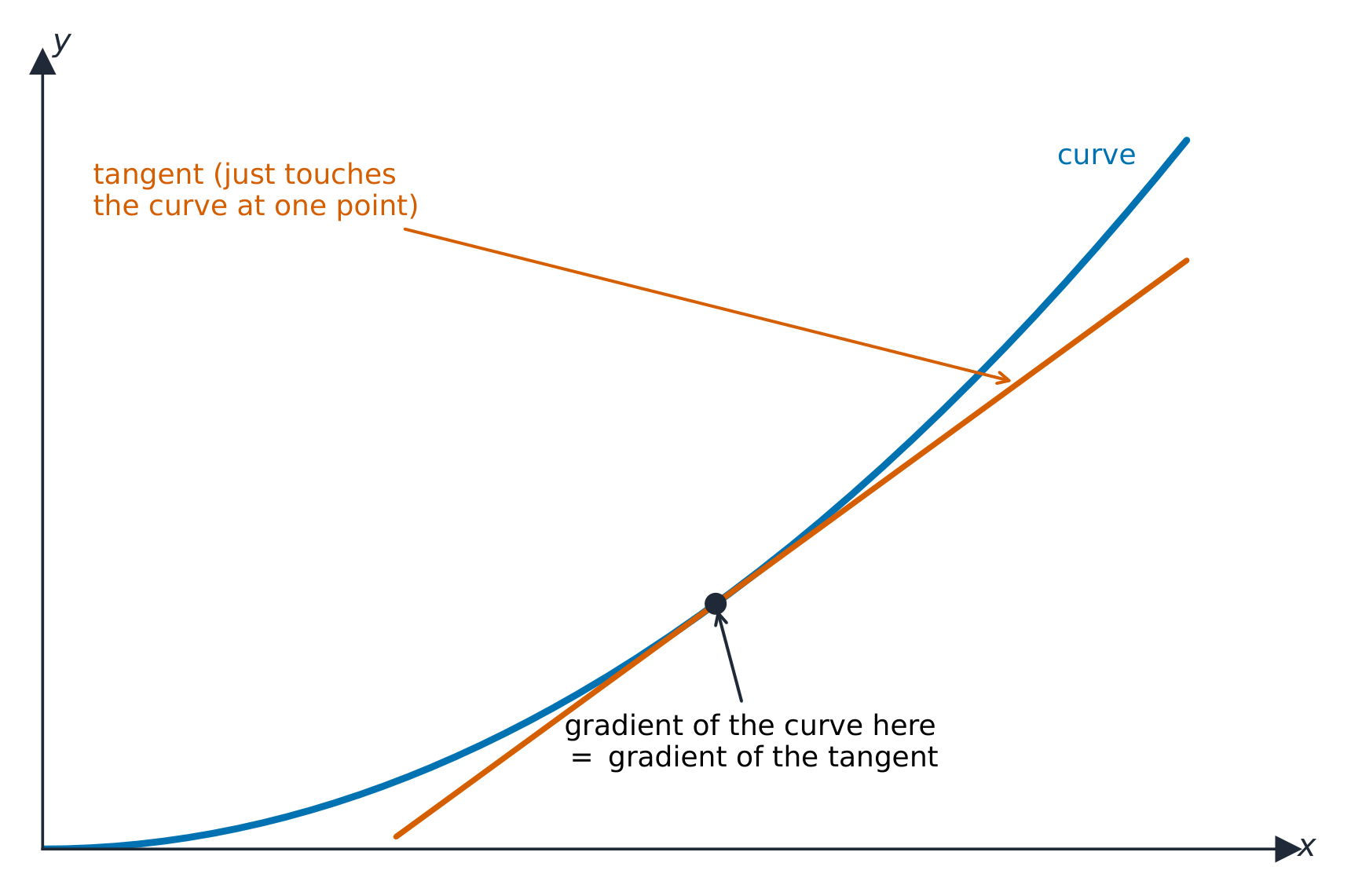
The instantaneous rate of change is the gradient of the tangent at a point
目测估算斜率
y = x²
Move the point and watch the tangent — its steepness is the derivative you would estimate from a graph.
To estimate $f'(a)$ from a graph, you should measure the slope of the...
难度 1/5 · 今日首次完成可获 100 金币及少量额外奖励
The derivative is the tangent slope, read from points on the tangent line.
From a table: the closest points
- Symmetric, one point on each side: $f'(a)\approx\dfrac{f(a+h)-f(a-h)}{2h}$. Usually the best choice for smooth data.
- One-sided, if that is all you have: $\dfrac{f(a+h)-f(a)}{h}$. Closer inputs generally give better estimates.
A table gives $f(1.9)=4.2$ and $f(2.1)=5.8$. Use the symmetric difference quotient to estimate $f'(2)$.
难度 2/5 · 今日首次完成可获 140 金币及少量额外奖励
$\dfrac{5.8-4.2}{2(0.1)}=\dfrac{1.6}{0.2}=8$.
Using input values closer to the point generally improves a table-based derivative estimate.
难度 1/5 · 今日首次完成可获 100 金币及少量额外奖励
A smaller interval better approximates the tangent slope.
A derivative read from a table or graph is an ____, not an exact value.
难度 1/5 · 今日首次完成可获 100 金币及少量额外奖励
Only algebra on a formula gives the exact derivative.
From $f(3)=10$ and $f(3.2)=11.4$, estimate $f'(3)$ with a one-sided difference quotient.
难度 2/5 · 今日首次完成可获 140 金币及少量额外奖励
$\dfrac{11.4-10}{3.2-3}=\dfrac{1.4}{0.2}=7$.
A table gives $f(1.9)=4.2$, $f(2)=5.0$, $f(2.1)=5.9$. Estimate $f'(2)$.
- Symmetric: $\dfrac{5.9-4.2}{2.1-1.9}=\dfrac{1.7}{0.2}=8.5$. (One-sided: $\dfrac{5.9-5.0}{0.1}=9$.)
- So $f'(2)\approx8.5$.
AP style: uneven spacing. Temperature $T(t)$ in °C, $t$ in minutes:
| $t$ (min) | 0 | 3 | 7 | 12 |
|---|---|---|---|---|
| $T(t)$ (°C) | 90 | 78 | 66 | 56 |
- Estimate $T'(5)$: use the data around 5, $t=3$ and $t=7$: $\dfrac{66-78}{7-3}=-3$ °C/min.
- In words: "At $t=5$ minutes the temperature is decreasing at about 3 °C per minute."
Rainfall $R(t)$ in mm, $t$ in hours: $R(0)=4$, $R(2)=10$, $R(5)=19$, $R(9)=27$. Use the data to estimate $R'(4)$.
难度 2/5 · 今日首次完成可获 140 金币及少量额外奖励
Use the points around 4: $t=2$ and $t=5$. $\dfrac{19-10}{5-2}=3$ mm per hour.
- Read the slope of the tangent, not of a secant, and take both points off the tangent.
- From a table, use the two data points closest to and around $a$. Divide by the real gap in $x$ (here 4, not 1).
- Give units and the direction (increasing or decreasing). It is an estimate, so write "$\approx$".
If an estimated derivative at a point is negative, the function there is...
难度 1/5 · 今日首次完成可获 100 金币及少量额外奖励
A negative rate means the function is falling there.
For the temperature table in the example, $T'(5)\approx-3$. Which statement is correct?
难度 1/5 · 今日首次完成可获 100 金币及少量额外奖励
A derivative is a rate at one instant, in °C per minute. It is not a temperature and not a total change.
Estimate $f'(a)$ from a graph by the tangent's slope, or from a table by a difference quotient over the closest inputs around $a$ (symmetric if possible). Report the sign, the size and the units.