Spinning around a shifted line
- Revolve a region not about an axis but about a line such as $y=-1$ or $x=3$. The disc method still works: $V=\pi\int R^2$ does not change.
- Only the radius changes. It is the distance from the curve to that line, so it must include the shift.
Radius = distance to the new axis
- About a horizontal line $y=k$: $R=|f(x)-k|$, integrated in $x$. About a vertical line $x=k$: $R=|g(y)-k|$, integrated in $y$.
- Write it as (bigger value) − (smaller value): axis below the curve gives $f(x)-k$; axis above gives $k-f(x)$.
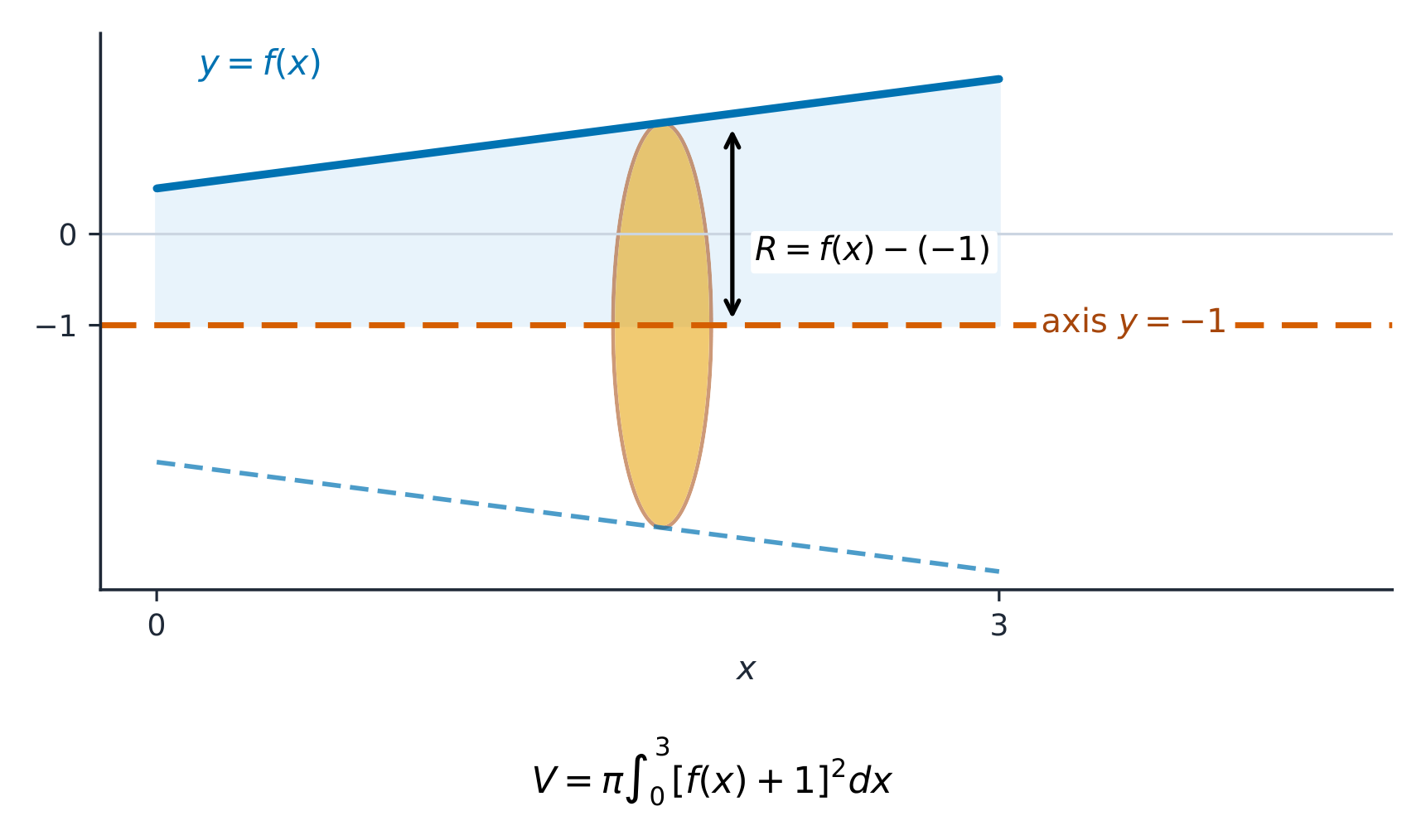
The curve above a shifted axis
y = a·√x
Revolving about $y=-1$ makes the radius reach from the curve down to that line — $R=f(x)+1$, larger than $f(x)$.
Revolving $y=f(x)$ about the line $y=-1$, the radius is...
难度 1/5 · 今日首次完成可获 100 金币及少量额外奖励
Distance from $f(x)$ down to $y=-1$ is(是) $f(x)-(-1)=f(x)+1$.
Revolving about $y=k$ (below the region), the radius of a curve $f(x)$ is...
难度 1/5 · 今日首次完成可获 100 金币及少量额外奖励
Curve value minus axis value: $f(x)-k$.
Axis below. Revolve the region between $y=\sqrt x$ and the line $y=-1$, for $0\le x\le4$, about $y=-1$.
- The region reaches down to the axis, so every slice is a solid disc. $R(x)=\sqrt x-(-1)=\sqrt x+1$.
- $V=\pi\displaystyle\int_0^4(x+2\sqrt x+1)\,dx=\pi\Big[\tfrac{x^2}{2}+\tfrac43x^{3/2}+x\Big]_0^4$
- $=\pi\big(8+\tfrac{32}{3}+4\big)=\dfrac{68\pi}{3}$
The region between $y=\sqrt x$ and the line $y=-1$, for $0\le x\le4$, is revolved about $y=-1$. The radius is $\sqrt x+1$, so $V=$
难度 1/5 · 今日首次完成可获 100 金币及少量额外奖励
$\pi\int_0^4(x+2\sqrt x+1)\,dx=\pi(8+\tfrac{32}{3}+4)=\tfrac{68\pi}{3}$.
Axis above. Revolve the region between $y=\sqrt x$, $y=2$ and the $y$-axis about the line $y=2$.
- The curve is below the axis, so $R(x)=2-\sqrt x$. The region runs from $x=0$ to where $\sqrt x=2$, $x=4$.
- $V=\pi\displaystyle\int_0^4(4-4\sqrt x+x)\,dx=\pi\Big[4x-\tfrac83x^{3/2}+\tfrac{x^2}{2}\Big]_0^4$
- $=\pi\big(16-\tfrac{64}{3}+8\big)=\dfrac{8\pi}{3}$
If the axis $y=3$ lies 高于 the region (curve $f(x)<3$), the radius is...
难度 1/5 · 今日首次完成可获 100 金币及少量额外奖励
Distance is axis minus curve: $3-f(x)$ (a positive gap).
A vertical shifted axis
- About $x=k$, slice horizontally: write the curve as $x=g(y)$, use $R(y)=|g(y)-k|$ and $y$-limits.
- Draw one radius segment from the axis to the curve. Its length, in terms of $y$, is $R$.
Revolving about a vertical line $x=k$, the radius is the ____ distance $|g(y)-k|$.
难度 1/5 · 今日首次完成可获 100 金币及少量额外奖励
For a vertical axis, measure horizontally.
Revolve the region between $x=y^2$, the line $x=4$ and the $x$-axis ($0\le y\le2$) about the line $x=4$.
- The axis $x=4$ is to the right of the curve, so $R(y)=4-y^2$.
- $V=\pi\displaystyle\int_0^2(4-y^2)^2\,dy=\pi\int_0^2(16-8y^2+y^4)\,dy$
- $=\pi\big(32-\tfrac{64}{3}+\tfrac{32}{5}\big)=\dfrac{256\pi}{15}$
The region between $y=x^2$ and $y=1$ is revolved about the line $y=1$. Find the volume to 3 decimal places.
难度 2/5 · 今日首次完成可获 140 金币及少量额外奖励
The curves meet at $x=\pm1$. The axis is above the curve, so $R=1-x^2$. $V=\pi\int_{-1}^{1}(1-2x^2+x^4)\,dx=\pi\big(2-\tfrac43+\tfrac25\big)=\tfrac{16\pi}{15}\approx3.351$.
The region between $y=x$ and the line $y=-1$, for $0\le x\le2$, is revolved about $y=-1$. What is the radius of a disc, and why?
Distance to y = -1 is the function value plus 1.
Revolve the region between $y=x$ and $y=-1$ on $[0,2]$ about $y=-1$. What is the disc radius?
难度 1/5 · 今日首次完成可获 100 金币及少量额外奖励
The axis is one unit below the origin line.
- Don't reuse the plain-axis radius: about $y=-1$ it is $f(x)+1$, not $f(x)$.
- Discs need the region to touch the axis. The region under $y=\sqrt x$ (down to the $x$-axis) revolved about $y=-1$ leaves a gap of 1, so the solid has a hole: use washers (8.12) with $r=1$.
- Square the whole radius: $(\sqrt x+1)^2=x+2\sqrt x+1$, not $x+1$.
When revolving about $y=-1$, you can still use radius $R=f(x)$.
难度 1/5 · 今日首次完成可获 100 金币及少量额外奖励
You must shift: $R=f(x)+1$.
The region between $y=\sqrt x$ and the $x$-axis on $[0,4]$ is revolved about $y=-1$. The volume is $\pi\int_0^4(\sqrt x+1)^2\,dx$.
难度 1/5 · 今日首次完成可获 100 金币及少量额外奖励
The region does not reach $y=-1$, so each slice is a washer with inner radius 1: $V=\pi\int_0^4\big[(\sqrt x+1)^2-1^2\big]dx=\tfrac{56\pi}{3}$.
About a shifted axis, keep $V=\pi\int R^2$ but measure the radius to that line: $R=f(x)-k$ (axis below), $k-f(x)$ (axis above), or $|g(y)-k|$ in $y$ for $x=k$. Discs only work when the region touches the axis; a gap means washers.