| English | 释义 | 拼音 |
|---|---|---|
| solution curve/səˈluːʃn kɜːv/ | 解曲线 | jiě qū xiàn |
| long-term behavior/lɒŋ tɜːm bɪˈheɪvjə/ | 长期行为 | cháng qī xíng wéi |
Following the arrows to a curve
- A slope field is a set of tangent directions; a solution curve 解曲线 threads through them.
- Start at a given point and move so you always stay tangent to the nearby dashes.
- The curve you trace is the particular solution passing through that point.
- No formula needed — you reason about solutions straight from the field.
A solution curve through the slope field must always stay...
难度 1/5 · 今日首次完成可获 100 金币及少量额外奖励
It follows the tangent directions.
Sketching a solution through a point
- Put your pencil at the given point and follow the local slope, curving as the dashes turn.
- Never cross the dashes at the wrong angle — always run along them.
- Different starting points give different members of the solution family.
- The dashes act like a current, and your curve is a boat drifting with it.
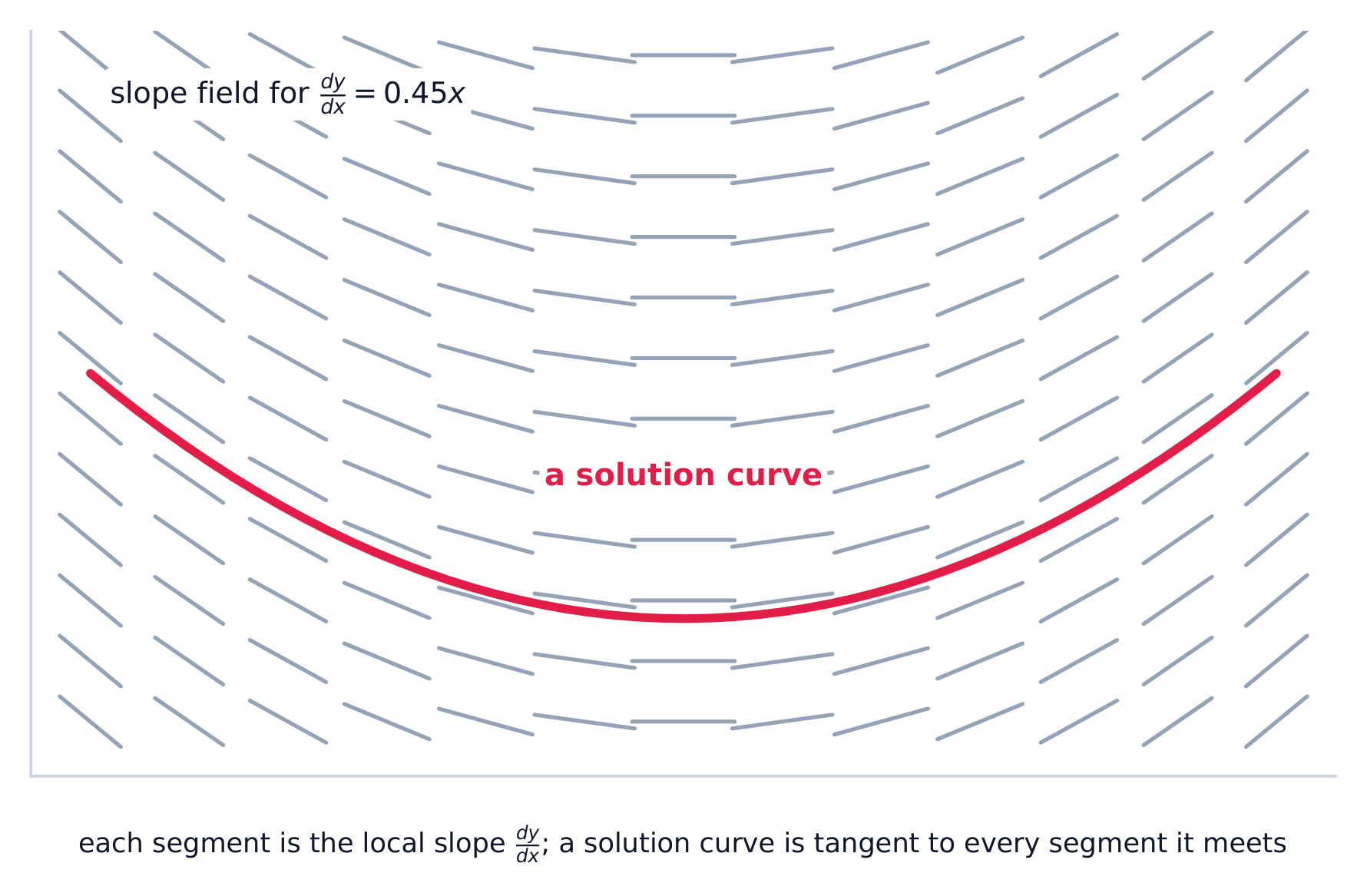
Each segment of a slope field is the local slope; a solution curve follows them
在方向场中穿引曲线
A solution curve stays tangent to every dash it passes — drag the start point and watch it follow the field.
Long-term behavior from the pattern
- Look far right (large $x$ or $t$) and read the long-term behavior 长期行为 of solutions.
- If nearby directions point toward a constant-solution line as time increases, solutions may approach that equilibrium. Flat dashes at a few points alone do not establish a limit.
- Do they steepen upward forever? Solutions grow without bound.
- The overall shape of the field forecasts where solutions end up.
The overall pattern of a slope field forecasts the ____ behavior of solutions.
难度 1/5 · 今日首次完成可获 100 金币及少量额外奖励
Read where the dashes send solutions as $x$ grows.
Equilibria: stable or unstable
- A whole line $y=c$ of horizontal dashes, with $F(x,c)=0$ for every $x$, is an equilibrium — a constant solution.
- If nearby solutions curve toward it, the equilibrium is stable (an attractor).
- If they curve away, it's unstable.
- Reading whether arrows point toward or away from the line tells you which.
Assuming a unique solution through every point, two distinct solution curves of the same equation can cross.
难度 1/5 · 今日首次完成可获 100 金币及少量额外奖励
Uniqueness prevents two distinct solution curves from meeting. A single prescribed slope does not by itself guarantee uniqueness.
支持 $\dfrac{dy}{dt}=y$, the equilibrium $y=0$ is...
难度 1/5 · 今日首次完成可获 100 金币及少量额外奖励
高于 $0$ slopes push up, below they push down → away from $0$.
A horizontal row of dashes in a slope field represents a...
难度 1/5 · 今日首次完成可获 100 金币及少量额外奖励
斜率 $0$ everywhere along it → a constant solution.
Select 所有 true statements about equilibria.
难度 2/5 · 今日首次完成可获 140 金币及少量额外奖励
Equilibria can be at any $y$ where the rate is $0$; toward = stable, away = unstable.
A solution curve must stay tangent to the slope field — it follows the dashes, it doesn't cut across them. When the equation has a unique solution through each point, distinct solution curves cannot meet. For example, this holds if $F$ and $\partial F/\partial y$ are continuous nearby. One slope at each point alone does not prove uniqueness.
For $\dfrac{dy}{dt}=y$, describe solutions through $(0,1)$ and $(0,-1)$.
- The line $y=0$ is an equilibrium (slope $0$ there).
- Above it ($y>0$), slopes are positive → the solution through $(0,1)$ grows away from $0$.
- Below it ($y<0$), slopes are negative → the solution through $(0,-1)$ falls away from $0$.
- So $y=0$ is an unstable equilibrium — solutions run away from it.
To reason with a slope field, sketch a solution curve by staying tangent to the dashes through a given point. The field's overall pattern reveals long-term behavior — solutions may approach an equilibrium (stable) or run away (unstable). Under a uniqueness hypothesis, distinct solution curves cannot meet.
Write from a curve that cannot cross
- A slope field has an equilibrium where the dashes are horizontal.
- Assume the equation has a unique solution through every point; two solution sketches start at different heights.
How should a sketch behave near a stable equilibrium, and may the curves cross?
Uniqueness rules out distinct solutions through the same point.
For an equation with unique solutions through each point, two distinct solution curves may do what?
难度 1/5 · 今日首次完成可获 100 金币及少量额外奖励
The uniqueness assumption prevents distinct solutions from meeting; they can approach an equilibrium asymptotically.