| English | 释义 | 拼音 |
|---|---|---|
| Fundamental Theorem of Calculus/ˌfʌndəˈmentl ˈθɪərəm ɒv ˈkælkjʊləs/ | 微积分基本定理 | wēi jī fēn jī běn dìng lǐ |
| accumulation function/əˌkjuːmjʊˈleɪʃn ˈfʌŋkʃn/ | 累积函数 | lěi jī hán shù |
The bridge between area and slope
- Differentiation (slopes) and integration (areas) look unrelated — but they are inverses.
- The Fundamental Theorem of Calculus 微积分基本定理 (FTC) is that stunning connection.
- Its first part is about a function defined by an integral, called an accumulation function 累积函数.
- Take its derivative and — magically — you get the integrand back.
The accumulation function
- Fix a lower limit $a$ and let the upper limit vary: $$g(x)=\int_a^x f(t)\,dt$$
- $g(x)$ is the accumulated (signed) area under $f$ from $a$ up to $x$.
- As $x$ moves right, $g$ collects more area; the variable of integration $t$ is just a placeholder.
- $g$ is a genuine function of $x$ — you can graph it, differentiate it, and analyze it.
The accumulation function grows at the rate given by the curve's height
Area accumulating up to x
y = t² + 1 (integrand)
As the upper limit slides right, $g(x)$ collects more area; its instantaneous growth rate is exactly $f(x)$.
A function of the form $g(x)=\int_a^x f(t)\,dt$ is called an ____ function.
难度 1/5 · 今日首次完成可获 100 金币及少量额外奖励
It accumulates signed area up to $x$.
In $g(x)=\int_a^x f(t)\,dt$, the variable $t$ is...
难度 1/5 · 今日首次完成可获 100 金币及少量额外奖励
$t$ is a dummy variable; $x$ is the actual input of $g$.
FTC Part 1: the derivative undoes the integral
- For $f$ continuous, the first part of the FTC says:
-
$$g'(x)=\frac{d}{dx}\int_a^x f(t)\,dt = f(x)$$
- In words: the derivative of the accumulation function is the integrand itself.
- Rate of area accumulation at $x$ = the height $f(x)$ there. Beautifully simple.
By FTC Part 1, $\dfrac{d}{dx}\int_a^x f(t)\,dt=$
难度 1/5 · 今日首次完成可获 100 金币及少量额外奖励
The derivative of the accumulation function is the integrand $f(x)$.
支持 $g(x)=\int_2^x (t^2+1)\,dt$, find $g'(3)$.
难度 2/5 · 今日首次完成可获 140 金币及少量额外奖励
$g'(x)=x^2+1$, so $g'(3)=10$.
With a chain-rule twist
- If the upper limit is a function $u(x)$, the chain rule kicks in:
- $\dfrac{d}{dx}\int_a^{u(x)} f(t)\,dt = f(u(x))\cdot u'(x)$.
- Plug the upper limit into $f$, then multiply by the derivative of that upper limit.
- (A variable lower limit flips the sign, since swapping limits negates the integral.)
支持 $\dfrac{d}{dx}\int_a^{x^2} f(t)\,dt$, the answer is...
难度 1/5 · 今日首次完成可获 100 金币及少量额外奖励
Chain rule: plug in the upper limit, times its derivative $2x$.
When the upper limit is $u(x)$, you multiply the integrand-at-$u$ by $u'(x)$.
难度 1/5 · 今日首次完成可获 100 金币及少量额外奖励
That chain-rule factor is required.
FTC Part 1 gives $g'(x)=f(x)$ only when $x$ is the plain upper limit. If the upper limit is $u(x)$ (like $x^2$), you must multiply by $u'(x)$: $\frac{d}{dx}\int_a^{x^2} f(t)\,dt = f(x^2)\cdot 2x$. Forgetting that chain-rule factor is the classic mistake.
Let $g(x)=\displaystyle\int_2^x (t^2+1)\,dt$. Find $g'(x)$ and $g'(3)$.
- By FTC Part 1: $g'(x)=x^2+1$ (just the integrand with $t\to x$).
- $g'(3)=3^2+1=10$.
- (No need to compute the integral itself — the derivative reads it straight off.)
The AP question: $g$ from the graph of $f$
- Free-response questions often show the graph of $f$ and define $g(x)=\displaystyle\int_0^x f(t)\,dt$. Values of $g$ come from areas: area above the axis counts as positive, area below as negative.
- Behaviour of $g$ comes from the FTC: $g'=f$ and $g''=f'$. So read the sign of $f$ for increasing/decreasing, and the slope of $f$ for concavity.
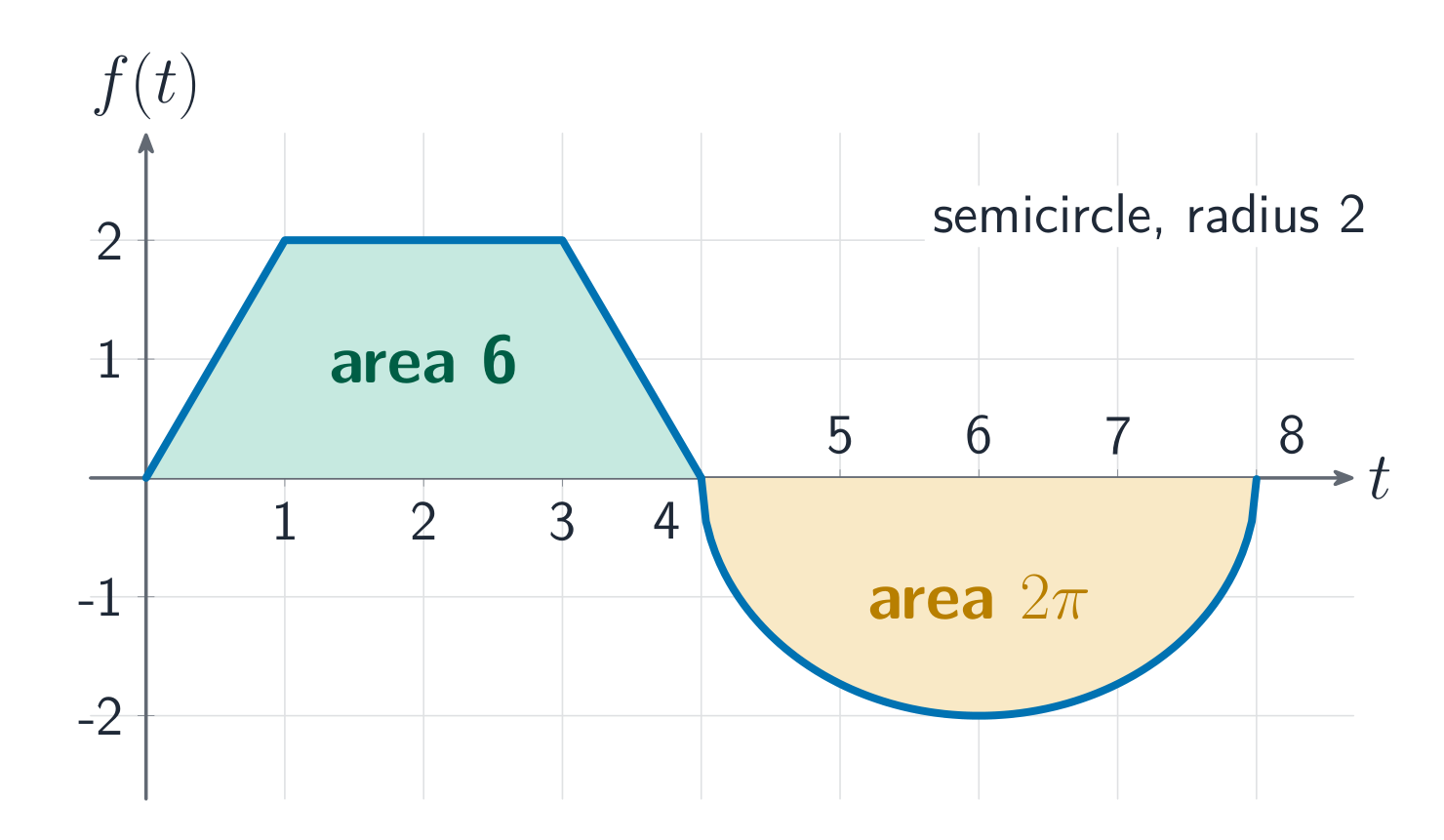
Values of $g$. For the graph above, $g(x)=\displaystyle\int_0^x f(t)\,dt$.
- $g(1)$ is a triangle: $g(1)=\tfrac12(1)(2)=1$.
- $g(4)$ is a trapezoid: $g(4)=\tfrac12(4+2)(2)=6$.
- $g(8)=6-\tfrac12\pi(2)^2=6-2\pi\approx-0.28$: the semicircle is below the axis, so its area is subtracted.
Using the graph in the lesson, find g(3) = ∫ from 0 to 3 of f(t) dt.
难度 2/5 · 今日首次完成可获 140 金币及少量额外奖励
Triangle from 0 to 1 (area 1) plus rectangle from 1 to 3 (area 4): g(3) = 5.
Using the same graph, find g(6) to 2 decimal places.
难度 2/5 · 今日首次完成可获 140 金币及少量额外奖励
g(6) = 6 − (quarter circle π) = 6 − π ≈ 2.86.
$g(x)=\displaystyle\int_0^x t^2\,dt$. Find $g'(2)$. What extra factor appears if the upper limit is $x^2$?
The integrand t squared at 2 is 4.
$g(x)=\displaystyle\int_0^x t^2\,dt$. What is $g'(2)$?
难度 1/5 · 今日首次完成可获 100 金币及少量额外奖励
The integrand at 2 is 4.
Behaviour of $g$.
- $g'=f>0$ on $(0,4)$ and $f<0$ on $(4,8)$, so $g$ increases, then decreases: an absolute maximum at $x=4$, where $g(4)=6$.
- $g''=f'$, and $f$ is decreasing on $(4,6)$ and increasing on $(6,8)$, so $g$ changes from concave down to concave up at $x=6$: a point of inflection.
- $g'(5)=f(5)=-\sqrt3$ (from the circle $(t-6)^2+y^2=4$).
On [0, 8], where does g have its absolute minimum?
难度 1/5 · 今日首次完成可获 100 金币及少量额外奖励
Candidates are the endpoints and x = 4: g(0) = 0, g(4) = 6, g(8) ≈ −0.28. The smallest is at x = 8.
The graph of g is concave up on (0, 1).
难度 1/5 · 今日首次完成可获 100 金币及少量额外奖励
True. g″ = f′ and f is increasing on (0, 1).
An accumulation function $g(x)=\int_a^x f(t)\,dt$ collects signed area up to $x$. FTC Part 1: $g'(x)=f(x)$ — differentiating an accumulation function returns the integrand. If the upper limit is $u(x)$, multiply by $u'(x)$ (chain rule).