Draw the whole shape from its derivatives
- $f'$ gives the slopes and $f''$ gives the bends. Put their sign charts together and you can sketch a curve you were never shown.
- This is where all of Unit 5 comes together into one picture.
What you collect
- From $f'$: where $f$ increases or decreases, and its extrema (where $f'$ changes sign).
- From $f''$: concavity and inflection points (where $f''$ changes sign). Then plot those points to fix the heights.
A local extremum of $f$ occurs at a ____ of $f'$ where it changes sign.
难度 1/5 · 今日首次完成可获 100 金币及少量额外奖励
A sign-changing zero of $f'$ marks an extremum of $f$.
Which features come from $f''$ (the second derivative)?
难度 2/5 · 今日首次完成可获 140 金币及少量额外奖励
Concavity + inflection from $f''$; increase/decrease + extrema from $f'$.
Four shapes, one for each sign pair
| $f'$ | $f''$ | The curve is… |
|---|---|---|
| $+$ | $+$ | rising, and getting steeper |
| $+$ | $-$ | rising, but levelling off |
| $-$ | $+$ | falling, but levelling off |
| $-$ | $-$ | falling, and getting steeper |
A local maximum should occur where $f$ turns from increasing to decreasing and the curve is concave...
难度 1/5 · 今日首次完成可获 100 金币及少量额外奖励
A peak is concave down (a cap).
On an interval, $f'<0$ and $f''>0$. The graph of $f$ is...
难度 1/5 · 今日首次完成可获 100 金币及少量额外奖励
$f'<0$: falling. $f''>0$: the slope is increasing, from very negative towards zero, so the fall gets gentler.
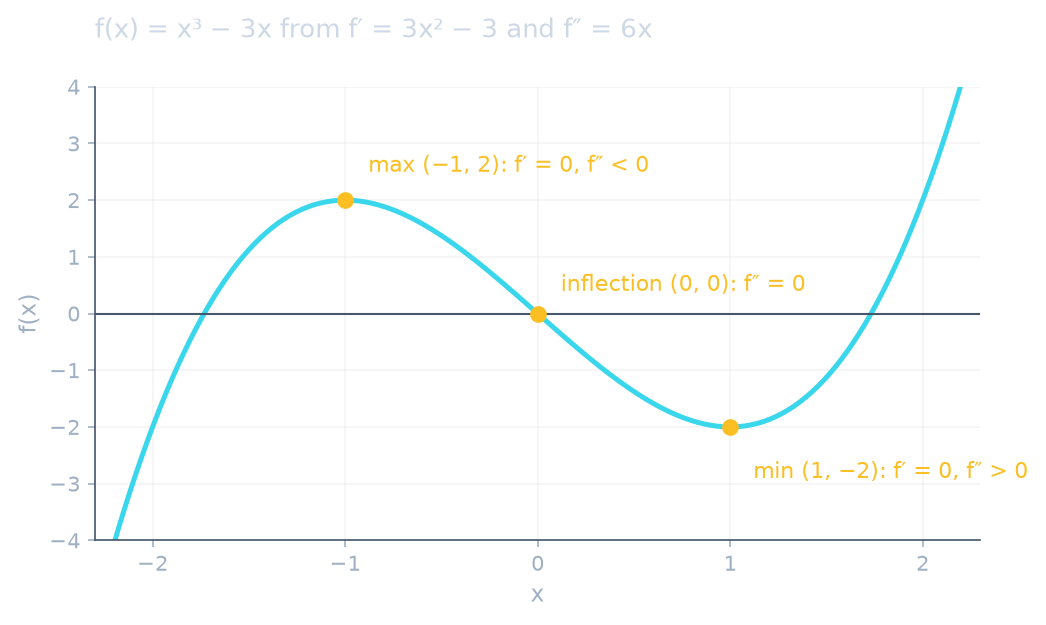
Sketch $f(x)=x^3-3x$.
- $f'=3(x-1)(x+1)$: max at $(-1,2)$, min at $(1,-2)$. $f''=6x$: inflection at $(0,0)$.
- The curve rises to $(-1,2)$, falls through $(0,0)$ while changing its bend, dips to $(1,-2)$, then rises.
最终形状
y = ax³ + cx
Peak at $(-1,2)$, inflection at $(0,0)$, valley at $(1,-2)$ — exactly what the $f'$ and $f''$ charts predict.
A zero of $f'$ with no extremum. Sketch $f(x)=x^4-4x^3$.
- $f'=4x^2(x-3)$. It is negative on both sides of $x=0$, so $x=0$ is not an extremum. Only $x=3$ is: a min at $(3,-27)$.
- $f''=12x(x-2)$: concave up, then down on $(0,2)$, then up. Inflections at $(0,0)$ and $(2,-16)$. So $f$ falls, flattens at the origin, keeps falling to $(3,-27)$, then rises.
$f(x)=x^4-4x^3$ has $f'(x)=0$ at $x=0$ and $x=3$. How many local extrema does $f$ have?
难度 2/5 · 今日首次完成可获 140 金币及少量额外奖励
$f'=4x^2(x-3)$ is negative on both sides of $x=0$, so there is no extremum there. Only $x=3$ (a minimum) counts.
Sketching $f'$ from the graph of $f$
- Horizontal tangents of $f$ are the zeros of $f'$. Where $f$ rises, $f'$ is above the axis; where it falls, below.
- Inflection points of $f$ are the peaks and valleys of $f'$.
Where the graph of $f$ has a horizontal tangent, the graph of $f'$...
难度 1/5 · 今日首次完成可获 100 金币及少量额外奖励
Horizontal tangent ⇒ slope $0$ ⇒ $f'=0$.
何地 $f$ is increasing, its derivative $f'$ is positive.
难度 1/5 · 今日首次完成可获 100 金币及少量额外奖励
Rising ⇔ $f'>0$.
The graph of $f$ lies above the $x$-axis everywhere, and has one point with a horizontal tangent. Where is a possible extremum of $f$, and what does the positive height of $f$ not tell you?
Read the derivative from the slope.
A point on the graph of $f$ lies above the $x$-axis, and the tangent there slopes downward. What is the sign of $f'$ there?
难度 1/5 · 今日首次完成可获 100 金币及少量额外奖励
Direction comes from slope, not height.
- Read $f'$ from the slope of $f$, not its height. Where $f$ is high but flat, $f'=0$.
- $f'=0$ is only a candidate for an extremum: check that $f'$ changes sign.
- Find the $y$-values of the key points from $f$, not from $f'$ or $f''$.
At a point where $f$ is high but flat, the value of $f'$ is...
难度 1/5 · 今日首次完成可获 100 金币及少量额外奖励
Read the slope, not the height: flat ⇒ $f'=0$.
To sketch $f$, combine the sign chart of $f'$ (rising, falling, extrema) with the sign chart of $f''$ (concavity, inflection points), then plot those points. Each sign pair gives one of four shapes.