| English | 释义 | 拼音 |
|---|---|---|
| inverse trigonometric functions/ɪnˈvɜːs ˌtrɪɡənəʊˈmetrɪk ˈfʌŋkʃnz/ | 反三角函数 | fǎn sān jiǎo hán shù |
Derivatives that hide a square root
- The inverse trig functions, such as $\arcsin$ and $\arctan$, undo sine and tangent. Their derivatives contain no trig at all: just powers and roots.
- These inverse trigonometric functions 反三角函数 come back in integration ($\int\frac{dx}{1+x^2}=\arctan x+C$), so learning their derivatives now pays off twice.
The two you must know
- $\dfrac{d}{dx}[\arcsin x]=\dfrac{1}{\sqrt{1-x^2}}$, for $-1<x<1$. $\dfrac{d}{dx}[\arctan x]=\dfrac{1}{1+x^2}$, for every $x$.
- $\arcsin$ has a root in the denominator; $\arctan$ has a plain $1+x^2$. Both derivatives are positive, so both functions are increasing.
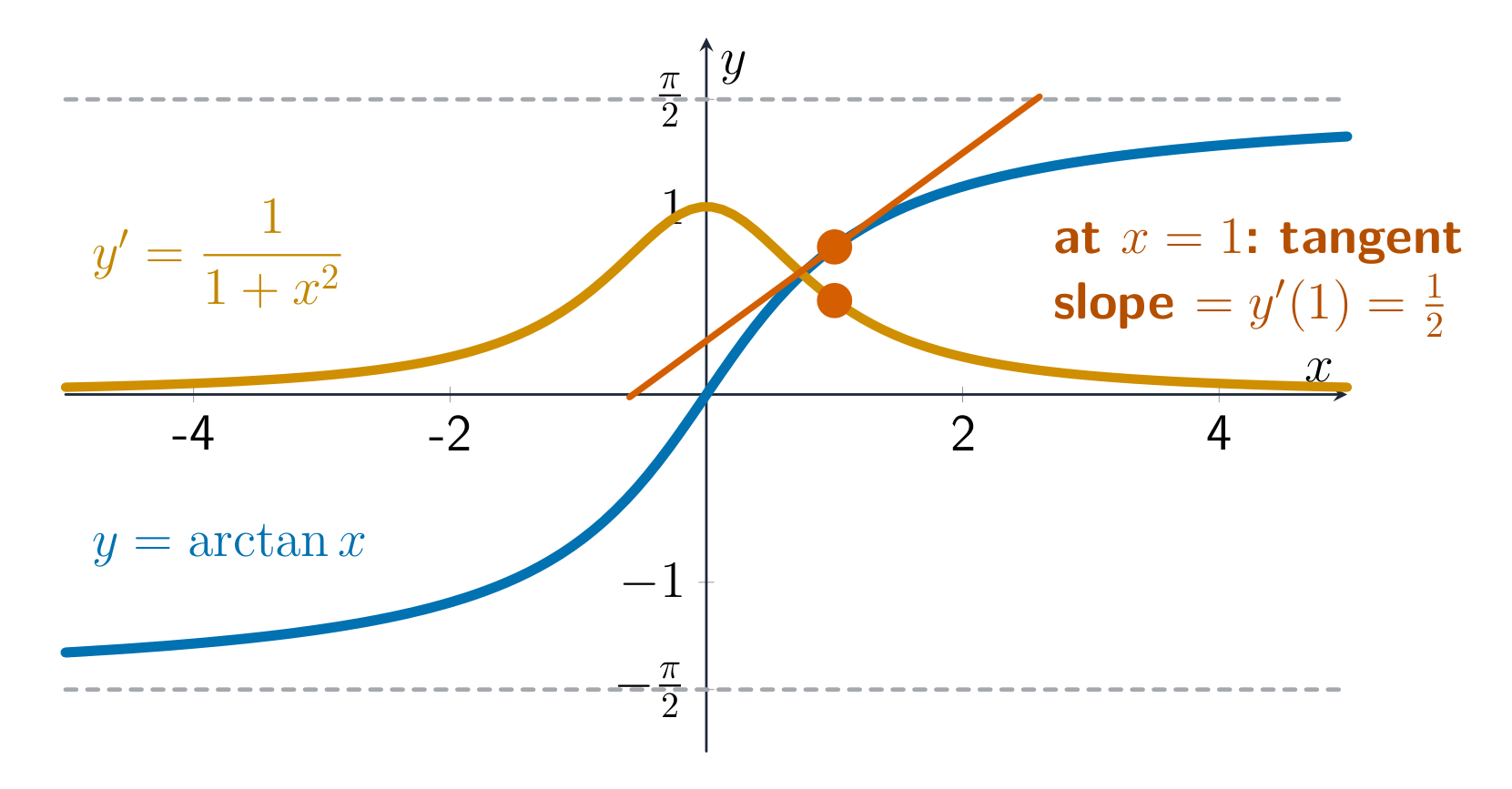
What is $\dfrac{d}{dx}[\arcsin x]$?
难度 1/5 · 今日首次完成可获 100 金币及少量额外奖励
$\arcsin$ has the root form $\tfrac{1}{\sqrt{1-x^2}}$.
Where the formula comes from
- Let $y=\arctan x$, so $\tan y=x$. Differentiate both sides with respect to $x$: $\sec^2 y\cdot\dfrac{dy}{dx}=1$, so $\dfrac{dy}{dx}=\dfrac{1}{\sec^2 y}$.
- Use $\sec^2 y=1+\tan^2 y=1+x^2$. So $\dfrac{dy}{dx}=\dfrac{1}{1+x^2}$. The same steps with $\sin y=x$ and $\cos y=\sqrt{1-x^2}$ give the $\arcsin$ formula.
What is $\dfrac{d}{dx}[\arctan x]$?
难度 1/5 · 今日首次完成可获 100 金币及少量额外奖励
$\arctan$ has the clean form $\tfrac{1}{1+x^2}$ (no root).
From $\tan y=x$ we get $\dfrac{dy}{dx}=\dfrac{1}{\sec^2 y}$. Which identity turns this into a function of $x$?
难度 1/5 · 今日首次完成可获 100 金币及少量额外奖励
Since $\tan y=x$, $\sec^2 y=1+\tan^2 y=1+x^2$, giving $\dfrac{1}{1+x^2}$.
The rest of the family
- $\dfrac{d}{dx}[\arccos x]=-\dfrac{1}{\sqrt{1-x^2}}$ and $\dfrac{d}{dx}[\text{arccot}\,x]=-\dfrac{1}{1+x^2}$: the "co-" inverses carry a minus.
- $\dfrac{d}{dx}[\text{arcsec}\,x]=\dfrac{1}{|x|\sqrt{x^2-1}}$. AP questions use $\arcsin$ and $\arctan$ far more than the others.
$\dfrac{d}{dx}[\arccos x]$ is the ____ of $\dfrac{d}{dx}[\arcsin x]$ (same magnitude, opposite sign).
难度 1/5 · 今日首次完成可获 100 金币及少量额外奖励
$\arccos$ carries the minus sign.
Select 所有 inverse-trig derivatives that contain a square root.
难度 2/5 · 今日首次完成可获 140 金币及少量额外奖励
$\arcsin$, $\arccos$, and arcsec have roots; $\arctan$ is(是) $\tfrac{1}{1+x^2}$ with no root.
Chain them up
- With the chain rule, replace $x$ by an inner function $u$ and multiply by $u'$.
- $\dfrac{d}{dx}[\arctan(3x)]=\dfrac{1}{1+(3x)^2}\cdot 3=\dfrac{3}{1+9x^2}$, and $\dfrac{d}{dx}[\arcsin(x^2)]=\dfrac{2x}{\sqrt{1-x^4}}$.
支持 $y=\arctan(3x)$, $y'=\dfrac{3}{1+9x^2}$. Find $y'$ at $x=0$.
难度 2/5 · 今日首次完成可获 140 金币及少量额外奖励
在……时 $x=0$: $\tfrac{3}{1+0}=3$.
$\dfrac{d}{dx}[\arctan(3x)]=\dfrac{1}{1+9x^2}$ (no inner factor).
难度 1/5 · 今日首次完成可获 100 金币及少量额外奖励
The chain rule adds the inner derivative $3$: $\tfrac{3}{1+9x^2}$.
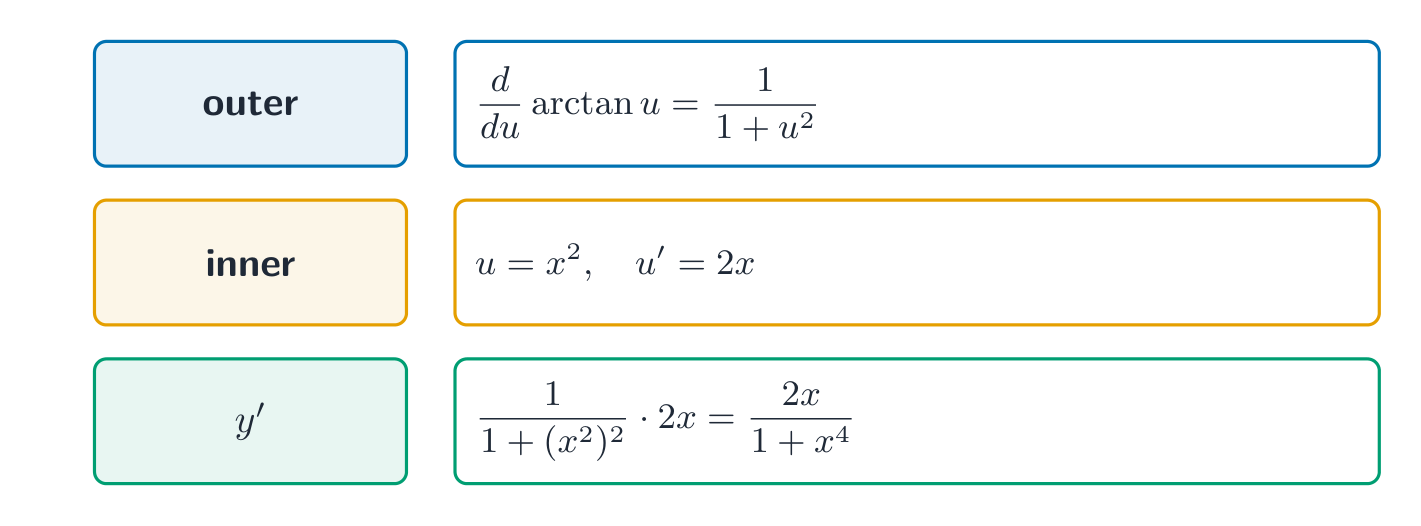
Differentiate $y=\arctan(x^2)$.
- Outer: $\arctan(u)$ with $u=x^2$, giving $\dfrac{1}{1+u^2}$. Inner derivative: $u'=2x$.
- $y'=\dfrac{1}{1+(x^2)^2}\cdot 2x=\dfrac{2x}{1+x^4}$.
A tangent line. Find the tangent to $y=\arcsin\left(\dfrac{x}{2}\right)$ at $x=1$.
- Point: $y=\arcsin\left(\dfrac12\right)=\dfrac{\pi}{6}$.
- Slope: $y'=\dfrac{1}{\sqrt{1-\frac{x^2}{4}}}\cdot\dfrac12$. At $x=1$: $\dfrac{1}{\sqrt{3/4}}\cdot\dfrac12=\dfrac{1}{\sqrt3}\approx0.577$.
- Tangent: $y-\dfrac{\pi}{6}=\dfrac{1}{\sqrt3}(x-1)$.
Find the slope of $y=\arcsin\left(\dfrac{x}{2}\right)$ at $x=1$. Give 3 decimal places.
难度 2/5 · 今日首次完成可获 140 金币及少量额外奖励
$y'=\dfrac{1}{\sqrt{1-x^2/4}}\cdot\dfrac12$. At $x=1$: $\dfrac{1}{\sqrt{3/4}}\cdot\dfrac12=\dfrac{1}{\sqrt3}\approx0.577$.
支持 $f(x)=\arctan x$, find $f'(0)$. What changes for $\arccos x$?
1 + 0 squared is 1, so the derivative is 1.
支持 $f(x)=\arctan x$, what is $f'(0)$?
难度 1/5 · 今日首次完成可获 100 金币及少量额外奖励
1 / (1 + 0) = 1.
With the product rule. Differentiate $f(x)=x\arctan x$, then find $f'(1)$.
- $f'(x)=1\cdot\arctan x+x\cdot\dfrac{1}{1+x^2}=\arctan x+\dfrac{x}{1+x^2}$.
- $f'(1)=\dfrac{\pi}{4}+\dfrac12\approx1.285$.
支持 $f(x)=x\arctan x$, find $f'(1)$. Give 3 decimal places.
难度 2/5 · 今日首次完成可获 140 金币及少量额外奖励
$f'(x)=\arctan x+\dfrac{x}{1+x^2}$, so $f'(1)=\dfrac{\pi}{4}+\dfrac12\approx1.285$.
- Don't mix up the shapes: $\arcsin$ gives $\frac{1}{\sqrt{1-x^2}}$ (a root); $\arctan$ gives $\frac{1}{1+x^2}$ (no root).
- Never drop the inner derivative: $\frac{d}{dx}[\arctan(3x)]=\frac{3}{1+9x^2}$, not $\frac{1}{1+9x^2}$.
- $\arctan x$ is not $\dfrac{1}{\tan x}$. That is $\cot x$, a different function.
$\arctan x$ means $\dfrac{1}{\tan x}$.
难度 1/5 · 今日首次完成可获 100 金币及少量额外奖励
$\arctan x$ is the inverse function (the angle whose tangent is $x$). $\dfrac{1}{\tan x}$ is(是) $\cot x$.
Memorize $\frac{d}{dx}[\arcsin x]=\frac{1}{\sqrt{1-x^2}}$ and $\frac{d}{dx}[\arctan x]=\frac{1}{1+x^2}$; both come from implicit differentiation. The "co-" inverses carry a minus. For composite inverse trigonometric functions, use the chain rule: the standard formula times $u'$.