| English | 释义 | 拼音 |
|---|---|---|
| polynomial/ˌpɒlɪˈnəʊmɪəl/ | 多项式 | duō xiàng shì |
Four rules that break a polynomial apart
- The Power Rule handles one term. To differentiate a whole polynomial 多项式 you need to combine terms.
- Four simple rules (constants, sums, differences and coefficients) let you do it term by term, in one pass.
Constant, sum, and difference
- Constant rule: the derivative of a constant is $0$, because a flat line has zero slope: $\dfrac{d}{dx}[7]=0$.
- Sum and difference rules: $\dfrac{d}{dx}[f\pm g]=f'\pm g'$. Split a long expression at each $+$ and $-$, and differentiate each term separately.
What is $\dfrac{d}{dx}[12]$?
难度 2/5 · 今日首次完成可获 140 金币及少量额外奖励
The derivative of any constant is $0$.
By the sum rule, $\dfrac{d}{dx}[f+g]=f'+$ ____.
难度 1/5 · 今日首次完成可获 100 金币及少量额外奖励
Differentiate each piece and add.
Constant multiple
- Constant multiple rule: a number in front just stays there: $\dfrac{d}{dx}[k\,f]=k\,f'$. For example, $\dfrac{d}{dx}[5x^3]=5\cdot 3x^2=15x^2$.
- Combined with the sum rule: $\dfrac{d}{dx}[5x^3-4x]=15x^2-4$.
A cubic and its changing slope
y = ax³ + bx
The derivative of a polynomial is another polynomial — drag the coefficients and picture where the slope is positive or negative.
If $f(x)=5x^3$, find $f'(2)$.
难度 2/5 · 今日首次完成可获 140 金币及少量额外奖励
$f'(x)=15x^2$, so $f'(2)=15\cdot4=60$.
支持 $\dfrac{d}{dx}[4x^2+3x-8]$, select 所有 correct term derivatives.
难度 2/5 · 今日首次完成可获 140 金币及少量额外奖励
The constant $-8$ differentiates to $0$, not $-8$.
Differentiate a polynomial in one pass
- Go term by term, using the Power Rule and keeping each coefficient: $\dfrac{d}{dx}[3x^4-2x^2+7x-9]=12x^3-4x+7$.
- The constant $-9$ disappears, and $7x$ becomes just $7$. With practice you write the derivative directly.
Differentiate $f(x)=3x^4-2x^2+7x-9$.
难度 1/5 · 今日首次完成可获 100 金币及少量额外奖励
Term by term: $12x^3$, $-4x$, $+7$, and the constant $\to 0$.
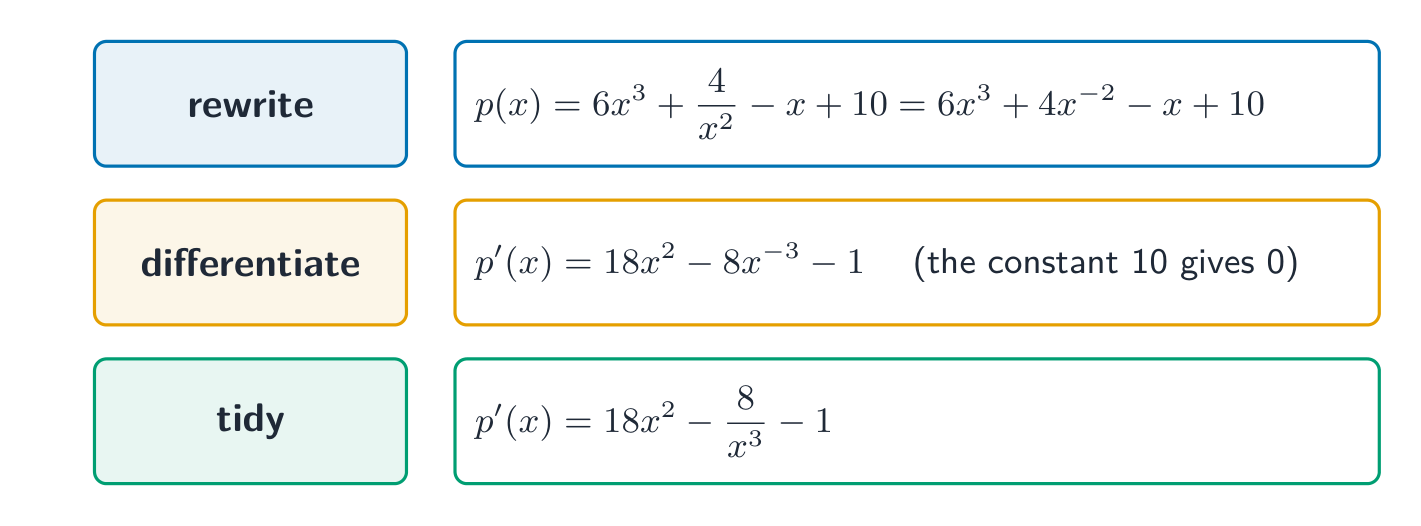
Differentiate $p(x)=6x^3+\dfrac{4}{x^2}-x+10$.
- Rewrite: $p(x)=6x^3+4x^{-2}-x+10$.
- Term by term: $6\cdot3x^2$, $4\cdot(-2)x^{-3}$, $-1$, and $0$.
- $p'(x)=18x^2-8x^{-3}-1=18x^2-\dfrac{8}{x^3}-1$.
From a table. $f(2)=3$, $f'(2)=5$, $g(2)=-4$ and $g'(2)=-1$. Find $h'(2)$ for $h(x)=3f(x)-2g(x)+x^2$.
- $h'(x)=3f'(x)-2g'(x)+2x$.
- $h'(2)=3(5)-2(-1)+4=21$. The values $f(2)$ and $g(2)$ are not needed.
$f'(1)=4$ and $g'(1)=-3$. Find $h'(1)$ for $h(x)=2f(x)-5g(x)+7$.
难度 2/5 · 今日首次完成可获 140 金币及少量额外奖励
$h'(x)=2f'(x)-5g'(x)$ (the $7$ gives $0$), so $h'(1)=8+15=23$.
A given slope. Where is the tangent to $f(x)=x^3-3x^2$ parallel to the line $y=9x$?
- Parallel means the same slope, $9$. $f'(x)=3x^2-6x=9$, so $x^2-2x-3=0$.
- $(x-3)(x+1)=0$: $x=3$ or $x=-1$.
Where is the tangent to $f(x)=x^2-4x$ parallel to $y=2x+1$?
难度 1/5 · 今日首次完成可获 100 金币及少量额外奖励
Parallel means slope $2$: $f'(x)=2x-4=2$, so $x=3$.
支持 $f(x)=3x^2-5x$, find $f'(2)$. Why can the two terms be differentiated separately?
Differentiate term by term to get $f'(x)=6x-5$; then $f'(2)=6(2)-5=12-5=7$.
支持 $f(x)=3x^2-5x$, what is $f'(2)$?
难度 1/5 · 今日首次完成可获 100 金币及少量额外奖励
6 times 2 minus 5 is 7.
There is no "product rule shortcut" hiding here: $\frac{d}{dx}[f\cdot g]$ is not $f'\cdot g'$. The sum/difference rules split across $+$ and $-$ only. Products and quotients need their own rules (lessons 2.8–2.9). Also, the derivative of a constant is $0$, not the constant itself.
The sum rule lets you compute $\dfrac{d}{dx}[f\cdot g]$ as $f'\cdot g'$.
难度 1/5 · 今日首次完成可获 100 金币及少量额外奖励
Sum/difference rules split across $+$ and $-$ only; a product needs the Product Rule.
Four combining rules: constant $\to 0$; sum/difference differentiate term by term; constant multiple keeps the coefficient out front ($\frac{d}{dx}[kf]=kf'$). With the Power Rule these differentiate any polynomial in a single pass — but they split only across $+$ and $-$, never across a product.