| English | 释义 | 拼音 |
|---|---|---|
| average rate of change/ˈævrɪdʒ reɪt ɒv tʃeɪndʒ/ | 平均变化率 | píng jūn biàn huà lǜ |
| slope/sləʊp/ | 斜率 | xié lǜ |
| secant line/ˈsiːkənt laɪn/ | 割线 | gē xiàn |
| tangent line/ˈtændʒənt laɪn/ | 切线 | qiè xiàn |
| instantaneous rate of change/ˌɪnstənˈteɪnɪəs reɪt ɒv tʃeɪndʒ/ | 瞬时变化率 | shùn shí biàn huà lǜ |
| limit/ˈlɪmɪt/ | 极限 | jí xiàn |
| derivative/dɪˈrɪvətɪv/ | 导数 | dǎo shù |
How fast, right now?
- Your car's speedometer reads $60\ \tfrac{\text{km}}{\text{h}}$ at a single instant.
- But speed is distance ÷ time — and at an instant, no time passes and no distance is covered.
- So how can you have a speed at a single moment?
- Answering this question is where calculus begins.
Average rate of change
- Over an interval, change is easy: it's the total change divided by the time taken.
- This is the average rate of change 平均变化率 of a function.
- On a graph it is the slope 斜率 of the straight line joining two points — a secant line 割线.
- Example: from $x=1$ to $x=3$, the average rate is $\dfrac{f(3)-f(1)}{3-1}$. Its units are output units per input unit.
The slope of a secant line between two points on a curve gives the...
难度 1/5 · 今日首次完成可获 100 金币及少量额外奖励
A secant joins two points, so its slope is the average rate of change over that interval.
Squeeze the two points together
- Now slide the second point closer and closer to the first.
- As the second point approaches the first, the secant slopes approach the tangent slope, when that finite limit exists.
- The limiting line through the first point is the tangent line 切线; it can cross the curve or meet it elsewhere.
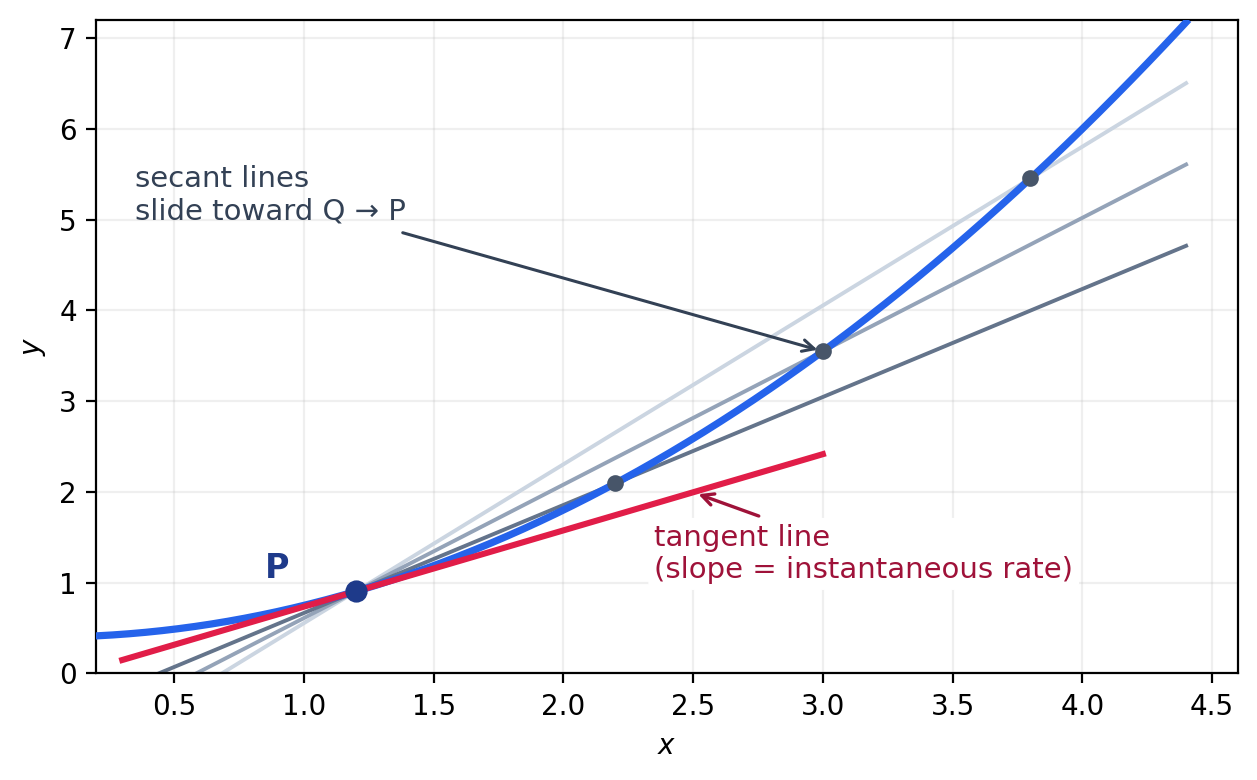
As the second point slides toward the first, the secant line approaches the...
难度 1/5 · 今日首次完成可获 100 金币及少量额外奖励
The secant pivots until it just touches the curve — it approaches the tangent line.
The instantaneous rate of change
- The slope of the tangent line is the instantaneous rate of change 瞬时变化率 at that point.
- That is the speedometer reading — the rate at one exact instant.
- For a position-time graph, it is the instantaneous velocity.
Average rate or instantaneous rate?
Decide whether each quantity is measured over an interval or at a single instant.
The slope of the tangent line is the ____ rate of change.
难度 1/5 · 今日首次完成可获 100 金币及少量额外奖励
The tangent line touches at one point, so its slope is the instantaneous rate of change there.
You cannot find the instantaneous rate by plugging in one point — that gives $\tfrac{0}{0}$, which is undefined. You have to watch what the average rate approaches as the interval shrinks.
You can find the instantaneous rate of change by plugging a single point into the average-rate formula.
难度 1/5 · 今日首次完成可获 100 金币及少量额外奖励
That gives $\tfrac{0}{0}$, which is undefined. You must take the 极限 as the interval shrinks to zero.
This "approaches" is a limit
- We never actually divide by zero; we ask what value the slope approaches.
- That value is a limit 极限 — the central idea of calculus.
- The limit of the average rate of change, as the interval shrinks to zero, is called the derivative 导数.
- The whole first unit of the course is about making this idea precise.
Select 所有 true statements about the derivative at a point.
难度 2/5 · 今日首次完成可获 140 金币及少量额外奖励
The derivative is the 极限 of average rates as the interval shrinks — the tangent slope, i.e. the instantaneous rate.
A ball's height is $h(t)=5t^2$ metres. Estimate its speed at $t=2$ s. Use intervals on both sides of $t=2$.
| Interval | Average rate $\dfrac{h(t)-h(2)}{t-2}$ (m/s) |
|---|---|
| $[2,\ 2.1]$ | $20.5$ |
| $[2,\ 2.01]$ | $20.05$ |
| $[1.99,\ 2]$ | $19.95$ |
| $[1.9,\ 2]$ | $19.5$ |
- From both sides the values close in on $20$. That limit is the speed at $t=2$: 20 m/s.
A ball's height is $h(t)=5t^2$ m. Estimate its instantaneous speed at $t=2$ s (in m/s).
难度 2/5 · 今日首次完成可获 140 金币及少量额外奖励
Shrinking the interval, the average rate closes in on $20\ \tfrac{\text{m}}{\text{s}}$ — that limit is the instantaneous speed.
支持 $f(x)=x^2$, what is the average rate of change from $x=1$ 到 $x=3$? What does it approach as the interval shrinks toward $x=1$?
The difference quotient on this interval is 4.
The average rate of change of $f(x)=x^2$ from $x=1$ 到 $x=3$ is...
难度 1/5 · 今日首次完成可获 100 金币及少量额外奖励
(9 - 1) / (3 - 1) = 4.
AP style: from a table. The temperature $T$ of a drink (°C) is measured at times $t$ (minutes).
| $t$ | 0 | 2 | 4 | 6 |
|---|---|---|---|---|
| $T(t)$ | 90 | 78 | 69 | 63 |
- Average rate on $[0,6]$: $\dfrac{63-90}{6-0}=-4.5$ °C per minute. The drink cools 4.5 °C per minute on average.
- Estimate the rate at $t=3$ with the closest points on each side: $\dfrac{T(4)-T(2)}{4-2}=\dfrac{69-78}{2}=-4.5$ °C per minute.
Use the drink table: $T(0)=90$, $T(2)=78$, $T(4)=69$, $T(6)=63$. Find the average rate of change of $T$ on $[2,6]$, in °C per minute.
难度 2/5 · 今日首次完成可获 140 金币及少量额外奖励
$\dfrac{T(6)-T(2)}{6-2}=\dfrac{63-78}{4}=-3.75$ °C per minute. The sign is negative because the drink is cooling.
$V(t)$ is the volume of water in a tank, in litres, $t$ hours after noon. What are the units of the rate of change of $V$?
难度 1/5 · 今日首次完成可获 100 金币及少量额外奖励
A rate of change is output units per input unit: litres per hour.
Average rate of change = slope of a secant line over an interval. Shrink the interval to zero and the secant approaches the tangent line, whose slope is the instantaneous rate of change. That limiting value is the derivative.