| English | 释义 | 拼音 |
|---|---|---|
| organic molecules/ɔːˈɡænɪk ˈmɒlɪkjuːlz/ | 有机分子 | yǒu jī fēn zǐ |
Where did the first life come from?
- Natural selection explains how life changed — but not how it first began.
- The earliest cells appeared on Earth billions of years ago.
- Before them, there was only chemistry, no biology.
- How that chemistry became the first living cell is one of science's great questions.
A very different young Earth
- Early Earth was hot, with volcanoes, lightning, and no free oxygen.
- Its air held simple gases, and its surface held water.
- These provided the ingredients and the energy for reactions.
- The stage was set for chemistry to become complex.
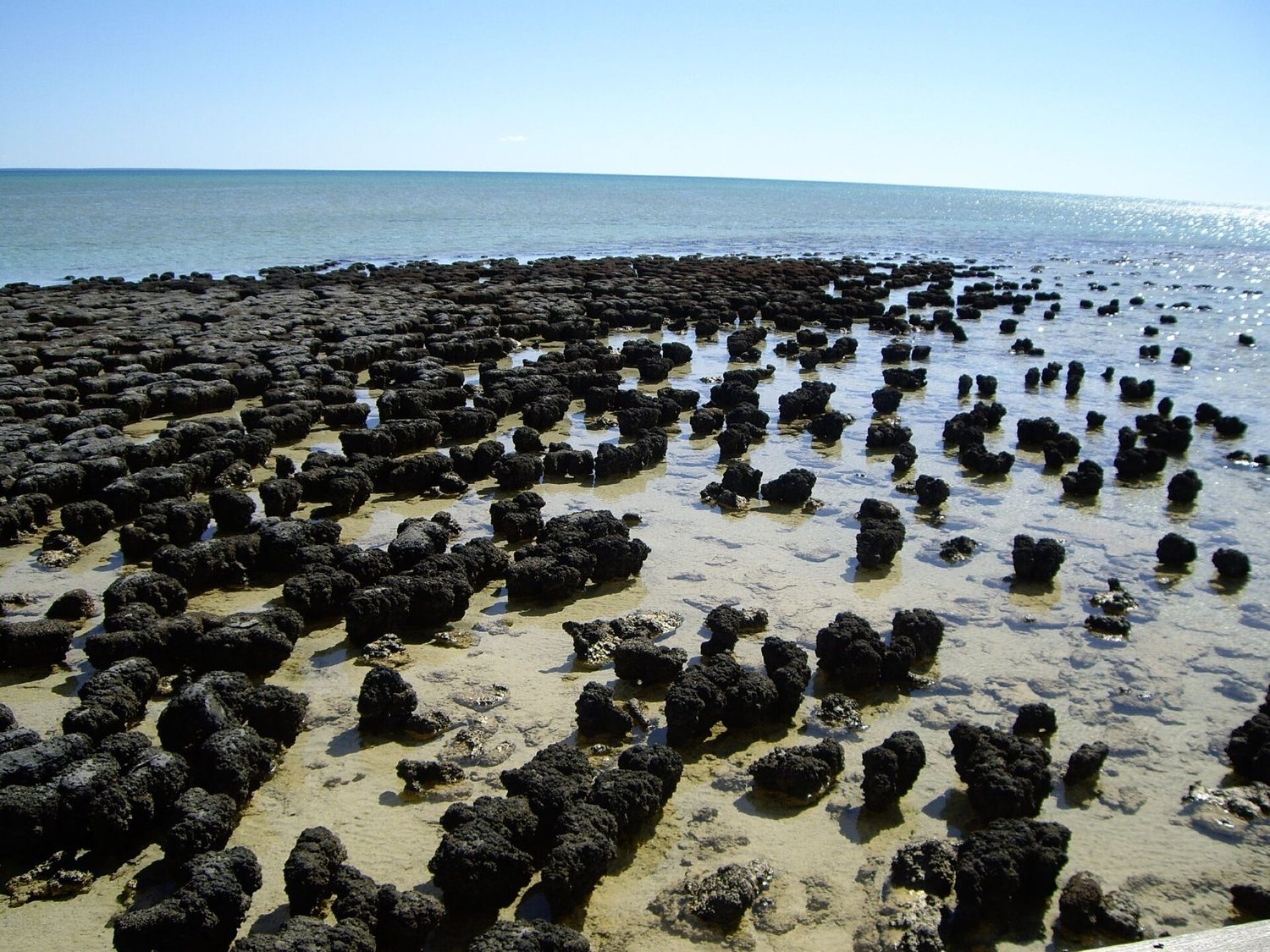
Stromatolites: layered microbial mats are among the oldest evidence of life on Earth
早期地球提供了什么能驱动化学反应的东西?
难度 1/5 · 今日首次完成可获 100 金币及少量额外奖励
早期地球有来自闪电、火山和阳光的能量——但几乎没有游离氧,也还没有生命。
Building organic molecules
- Given energy, simple gases can react to form small organic molecules 有机分子.
- The famous Miller-Urey experiment showed this in the lab, making amino acids.
- Over time, these small molecules could join into larger polymers, including RNA.
- Step by step, the chemistry grew more life-like.
从化学到第一个细胞
一步步走过早期地球上简单的化学物质如何可能积累成最早的活细胞。
米勒-尤里实验表明,早期地球的条件能形成……
难度 1/5 · 今日首次完成可获 100 金币及少量额外奖励
米勒和尤里用简单的气体和能量制造出了有机分子(氨基酸)——关键的第一步。
The first cells
- Molecules that could copy themselves had a huge advantage.
- Wrapped inside simple membranes, they formed the first cell-like structures.
- Once such a structure could copy itself, life — and natural selection — could begin.
- From that first cell, all of today's diversity slowly branched out.
生命被认为是逐步积累起来的:小分子,然后聚合物,然后细胞。
难度 1/5 · 今日首次完成可获 100 金币及少量额外奖励
这些步骤逐步积累:简单的分子,然后更大的聚合物,然后被膜包住、能自我复制的细胞。
一旦最早的细胞存在,生命的多样性通过自然____产生。
难度 1/5 · 今日首次完成可获 100 金币及少量额外奖励
第一个细胞的起源与自然选择是分开的,自然选择随后产生了后来所有的多样性。
选出关于生命起源的所有正确说法。
难度 2/5 · 今日首次完成可获 140 金币及少量额外奖励
生命被认为是逐步积累的,而不是瞬间出现的。其余三条正确。
This lesson is about the origin of the first life — a chemistry question. It is separate from natural selection, which explains the diversity of life after the first cell existed. Do not use "evolution" to mean the origin of life itself.
The Miller-Urey experiment:
- In 1953, scientists sealed simple gases and water in a flask and added sparks (like lightning).
- After days, the flask contained amino acids — the building blocks of proteins.
- It showed that life's ingredients can form from non-living chemistry, given energy.
The origin of life asks how the first cell arose from chemistry. On early Earth, energy drove simple gases to form organic molecules (shown by Miller-Urey), which built up into polymers and eventually membrane-enclosed, self-copying cells. This is a separate question from natural selection, which then produced all later diversity.
Write from this case
- A lab sparks inorganic gases like those proposed for early Earth.
- No cells are put in the flask.
哪些生物单体可以形成?
非生物合成可生成氨基酸。
这类火花实验产生了什么?
难度 1/5 · 今日首次完成可获 100 金币及少量额外奖励
形成了单体,但未形成细胞。