| English | 释义 | 拼音 |
|---|---|---|
| reproductive isolation/rɪprəˈdʌktɪv ˌaɪsəˈleɪʃn/ | 生殖隔离 | shēng zhí gé lí |
| species/ˈspiːsiːz/ | 物种 | wù zhǒng |
| allopatric/ˌæləˈpætrɪk/ | 异域 | yì yù |
| sympatric speciation/ˈsɪmpətrɪk ˌspiːʃɪˈeɪʃn/ | 同域物种形成 | tóng yù wù zhǒng xíng chéng |
| prezygotic isolation/prɪzɪˈɡɒtɪk ˌaɪsəˈleɪʃn/ | 合子前隔离 | hé zǐ qián gé lí |
| postzygotic isolation/ˌpəʊstzɪˈɡɒtɪk ˌaɪsəˈleɪʃn/ | 合子后隔离 | hé zǐ hòu gé lí |
| divergent evolution/daɪˈvɜːdʒənt ɪvəˈluːʃn/ | 趋异进化 | qū yì jìn huà |
| adaptive radiation/əˈdæptɪv ˌreɪdɪˈeɪʃn/ | 适应辐射 | shì yìng fú shè |
| convergent evolution/kənˈvɜːdʒənt ɪvəˈluːʃn/ | 趋同进化 | qū tóng jìn huà |
A barrier can separate populations without a wall
- Two plant groups grow in the same field, yet chromosome differences prevent fertile crosses. Conversely, a river can separate populations that could still interbreed if reunited.
- Speciation depends on reproductive isolation 生殖隔离 and reduced gene flow. Identify the mechanism of isolation as well as the geographic setting.
What a species 物种 is
- A species is a group that can interbreed and produce fertile offspring.
- All members share one gene pool.
- Two organisms that cannot interbreed belong to different species.
- So the key to a new species is breaking that ability to interbreed.
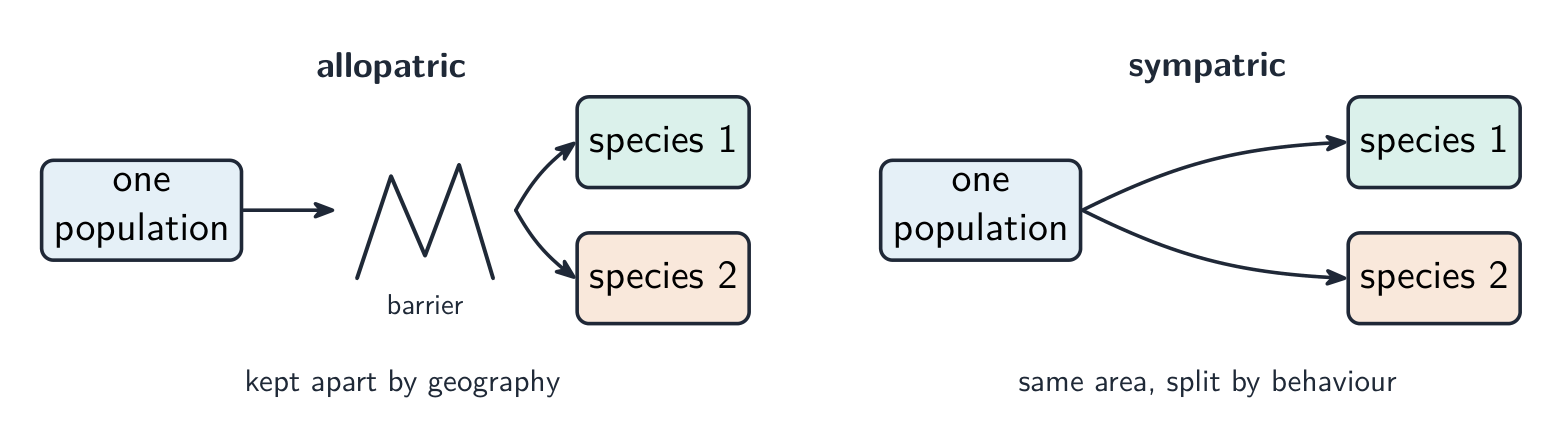
Allopatric 异域 and sympatric speciation 同域物种形成
两个生物属于同一个物种,如果它们能……
难度 1/5 · 今日首次完成可获 100 金币及少量额外奖励
一个物种是能一起交配繁殖并产生有繁殖能力后代的一群。
Reproductive isolation
- For one species to become two, the groups must stop interbreeding.
- This is called reproductive isolation.
- Once isolated, the two gene pools no longer mix.
- Each is then free to change in its own direction.
一个新物种如何形成
一步步走过物种形成——一个种群被分开,两半分化,最终它们不能再交配繁殖。
一个物种要分裂成两个,必须发生什么?
难度 1/5 · 今日首次完成可获 100 金币及少量额外奖励
物种形成需要生殖隔离——两群不能再交配繁殖,所以它们的基因库彻底分开。
一旦分开,两群能积累不同的突变和变化。
难度 1/5 · 今日首次完成可获 100 金币及少量额外奖励
分开的基因库通过不同的突变、选择和偶然分化,直到它们不能交配繁殖。
Allopatric speciation
- A common route is allopatric speciation: a geographic barrier splits a population.
- A river, mountain range, or ocean divides the group in two.
- Over generations, different mutations and selection make the halves diverge.
- Eventually they differ so much they can no longer interbreed — two species.
由地理屏障把种群分开引起的物种形成叫做____物种形成。
难度 1/5 · 今日首次完成可获 100 金币及少量额外奖励
异域物种形成发生在一道物理屏障——比如一条河——把种群分开时。
选出关于物种形成的所有正确说法。
难度 2/5 · 今日首次完成可获 140 金币及少量额外奖励
长得不同还不够——检验标准是它们能否交配繁殖。其余三条正确。
Barriers can act before or after fertilization
- Prezygotic isolation 合子前隔离 prevents fertilization: populations may breed at different times, use different courtship signals or have incompatible gametes. Postzygotic isolation 合子后隔离 acts after fertilization: a hybrid may fail to develop or may be sterile.
- Geographic separation can reduce gene flow but does not alone prove that speciation has occurred. The biological species concept concerns viable, fertile offspring; it is hard to apply to fossils and organisms that reproduce only asexually.
两个种群发生交配,但其杂交后代不育。这描述的是哪种障碍?
难度 1/5 · 今日首次完成可获 100 金币及少量额外奖励
受精已发生;该障碍作用于杂交后代阶段。
New species can arise in the same place
- Sympatric speciation occurs with geographic overlap. In plants, a change in chromosome-set number can create reproductive isolation; changes in host use and mating preference can also reduce gene flow.
- Worked comparison: a river separates two populations, an allopatric setting. Two plant groups share a field but different chromosome numbers prevent fertile crosses, a sympatric setting. Identify the barrier, not just the map.
两种植物类群占据同一块田地,但染色体数目差异阻止了可育杂交。这符合哪种情况?
难度 1/5 · 今日首次完成可获 100 金币及少量额外奖励
它们在地理上重叠,但基因交流受阻。
Compare evolutionary patterns
- Divergent evolution 趋异进化 produces different adaptations from a shared ancestry. In adaptive radiation 适应辐射, one lineage diversifies into several ecological roles. Convergent evolution 趋同进化 produces similar adaptations in independently evolving lineages under similar pressures.
- Gradualism describes accumulated change over long periods. Punctuated equilibrium describes long periods of relative stasis interrupted by comparatively rapid change. Neither requires an individual to transform into a new species overnight.
在独立演化的谱系中,相似的适应性特征并不总是表明存在最近的共同祖先。
难度 1/5 · 今日首次完成可获 100 金币及少量额外奖励
相似的定向选择压力可以产生趋同的适应性特征。
一个谱系表现出长期停滞与相对快速变化交替的模式。这符合哪种模型?
难度 1/5 · 今日首次完成可获 100 金币及少量额外奖励
该模型将停滞状态与相对快速的进化改变相结合。
Looking different is not enough to make a new species. Two groups become separate species only when they are reproductively isolated — unable to interbreed and produce fertile offspring. Colour or size differences alone do not count.
A river makes two squirrels:
- Long ago, the Grand Canyon split one squirrel population in two.
- The two sides could no longer meet or interbreed.
- Over thousands of years each side changed separately — today they are two distinct species.
Speciation is one species splitting into two. It requires reproductive isolation — the groups can no longer interbreed, so their gene pools diverge. In allopatric speciation, a geographic barrier splits a population; the separated halves change until they become distinct species.
Write from this case
- A river splits one population into two.
- The two sides no longer interbreed, and later they do not produce fertile offspring even if the river disappears.
哪种物种形成方式包含地理分隔?
Allo意为“其他地方”。屏障将种群分隔开。
哪种物种形成始于地理屏障?
难度 1/5 · 今日首次完成可获 100 金币及少量额外奖励
空间上的分离属于异域物种形成。