| English | 释义 | 拼音 |
|---|---|---|
| population/ˌpɒpjʊˈleɪʃn/ | 种群 | zhǒng qún |
| gene pool/dʒiːn puːl/ | 基因库 | jī yīn kù |
| allele frequency/əˈliːl ˈfriːkwənsi/ | 等位基因频率 | děng wèi jī yīn pín lǜ |
The seals that almost disappeared
- By the 1890s, hunters had killed so many northern elephant seals that perhaps only 20–100 were left. Today there are more than 200 000, but they have very little genetic variation: almost all of them descend from those few survivors.
- Natural selection is not the only force that changes populations. Random events such as this one also change which alleles a population carries.
Gene pool and allele frequency
- A population 种群 is a group of one species living and breeding in one area. All the alleles in it form its gene pool 基因库. Allele frequency 等位基因频率 = copies of one allele ÷ all copies of that gene.
- Evolution 进化 in a population is a change in allele frequencies over generations. Individuals do not evolve; populations do.
A population of 100 beetles has 36 BB, 48 Bb and 16 bb. There are $2\times100=200$ copies of the gene. Copies of B $=2(36)+48=120$, so the frequency of B $=120/200=$ 0.6, and b $=0.4$.
Evolution as changing allele frequency
Step through how selection changes the mix of alleles in a gene pool over generations.
A gene pool is…
难度 1/5 · 今日首次完成可获 100 金币及少量额外奖励
A gene pool is the whole collection of alleles in a 人口 at a given time.
Allele frequency describes…
难度 1/5 · 今日首次完成可获 100 金币及少量额外奖励
Allele frequency is the proportion of a gene pool made up of one particular allele.
At the population level, evolution is a change in allele ____ over generations.
难度 1/5 · 今日首次完成可获 100 金币及少量额外奖励
Evolution is defined as a change in allele frequency in a population over time.
Natural selection, migration, and mutation can all change allele frequencies.
难度 1/5 · 今日首次完成可获 100 金币及少量额外奖励
Selection, migration, mutation, and chance (genetic drift) all shift allele frequencies.
A population of 50 plants has 8 RR, 24 Rr and 18 rr. What is the frequency of allele R?
难度 2/5 · 今日首次完成可获 140 金币及少量额外奖励
Copies of R = 2(8) + 24 = 40, out of 2 × 50 = 100 copies, so 40/100 = 0.4.
Mutation: the source of new alleles
- Mutation 突变 is a random change in DNA. It is the only process that creates new alleles, so it adds new genetic variation to a population.
- Mutation does not happen "because the organism needs it". It produces random variation; natural selection then acts on the phenotypes that this variation produces.
Which process is the only source of 新的 alleles in a population?
难度 1/5 · 今日首次完成可获 100 金币及少量额外奖励
Drift and selection change the frequencies of alleles that already exist. Only mutation creates new ones.
Genetic drift: chance changes in small populations
- Genetic drift 遗传漂变 is a change in allele frequencies caused by chance, not by selection: which individuals happen to survive and reproduce, and which alleles happen to be passed on.
- Drift is strongest in small populations. By chance alone an allele can be lost (frequency 0) or fixed (frequency 1), even if it is harmless or helpful. In large populations, chance effects mostly cancel out.
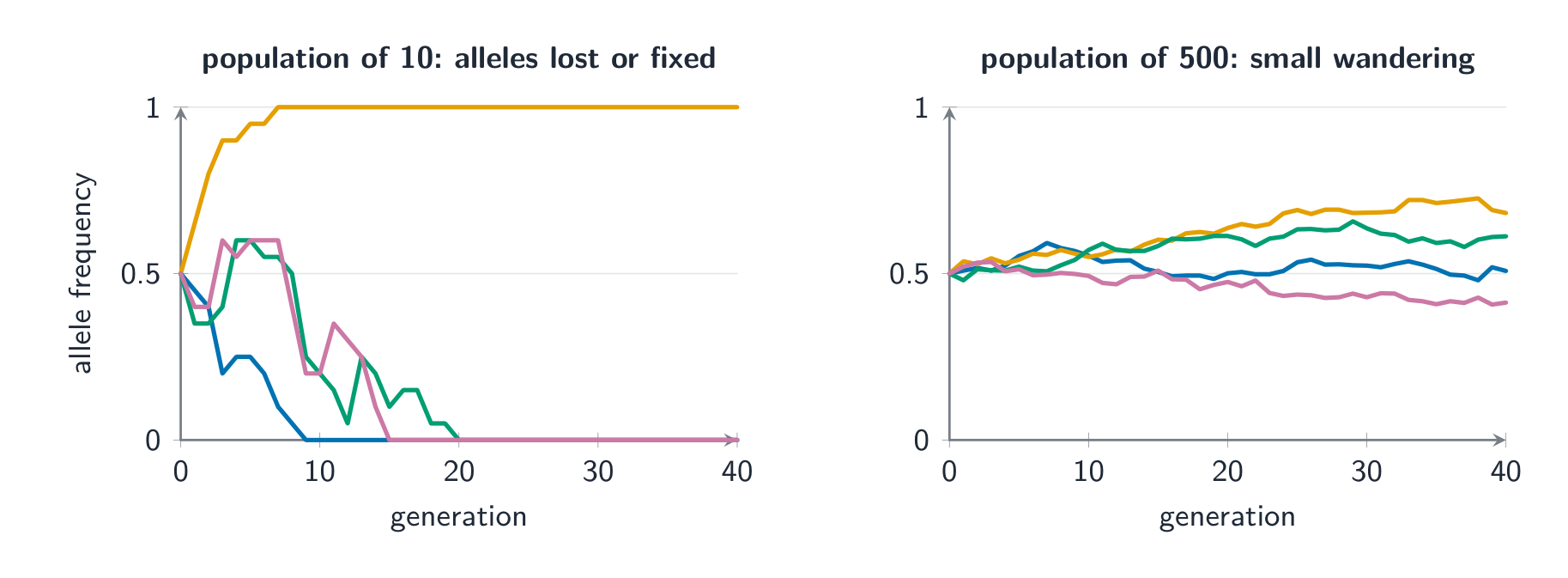
Genetic drift changes allele frequencies more in small populations than in large ones.
难度 1/5 · 今日首次完成可获 100 金币及少量额外奖励
In a small population, a few chance events (who survives, which alleles are passed on) change the frequencies a lot.
Two kinds of drift: bottleneck and founder
| Bottleneck effect 瓶颈效应 | Founder effect 奠基者效应 | |
|---|---|---|
| What happens | a population is reduced to a few individuals for at least one generation | a few individuals separate and start a new population |
| Cause | disaster, disease, hunting | migration to an island or new area, or social isolation |
| Example | northern elephant seals; cheetahs | Old Order Amish (Pennsylvania): Ellis–van Creveld syndrome, a rare dwarfism with extra fingers, is far more common |
| Result | genetic variation lost; allele frequencies differ from the original population | new population's allele frequencies reflect the few founders, not the source population |
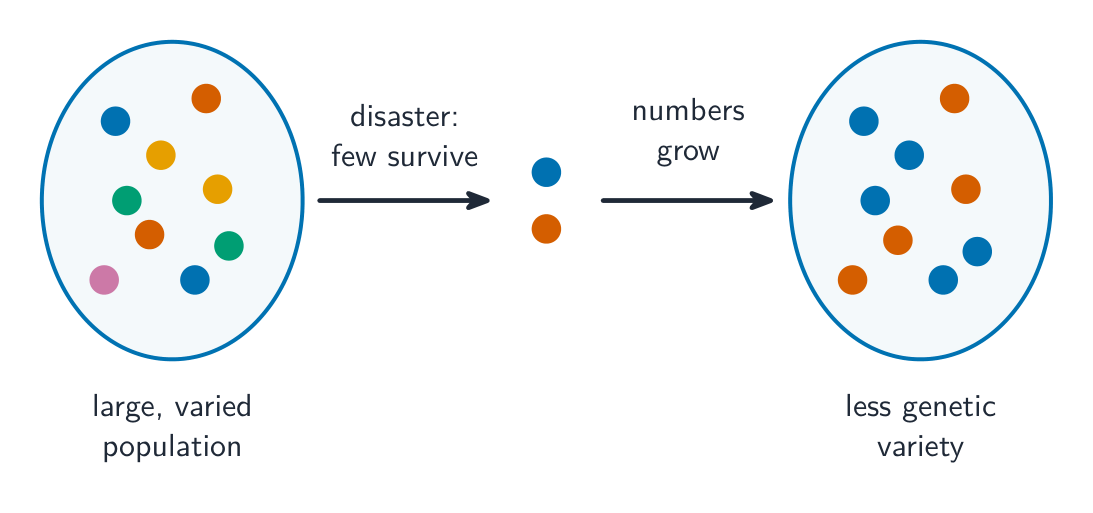
Match each event to the process.
难度 2/5 · 今日首次完成可获 140 金币及少量额外奖励
Bottleneck = shrinking; founder = a small group leaves; gene flow = alleles move between populations.
Gene flow: alleles that move
- Migration can cause gene flow 基因流: the addition or removal of alleles when individuals (or pollen and seeds) move between populations.
- Gene flow makes populations more similar to each other. Drift in isolated populations does the opposite: it lets a small population diverge from other populations of the same species.
Select 所有 true statements about population genetics.
难度 2/5 · 今日首次完成可获 140 金币及少量额外奖励
Individuals do not evolve; populations do, as allele frequencies change. The other three are correct.
Two populations of the same fish species become connected by a new canal, and fish swim between them. What is the most likely effect on the two populations?
难度 1/5 · 今日首次完成可获 100 金币及少量额外奖励
Migration causes gene flow, which mixes the gene pools and reduces differences between them.
Worked FRQ answer
A hurricane kills 95% of the lizards on a small island. The survivors are, by chance, mostly brown; green lizards had been common before.
(A) Identify the process that changed the colour allele frequencies. Genetic drift, specifically the bottleneck effect.
(B) Explain why this is not natural selection. The survivors were not more likely to survive because of their colour; which lizards survived was random.
(C) Predict the effect on genetic variation, and explain one consequence. Genetic variation decreases, because alleles carried only by the dead lizards are lost. With less variation, the population is less able to adapt if its environment changes (for example, to a new disease).
- Why it scores: (B) uses the key idea that drift is nonselective: survival is not linked to the trait. (C) gives a prediction and a reason.
- Drift is random, not adaptive. It can make a harmful allele more common. Only natural selection consistently favours helpful alleles.
- Bottleneck = the population shrinks; founder = a small group leaves. Both are drift, and both reduce variation.
- Gene flow reduces differences between populations; drift and mutation can increase them.
Evolution is a change in allele frequencies in a population. Besides natural selection, random processes change them: mutation adds new alleles; genetic drift changes frequencies by chance, most strongly in small populations, through the bottleneck and founder effects; migration causes gene flow, which adds or removes alleles and makes populations more alike. Drift lets small populations diverge from others of the same species.