| English | 释义 | 拼音 |
|---|---|---|
| gene expression/dʒiːn ekˈspreʃn/ | 基因表达 | jī yīn biǎo dá |
| transcription factors/trænˈskrɪpʃn ˈfæktəz/ | 转录因子 | zhuǎn lù yīn zǐ |
Not all genes on at once
- Your genome holds tens of thousands of genes.
- But a cell never needs all of them working at the same time.
- So it switches genes on and off as required.
- Controlling which genes are used is called gene regulation.
Genes are switched on and off
- Gene expression 基因表达 is a gene being read to make its protein.
- A gene can be switched on (expressed) or off (silent).
- An off gene is still in the DNA — it is just not being used.
- Regulation decides which genes are on in each cell, at each moment.
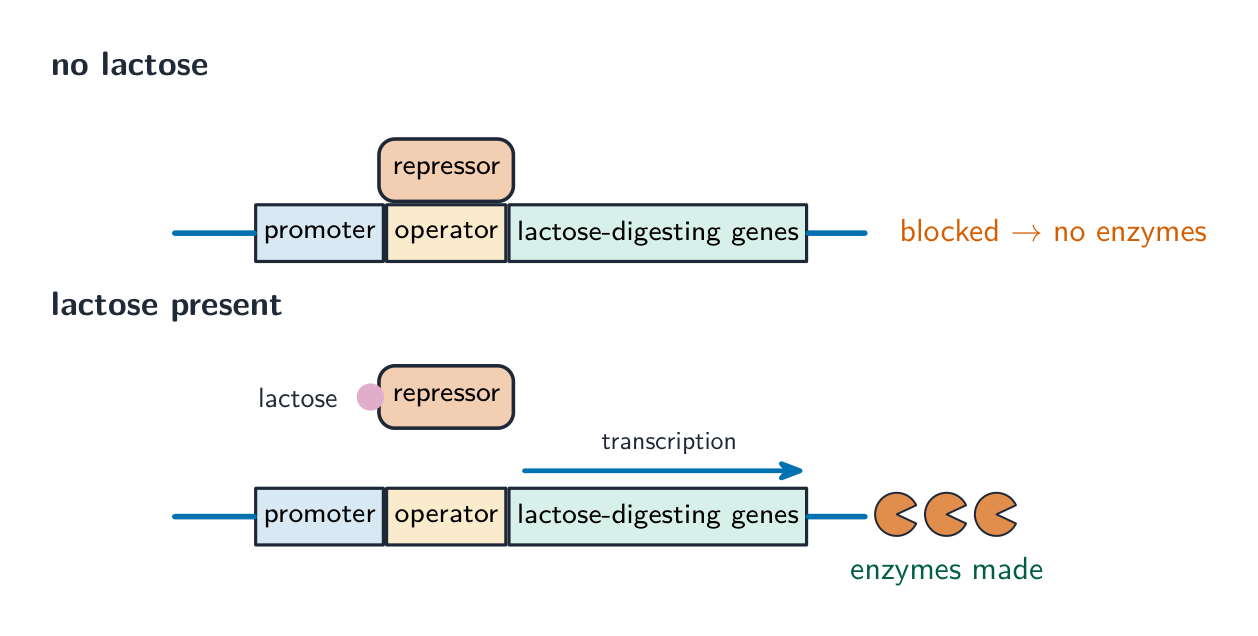
The lac operon switches genes on only when lactose is present
基因表达 means…
难度 1/5 · 今日首次完成可获 100 金币及少量额外奖励
基因表达 is a gene being used — transcribed and translated to make its protein.
A cell keeps every one of its genes switched on all the time.
难度 1/5 · 今日首次完成可获 100 金币及少量额外奖励
A cell expresses only the genes it needs right now; the rest are switched off.
Transcription factors flip the switch
- Transcription factors 转录因子 are proteins that bind to DNA.
- They decide whether RNA polymerase can transcribe a gene.
- Some help switch a gene on; others switch it off.
- A signal from outside can activate these factors, turning genes on in response.
Switching a gene on
Step through how a signal turns a gene on - only then is its protein made.
Proteins that bind DNA to switch genes on or off are called transcription ____.
难度 1/5 · 今日首次完成可获 100 金币及少量额外奖励
Transcription factors control whether RNA polymerase can transcribe a gene.
Why regulation matters
- Making every protein all the time would waste huge amounts of energy.
- Regulation lets a cell make only what it needs, right when it needs it.
- It also lets a cell respond to changes in its environment.
- In bacteria, groups of related genes share a switch called an operon.
Why is regulating gene expression useful?
难度 1/5 · 今日首次完成可获 100 金币及少量额外奖励
Regulation lets a cell make the right proteins at the right time — efficient and responsive.
Select 所有 true statements about gene regulation.
难度 2/5 · 今日首次完成可获 140 金币及少量额外奖励
A switched-off gene is still there in the DNA — it is just not expressed. The other three are correct.
Almost every cell in your body holds the same genes. Cells differ not in which genes they have, but in which are switched on. A muscle cell and a nerve cell run different genes from the very same genome.
A bacterium and its food:
- The bacterium E. coli keeps the genes for digesting lactose switched off.
- When lactose appears, those genes are switched on and the enzymes are made.
- When the lactose is gone, the genes switch off again — no waste.
Gene expression is a gene being used to make its protein, and cells control it through gene regulation. Transcription factors switch genes on or off, so a cell makes only the proteins it needs. Every cell has the same genes; they differ in which are expressed.
Write from this case
- The lac operon is considered with lactose absent.
- Glucose is not the variable in this case.
What does the lac repressor do?
Without lactose the repressor keeps the operon off.
What happens at the lac operator when lactose is absent?
难度 1/5 · 今日首次完成可获 100 金币及少量额外奖励
The repressor blocks transcription until lactose inactivates it.