| English | 释义 | 拼音 |
|---|---|---|
| signal/ˈsɪɡnl/ | 信号 | xìn hào |
| receptor/rɪˈseptə/ | 受体 | shòu tǐ |
| ligand/ˈlɪɡænd/ | 配体 | pèi tǐ |
| target cell/ˈtɑːɡɪt sel/ | 靶细胞 | bǎ xì bāo |
Cells talk to each other
- Some bacteria glow only when there are many of them together. Each cell releases a small signal molecule; when enough cells are nearby, the signal is strong enough to switch on the light genes. This quorum sensing lets single cells act as a group.
- Cells in your body do the same: they communicate so that trillions of cells grow, defend the body and keep conditions stable together.
Why do the cells of a body need to communicate?
难度 1/5 · 今日首次完成可获 100 金币及少量额外奖励
Cells must communicate to act together — growing, defending, and responding as one coordinated body.
Signals and receptors
- A signalling cell releases a signal molecule (a ligand 配体). It is detected only by cells with a matching receptor 受体 protein: these are the target cells.
- The ligand fits the receptor's shape, like a key in a lock. Cells without the receptor ignore the signal, even if it reaches them.
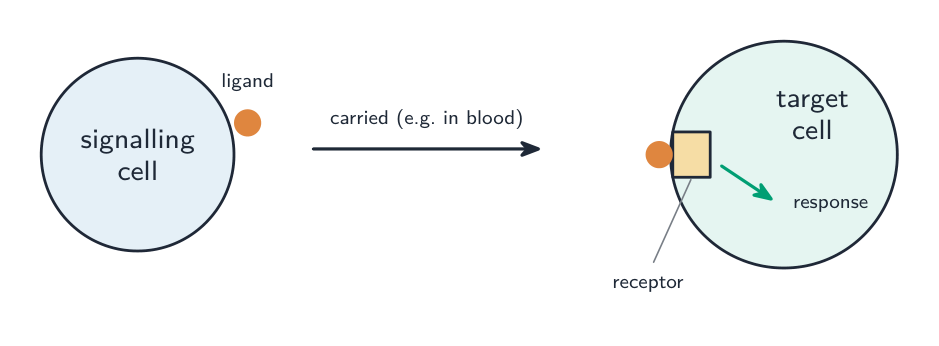
A signal molecule (ligand) is detected when it binds to a…
难度 1/5 · 今日首次完成可获 100 金币及少量额外奖励
A ligand binds a specific 受体, like a key in a lock, delivering the message.
A cell that has the right receptor and can respond to a signal is called a ____ cell.
难度 1/5 · 今日首次完成可获 100 金币及少量额外奖励
Only a target cell with the matching receptor responds; other cells ignore the signal.
Three distances
| Type | How it works | Examples |
|---|---|---|
| direct contact | molecules on touching cells interact | immune cells: an antigen-presenting cell activates a helper T cell; plant cells through plasmodesmata |
| local (short distance) | a local regulator reaches nearby cells | neurotransmitters at a synapse; quorum sensing in bacteria; morphogens in an embryo |
| long distance | hormones travel in the blood to target cells of another type | insulin, human growth hormone, thyroid hormones, testosterone, estrogen |

信号传得多远?
Sort each kind of cell signalling by how far the message has to travel.
A hormone can travel through the blood to reach distant cells all over the body.
难度 1/5 · 今日首次完成可获 100 金币及少量额外奖励
Hormones are long-distance signals — they travel in the blood to far-off target cells.
What signaling uses the blood to a distant organ?
难度 1/5 · 今日首次完成可获 100 金币及少量额外奖励
Distance plus the bloodstream is endocrine.
Match each example to the type of cell communication.
难度 2/5 · 今日首次完成可获 140 金币及少量额外奖励
Touching cells use direct contact; local regulators act nearby; hormones travel in the blood.
In quorum sensing, why do bacteria switch on certain genes only when they are crowded?
难度 1/5 · 今日首次完成可获 100 金币及少量额外奖励
Each cell releases a little signal; only a large population makes enough to trigger the response.
One signal, many targets
- A hormone in the blood reaches every cell, but only target cells respond. Insulin from the pancreas makes liver and muscle cells take up glucose, because they have insulin receptors.
- Different target cells can respond differently to the same signal, depending on what the receptor switches on inside each cell.
Select 所有 true statements about cell communication.
难度 2/5 · 今日首次完成可获 140 金币及少量额外奖励
A cell responds only if it has the matching receptor, so not every cell responds to every signal.
Every cell that a hormone reaches in the blood responds to it.
难度 1/5 · 今日首次完成可获 100 金币及少量额外奖励
Only target cells with the matching receptor respond.
Worked FRQ answer
After a meal, cells in the pancreas release insulin into the blood. Liver cells respond by taking up glucose; skin cells do not respond.
(A) Identify the type of signalling, and justify. Long-distance (endocrine) signalling: insulin is a hormone that travels in the blood from the pancreas to cells of another type far away.
(B) Explain why liver cells respond but skin cells do not. Liver cells have insulin receptors; skin cells do not. Only cells with a matching receptor can detect the ligand.
(C) Describe one example of cells communicating by direct contact. An antigen-presenting cell touches a helper T cell, and molecules on the two cell surfaces interact to activate the T cell.
- Why it scores: (A) names the type and the evidence (travels in the blood, other cell type); (B) explains the response by the receptor.
- A signal reaching a cell is not enough: the cell must have the matching receptor.
- Local regulators act nearby; hormones travel in the blood. Distance and route decide the type.
- Direct contact needs the cells to touch; no signal is released into the fluid.
Cells communicate by direct contact (touching cells, such as immune cells) or by chemical signals from a distance: local regulators reach nearby cells (neurotransmitters, quorum sensing, morphogens), and hormones travel long distances to target cells of another type (insulin, growth hormone, thyroid hormones, testosterone, estrogen). Only cells with a matching receptor respond.