Production and use of ultrasound · 超声的产生与使用
| English | 中文 | Pinyin · 拼音 |
|---|---|---|
| transducer/trænsˈdjuːsə/ | 换能器 | huàn néng qì |
| ultrasound/ˌʊltrəˈsaʊnd/ | 超声波 | chāo shēng bō |
| piezo-electric/piˌeɪtsəʊ ɪˈlektrɪk/ | 压电 | yā diàn |
| electromotive force/ɪˌlektrəʊˈməʊtɪv fɔːs/ | 电动势 | diàn dòng shì |
| longitudinal/ˌlɒŋɡɪˈtjuːdɪnl/ | 纵波 | zòng bō |
| resolution/ˌrezəˈluːʃn/ | 分辨率 | fēn biàn lǜ |
| specific acoustic impedance/spəˈsɪfɪk əˈkuːstɪk ɪmˈpiːdəns/ | 声阻抗 | shēng zǔ kàng |
| density/ˈdensɪti/ | 密度 | mìdù |
| intensity reflection coefficient/ɪnˈtensɪti rɪˈflekʃn ˌkəʊɪˈfɪʃənt/ | 强度反射系数 | qiáng dù fǎn shè xì shù |
Without the jelly you would see nothing at all
- Before a scan the sonographer smears cold gel on the skin. It looks like a comfort measure. It is not.
- Without it there is a thin layer of air between the transducer and the skin, and 99.9% of the pulse reflects straight back off it.
- With the gel, only about $0.2\%$ reflects and almost the whole pulse enters the body.
- One number, computed from $Z = \rho c$, decides that. This lesson is how ultrasound is made, how it is used, and what that number means.
没有那层胶,你什么也看不到
- 做超声之前,技师会在皮肤上抹一层凉凉的胶。看上去像是为了舒适。其实不是。
- 没有它,换能器与皮肤之间就隔着一薄层空气,而脉冲的 99.9% 会直接被反射回来。
- 抹了胶,只有约 $0.2\%$ 被反射,几乎整个脉冲都进入了体内。
- 决定这件事的是由 $Z = \rho c$ 算出的一个数。这一课讲超声怎么产生、怎么使用,以及那个数意味着什么。
The piezo-electric effect
- A piezo-electric 压电 crystal such as quartz or PZT does two linked things, and both are needed.
- Put a p.d. across it and it changes shape. That is how vibrations are made.
- Change its shape, by squeezing it, and an electromotive force 电动势 appears across it. That is how vibrations are detected.
- The two effects are exact opposites of each other, which is why one crystal can do both jobs.
Push it and it speaks, speak to it and it pushes back
压电效应
- 石英或 PZT 这样的压电(piezo-electric)晶体做两件相互关联的事,两件都用得上。
- 在它两端加电压,它就改变形状。振动就是这样产生的。
- 改变它的形状,比如挤压它,它两端就出现电动势(electromotive force)。振动就是这样被探测的。
- 这两个效应互为逆过程,所以一块晶体能干两份活。

推它一下它说话,对它说话它就推回来
A piezo-electric crystal: · 压电晶体:
Both effects let one crystal send ultrasound (apply p.d.) and detect it (read the e.m.f.). · 这两种效应使单个晶体既能发射超声(施加电势差)又能检测超声(读取电动势)。
The transducer
- A transducer 换能器 uses that effect to both make and detect ultrasound 超声波, meaning longitudinal 纵波 waves above $20\ \text{kHz}$.
- Generating, for three marks: an alternating p.d. is applied across the crystal; the crystal expands and contracts at the frequency of the p.d.; the p.d. is set at the crystal's resonant frequency so the vibration is large, and the faces push on the tissue.
- Detecting, for two marks: the returning wave's pressure variations change the shape of the crystal, and a changing shape generates an e.m.f., which is amplified and recorded.
- The same crystal does both, switched between transmitting and listening.
One crystal, two jobs
换能器
- 换能器(transducer)利用这个效应既产生又探测超声波(ultrasound),即频率高于 $20\ \text{kHz}$ 的纵波(longitudinal)。
- 产生,三分:在晶体两端加交变电压;晶体以该电压的频率伸缩;电压频率取在晶体的共振频率上,使振动幅度大,晶体的端面推动组织。
- 探测,两分:返回波的压强变化改变晶体的形状,而形状变化产生电动势,经放大后记录下来。
- 同一块晶体两件事都做,在发射与接收之间切换。
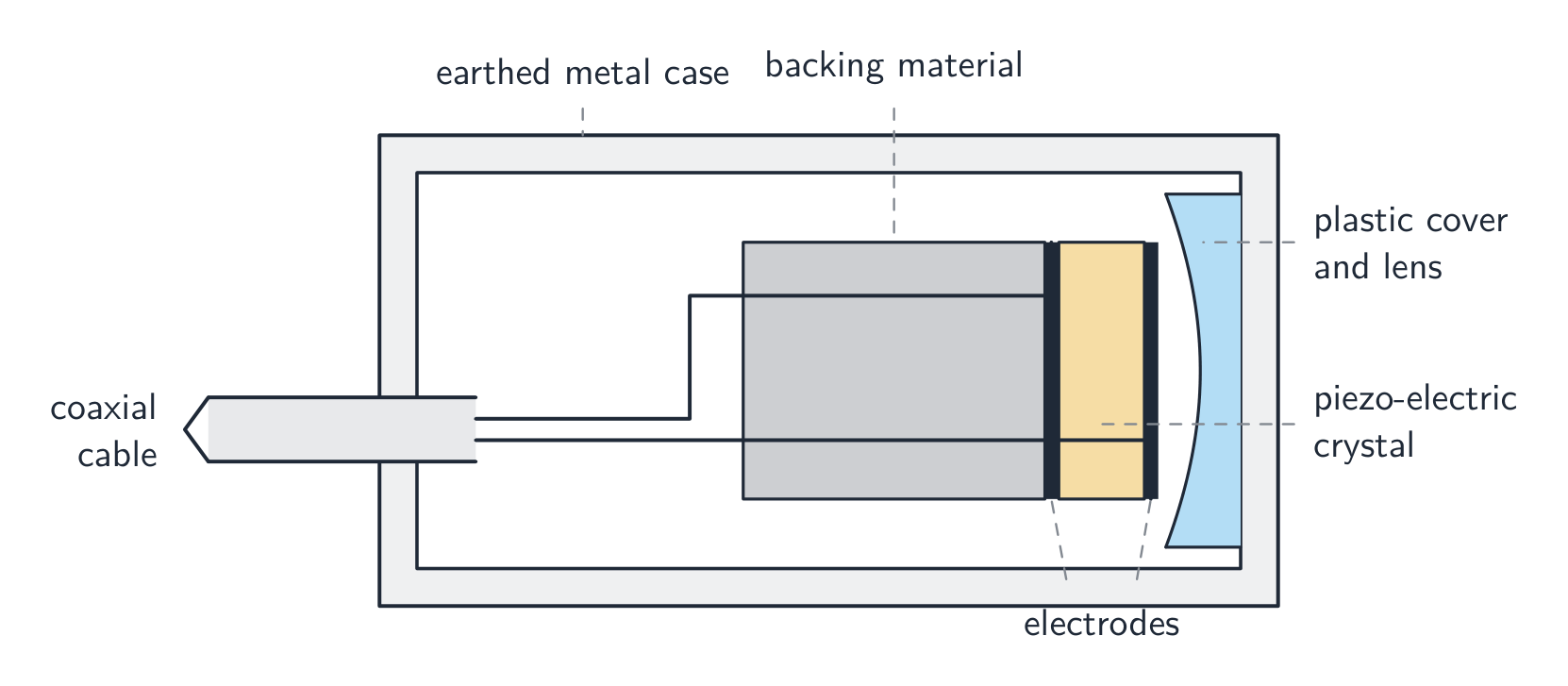
一块晶体,两份活
Put the generation of ultrasound by a transducer in order. · 按顺序排列探头产生超声的过程。
Detection is the reverse: the returning wave changes the crystal's shape, and a changing shape generates an e.m.f. · 检测过程相反:返回的波改变晶体的形状,而形状的变化产生电动势。
Pulse-echo imaging
- The four-mark outline runs: a pulse is sent in through coupling gel; at each boundary part reflects and returns; the time delay gives the depth; the intensity of the echo says what kind of boundary it was.
- Depth comes from the there-and-back trip:
- Sweeping the transducer, or using an array, builds a two-dimensional image.
- The factor of $2$ is the single commonest arithmetic slip in this topic.
One spike out, several back
脉冲回波成像
- 四分的概述是:通过耦合胶把一个脉冲送进体内;在每个界面处一部分被反射并返回;时间延迟给出深度;回波的强度说明那是什么样的界面。
- 深度来自一去一回的行程:
- 让换能器扫过身体,或使用阵列,就建立起二维图像。
- 那个 $2$ 是这个主题里最常见的算术失误。

出去一个尖峰,回来好几个
Worked example: how deep is the boundary
- A pulse returns $60\ \mu\text{s}$ after it was sent, and the speed of sound in the tissue is $1500\ \text{m/s}$. Find the depth of the reflecting boundary.
- $d = \dfrac{ct}{2} = \dfrac{1500 \times 60\times10^{-6}}{2} = 0.045\ \text{m} = 4.5\ \text{cm}$.
- Halve it, because the pulse travelled there and back. Forgetting to gives $9.0\ \text{cm}$, which is a whole answer wrong for a reason worth remembering.
例题:界面有多深
- 脉冲发出后 $60\ \mu\text{s}$ 返回,组织中的声速是 $1500\ \text{m/s}$。求反射界面的深度。
- $d = \dfrac{ct}{2} = \dfrac{1500 \times 60\times10^{-6}}{2} = 0.045\ \text{m} = 4.5\ \text{cm}$。
- 要除以二,因为脉冲走了一个来回。忘了除会得到 $9.0\ \text{cm}$,整个答案都错,而错的理由值得记住。
An echo returns after $2.0 \times 10^{-4}\ \text{s}$; the speed of sound is $1500\ \dfrac{\text{m}}{\text{s}}$. How deep is the boundary? · 回声在 $2.0 \times 10^{-4}\ \text{s}$ 后返回;声速为 $1500\ \dfrac{\text{m}}{\text{s}}$。边界有多深?
$d = \dfrac{ct}{2} = \dfrac{1500 \times 2.0 \times 10^{-4}}{2} = 0.15\ \text{m}$ (the pulse travels there and back). · $d = \dfrac{ct}{2} = \dfrac{1500 \times 2.0 \times 10^{-4}}{2} = 0.15\ \text{m}$(脉冲往返一次)。
An ultrasound pulse returns 60 microseconds after transmission, with a speed of sound of 1500 m/s. How deep is the boundary, in cm? · 超声脉冲在发射后 60 微秒返回,声速为 1500 m/s。边界深度是多少厘米?
d = ct/2 = 4.5 cm. Halve it: the pulse travelled there AND back. Forgetting the 2 gives 9.0 cm. · d = ct/2 = 4.5 cm。除以二:脉冲是去 AND 回。忘记除以 2 会得到 9.0 cm。
Why pulses, and why megahertz
- The transducer sends a short pulse and then listens. Every echo must arrive before the next pulse leaves, or echoes from different pulses could not be told apart, and the crystal cannot transmit and receive at the same moment.
- The frequency is a compromise. A higher frequency means a shorter wavelength and finer detail, better resolution 分辨率.
- But a higher frequency is also attenuated more strongly, so a deep organ needs a lower frequency than a shallow one.
- Medical scanning uses $1$ to $15\ \text{MHz}$, giving wavelengths of a fraction of a millimetre in tissue.
为什么用脉冲,为什么用兆赫
- 换能器发出一个短脉冲,然后倾听。每个回波都必须在下一个脉冲发出之前到达,否则不同脉冲的回波就分辨不开,而且晶体不能同时发射和接收。
- 频率是一种折中。频率越高波长越短、细节越精细,即分辨率(resolution)越好。
- 但频率越高衰减也越强,所以深部器官需要比浅部更低的频率。
- 医学扫描用 $1$ 到 $15\ \text{MHz}$,在组织中的波长是零点几毫米。
A higher ultrasound frequency has which effects? Select all · 所有 that apply. · 更高的超声频率会产生哪些影响?选择 所有 适用项。
Reflection is set by the impedance mismatch, not the frequency. The frequency choice is a resolution-against-penetration compromise, so a deep organ is scanned at a lower frequency. · 反射由阻抗失配决定,而非频率。频率的选择是分辨率与穿透力的折衷方案,因此扫描深层器官时使用较低的频率。
Specific acoustic impedance
- The specific acoustic impedance 声阻抗 of a medium is the product of its density and the speed of sound in it.
- Both quantities must be named for the two marks. "How hard sound finds it to pass" scores nothing.
- Density 密度 alone does not decide it: water and soft tissue have very different compositions and nearly the same $Z$, and it is $Z$, not density, that fixes how much reflects.
- For soft tissue: $Z = 1060 \times 1540 = 1.6\times10^{6}\ \text{kg/(m}^2\text{ s)}$.
声阻抗
- 介质的声阻抗(specific acoustic impedance)是它的密度与其中声速的乘积。
- 两个量都要说出来才能拿两分。"声音在其中通过的难易程度"得零分。
- 单靠密度(density)决定不了它:水和软组织成分差别很大而 $Z$ 几乎相同,而决定反射多少的是 $Z$,不是密度。
- 对软组织:$Z = 1060 \times 1540 = 1.6\times10^{6}\ \text{kg/(m}^2\text{ s)}$。
Acoustic impedance Z = density × ____. · 声阻抗 Z = 密度 × ____。
$Z = \rho c$ — density times the speed of sound in the medium. · $Z = \rho c$ — 介质中的密度乘以声速。
Match each boundary to what happens to the pulse. · 将每个边界与其对脉冲的影响相匹配。
Imaging needs the middle case. The gel exists to convert the first case into the third at the skin. · 成像需要中间情况。耦合凝胶的作用是将第一种情况转化为皮肤表面的第三种情况。
How much reflects at a boundary
- At a boundary between impedances $Z_1$ and $Z_2$, the intensity reflection coefficient 强度反射系数 is
- Very different impedances reflect almost everything, which is the skin-air problem.
- Very similar impedances reflect almost nothing, so the boundary is invisible.
- The useful case for imaging is in between: different enough to give an echo, similar enough that the pulse carries on to the next boundary.
The mismatch is the echo
界面处反射多少
- 在阻抗为 $Z_1$ 与 $Z_2$ 的两种介质的界面上,强度反射系数(intensity reflection coefficient)是
- 阻抗差别很大几乎全反射,这就是皮肤与空气之间的麻烦。
- 阻抗很接近几乎不反射,于是那个界面看不见。
- 成像有用的情形在两者之间:差得足以有回波,又近得让脉冲能继续走到下一个界面。

失配之处就是回波
Ultrasound scan route · 超声扫描流程
Follow a pulse from transducer to echo image. · 追踪脉冲从探头到回声图像的过程。
Two media with very similar acoustic impedance give almost no echo. · 两种声阻抗非常相似的介质产生的回声极少。
The reflected fraction depends on the impedance difference; similar impedances reflect very little, so the boundary is hard to see. · 反射比例取决于阻抗差;阻抗相似时反射极少,因此边界难以看清。
Worked example: why the gel is not optional
- Air has $\rho = 1.29\ \text{kg/m}^3$ and $c = 343\ \text{m/s}$. Gel has $Z = 1.50\times10^{6}$ and soft tissue $Z = 1.63\times10^{6}\ \text{kg/(m}^2\text{ s)}$. Compare the reflection at an air-tissue and a gel-tissue boundary.
- $Z_{\text{air}} = 1.29 \times 343 = 442\ \text{kg/(m}^2\text{ s)}$, which is smaller than tissue's by a factor of nearly $4000$.
- Air-tissue: $\left(\dfrac{442 - 1.63\times10^{6}}{442 + 1.63\times10^{6}}\right)^2 = 0.9989$, so $99.9\%$ reflects and only $0.1\%$ enters the body.
- Gel-tissue: $\left(\dfrac{1.50 - 1.63}{1.50 + 1.63}\right)^2 = 0.0017$, so only $0.2\%$ reflects.
- The gel replaces the air with something whose impedance nearly matches skin, so almost the whole pulse gets in, and the echoes get back out the same way.
例题:那层胶不是可有可无
- 空气 $\rho = 1.29\ \text{kg/m}^3$、$c = 343\ \text{m/s}$。胶的 $Z = 1.50\times10^{6}$,软组织 $Z = 1.63\times10^{6}\ \text{kg/(m}^2\text{ s)}$。比较空气-组织界面与胶-组织界面的反射。
- $Z_{\text{air}} = 1.29 \times 343 = 442\ \text{kg/(m}^2\text{ s)}$,比组织小了近 $4000$ 倍。
- 空气-组织:$\left(\dfrac{442 - 1.63\times10^{6}}{442 + 1.63\times10^{6}}\right)^2 = 0.9989$,即 $99.9\%$ 被反射,只有 $0.1\%$ 进入体内。
- 胶-组织:$\left(\dfrac{1.50 - 1.63}{1.50 + 1.63}\right)^2 = 0.0017$,只有 $0.2\%$ 被反射。
- 胶用一种阻抗与皮肤几乎匹配的东西取代了空气,于是几乎整个脉冲都能进去,回波也能沿同样的路出来。
The coupling gel between the probe and the skin: · 探头与皮肤之间的耦合凝胶:
Without it, the huge skin–air impedance difference would reflect almost all the ultrasound at the surface. · 如果没有它,巨大的皮肤-空气阻抗差会在表面反射几乎所有超声。
Gel has Z = 1.50e6 and soft tissue Z = 1.63e6 kg/(m^2 s). What percentage of the intensity reflects at the gel-tissue boundary? · 凝胶的 Z = 1.50e6,软组织的 Z = 1.63e6 kg/(m^2 s)。在凝胶-组织边界处有多少百分比的强度被反射?
((1.50-1.63)/(1.50+1.63))^2 = 0.0017, that is 0.17%. At an air-tissue boundary the same formula gives 99.9%, which is why the gel is not optional. · ((1.50-1.63)/(1.50+1.63))^2 = 0.0017,即 0.17%。在空气-组织边界处,同一公式给出 99.9%,这就是为什么凝胶不是可选的。
Attenuation
- Ultrasound weakens as it travels, by the same exponential law that governs X-rays and radioactive decay:
- $\mu$ is the attenuation coefficient of the medium, and a higher frequency has a larger $\mu$, which is the trade-off behind the choice of frequency.
- To find a thickness, take logs: $x = \dfrac{1}{\mu}\ln\dfrac{I_0}{I}$.
- Watch the units: $\mu$ in $\text{cm}^{-1}$ needs $x$ in cm. Mixing them is the standard error and gives an answer wrong by a factor of $100$ in the exponent.
衰减
- 超声在传播中变弱,遵循的正是支配 X 射线和放射性衰变的那条指数律:
- $\mu$ 是介质的衰减系数,而频率越高 $\mu$ 越大,这就是选择频率时那个权衡的由来。
- 求厚度就取对数:$x = \dfrac{1}{\mu}\ln\dfrac{I_0}{I}$。
- 注意单位:$\mu$ 用 $\text{cm}^{-1}$ 时 $x$ 就得用 cm。混用是常见错误,会让指数里差 $100$ 倍。
Marks that slip away
- Halve the distance in the pulse-echo calculation. The pulse goes there and back.
- $Z = \rho c$ needs both density and speed named in the definition.
- The reflection formula uses the difference over the sum, squared. Forgetting to square it changes the answer completely.
- The gel matches impedances, it does not "help the sound travel". Say what it replaces and why.
- Higher frequency gives better resolution but more attenuation. A question about a deep organ is asking for that trade-off.
容易丢掉的分
- 脉冲回波的计算要把距离除以二。脉冲走的是来回。
- $Z = \rho c$ 的定义里密度和声速两者都要说出来。
- 反射公式用的是差比和,再平方。忘了平方,答案就完全变了。
- 胶是用来匹配阻抗的,不是"帮助声音传播"。要说出它取代了什么、为什么。
- 频率越高分辨率越好但衰减越大。问深部器官的题,考的就是这个权衡。
You've got it
- a piezo-electric crystal changes shape under a p.d. and generates an e.m.f. when its shape changes, so one transducer both sends and detects
- pulse-echo imaging gives depth from $d = ct/2$ and tissue type from the echo's intensity
- specific acoustic impedance is $Z = \rho c$, and $I_R/I_0 = \left(\frac{Z_1-Z_2}{Z_1+Z_2}\right)^2$, which is why an air gap reflects $99.9\%$ and the gel is essential
- ultrasound is attenuated as $I = I_0 e^{-\mu x}$, and a higher frequency trades better resolution for worse penetration
你掌握了
- 压电晶体在电压下改变形状、在形状改变时产生电动势,所以一个换能器既发射又探测
- 脉冲回波成像由 $d = ct/2$ 给出深度,由回波强度给出组织类型
- 声阻抗是 $Z = \rho c$,而 $I_R/I_0 = \left(\frac{Z_1-Z_2}{Z_1+Z_2}\right)^2$,这就是一层空气会反射 $99.9\%$、而胶必不可少的原因
- 超声按 $I = I_0 e^{-\mu x}$ 衰减,频率越高是拿更差的穿透换更好的分辨率