Radioactive decay · 放射性衰变
| English | 中文 | Pinyin · 拼音 |
|---|---|---|
| random/ˈrændəm/ | 随机 | suí jī |
| spontaneous/spɒnˈteɪnɪəs/ | 自发 | zì fā |
| count rate/kaʊnt reɪt/ | 计数率 | jì shù lǜ |
| activity/ækˈtɪvɪti/ | 活度 | huó dù |
| decay constant/dɪˈkeɪ ˈkɒnstənt/ | 衰变常数 | shuāi biàn cháng shù |
| radionuclide/ˌreɪdiəʊˈnjuːklaɪd/ | 放射性核素 | fàng shè xìng hé sù |
| becquerel/ˈbekwərəl/ | 贝克勒尔 | bèi kè lēi ěr |
| half-life/hɑːf laɪf/ | 半衰期 | bàn shuāi qī |
| exponential decay/ˌekspəˈnenʃl dɪˈkeɪ/ | 指数衰减 | zhǐ shù shuāi jiǎn |
Clicks that never come evenly
- Put a Geiger counter beside a long-lived source and listen. The clicks come in bursts and gaps, never in a steady rhythm.
- Count for ten seconds, again and again, and no two counts match. Yet the long-run average is perfectly steady.
- That fluctuation is not sloppy apparatus. It is the evidence that decay is random 随机.
- This lesson is what "random and spontaneous" means precisely, and the exponential law that follows from it.
永远不会均匀到来的咔嗒声
- 把盖革计数器放在一个长寿命源旁边听。咔嗒声一阵一阵、时断时续,从来不成稳定的节拍。
- 数十秒钟,一遍又一遍地数,没有两次的计数是一样的。可是长期的平均值稳得很。
- 那种起伏不是仪器马虎。它就是衰变随机(random)的证据。
- 这一课讲"随机而自发"到底精确地指什么,以及由它推出的指数律。
Random and spontaneous
- Spontaneous 自发 means the decay happens with no outside trigger, and the rate is unaffected by temperature, pressure or chemical state.
- Random means it is impossible to predict which nucleus will decay next, or when a given nucleus will decay. Only a probability can be given.
- The evidence for randomness is the fluctuating count rate: counts in equal intervals from the same source are never the same twice, even when the activity is not changing.
- Naming the two words is not the answer. The marks are on not affected by external factors and cannot predict which or when.
A steady average made of unsteady counts
随机与自发
- 自发(spontaneous)是指衰变没有外来触发,而且其速率不受温度、压强或化学状态影响。
- 随机是指无法预测哪一个核会下一个衰变,也无法预测某个核何时衰变。只能给出概率。
- 随机性的证据是起伏的计数率:同一个源在等长时间间隔内的计数没有两次相同,哪怕活度并没有变化。
- 把这两个词说出来不算答案。分在不受外界因素影响和无法预测是哪一个、在何时上。
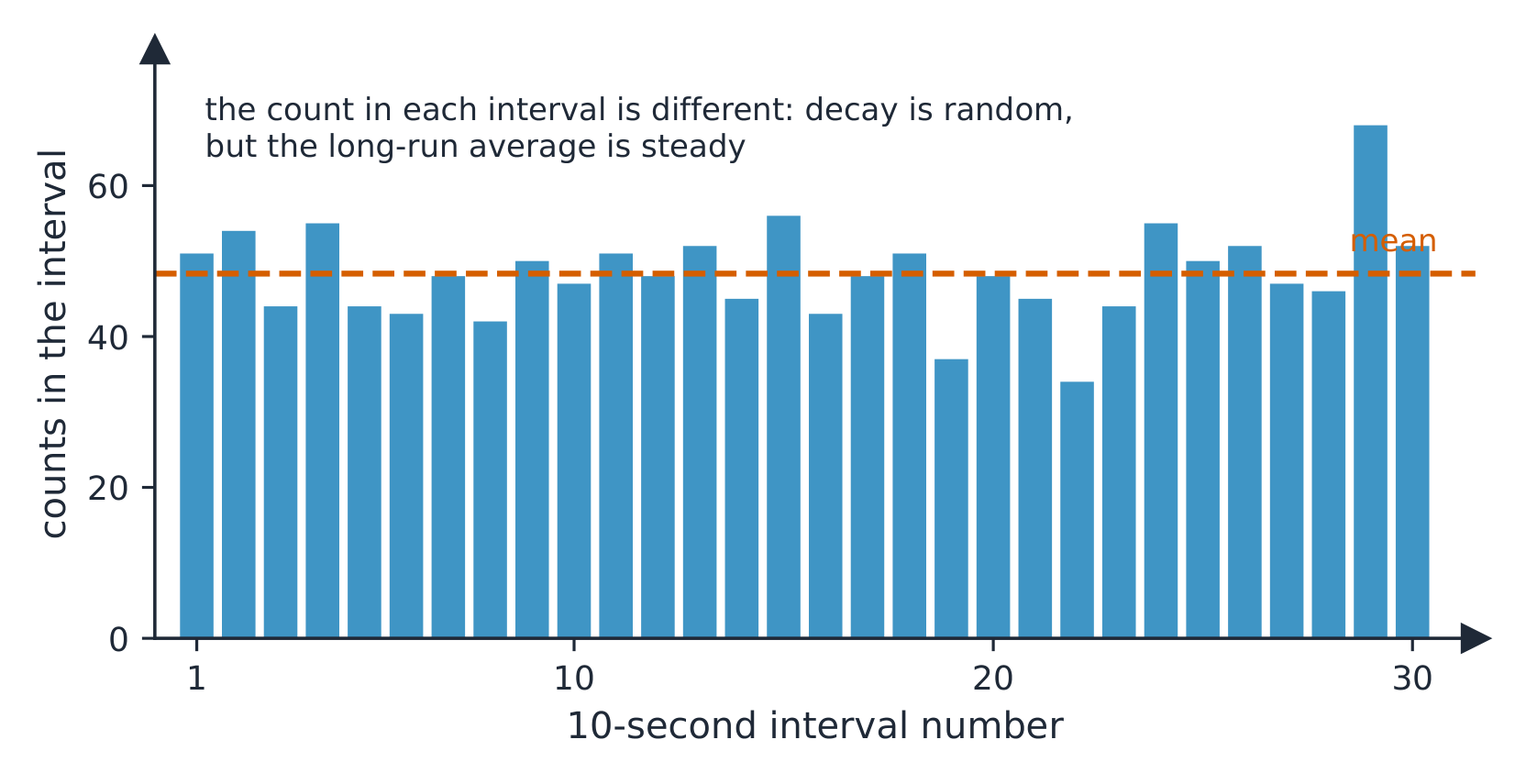
由不稳的计数构成的稳定平均
Select all · 所有 the true statements about radioactive decay. · 选出所有关于放射性衰变的正确说法。
It is spontaneous and random, and the rate does not depend on conditions. You can only give the probability of a single decay. · 它是自发且随机的,速率不取决于条件。你只能给出单次衰变的概率。
What is the evidence that radioactive decay is random? · 放射性衰变是随机的,证据是什么?
A falling activity shows decay happens; a constant half-life shows the probability is fixed; heating shows it is SPONTANEOUS. Only the fluctuation shows randomness. · 活度下降说明有衰变;半衰期恒定说明概率固定;加热无效说明它是自发的。只有起伏说明随机性。
Activity and the decay constant
- For $N$ undecayed nuclei of a radionuclide 放射性核素:
- Activity 活度 is the number of decays per unit time, measured in becquerel 贝克勒尔 (Bq), where $1\ \text{Bq} = 1$ decay per second.
- The decay constant 衰变常数 is the probability per unit time that a nucleus will decay, also in $\text{s}^{-1}$.
- They share a unit but they are not the same idea: $A$ counts events, $\lambda$ is a probability. Calling $\lambda$ "the rate of decay" is the standard lost mark.
活度与衰变常数
- 对某放射性核素(radionuclide)的 $N$ 个未衰变的核:
- 活度(activity)是单位时间内衰变的次数,单位是贝克勒尔(becquerel,Bq),$1\ \text{Bq} =$ 每秒一次衰变。
- 衰变常数(decay constant)是一个核在单位时间内衰变的概率,单位同样是 $\text{s}^{-1}$。
- 它们单位相同却不是同一个概念:$A$ 数的是事件,$\lambda$ 是概率。把 $\lambda$ 叫作"衰变的速率"是标准的丢分点。
The activity of a radioactive source is: · 一个放射源的活度是:
Activity = decay constant × number of undecayed nuclei, measured in becquerel. · 活度 = 衰变常数 × 未衰变核的数目,单位是贝克勒尔。
Match each quantity to its definition. · 把每个量与它的定义配对。
Activity and the decay constant share the unit s^-1 but are different quantities. Calling the decay constant "the rate of decay" is the standard lost mark. · 活度和衰变常数共用单位 s^-1,但它们是不同的量。把衰变常数叫作"衰变的速率"是标准丢分点。
Worked example: a tiny mass, a huge activity
- Fluorine-18 has a half-life of $110$ minutes. Show that $\lambda = 1.05\times10^{-4}\ \text{s}^{-1}$, and find the activity of $2.1\times10^{-12}\ \text{kg}$ of it.
- $\lambda = \dfrac{0.693}{110\times60} = 1.05\times10^{-4}\ \text{s}^{-1}$. Convert the half-life to seconds first, or $\lambda$ comes out per minute.
- Number of nuclei: $N = \dfrac{2.1\times10^{-12}}{18\times1.661\times10^{-27}} = 7.0\times10^{13}$.
- $A = \lambda N = (1.05\times10^{-4})(7.0\times10^{13}) = 7.4\times10^{9}\ \text{Bq}$.
- A picogram gives billions of decays a second because the half-life is short. The same mass of uranium-238, half-life $4.5\times10^{9}$ years, gives about $10^{-5}\ \text{Bq}$.
例题:极小的质量,极大的活度
- 氟-18 的半衰期是 $110$ 分钟。证明 $\lambda = 1.05\times10^{-4}\ \text{s}^{-1}$,并求 $2.1\times10^{-12}\ \text{kg}$ 氟-18 的活度。
- $\lambda = \dfrac{0.693}{110\times60} = 1.05\times10^{-4}\ \text{s}^{-1}$。先把半衰期换成秒,否则 $\lambda$ 会是"每分钟"的。
- 核的个数:$N = \dfrac{2.1\times10^{-12}}{18\times1.661\times10^{-27}} = 7.0\times10^{13}$。
- $A = \lambda N = (1.05\times10^{-4})(7.0\times10^{13}) = 7.4\times10^{9}\ \text{Bq}$。
- 一皮克就给出每秒几十亿次衰变,因为半衰期很短。同样质量的铀-238(半衰期 $4.5\times10^{9}$ 年)只给出约 $10^{-5}\ \text{Bq}$。
A source has $\lambda = 0.010$ per second and $1.0 \times 10^{6}$ undecayed nuclei. What is its activity? · 一个源的 $\lambda = 0.010$ 每秒,有 $1.0 \times 10^{6}$ 个未衰变的核。它的活度是多少?
$A = \lambda N = 0.010 \times 1.0 \times 10^{6} = 1.0 \times 10^{4}\ \text{Bq}$. · $A = \lambda N = 0.010 \times 1.0 \times 10^{6} = 1.0 \times 10^{4}\ \text{Bq}$。
Why the decay is exponential
- Since $\lambda$ is the fractional decay rate, $\dfrac{dN}{dt} = -\lambda N$, and the solution is an exponential decay 指数衰减:
- Any count rate 计数率 proportional to the activity follows the same law, which is why the equation is usually quoted as $x = x_0 e^{-\lambda t}$.
- The three-mark explanation: (1) $\lambda$ is the probability per unit time and is the same for every nucleus whatever its age; (2) so the rate of decay is proportional to the number of undecayed nuclei, $A = \lambda N$; (3) a rate of change proportional to the quantity itself gives an exponential, meaning the same fraction decays in each equal interval.
- So the number never quite reaches zero. It only halves, again and again.
衰变为什么是指数的
- 由于 $\lambda$ 是按比例的衰变率,$\dfrac{dN}{dt} = -\lambda N$,其解是指数衰减(exponential decay):
- 任何与活度成正比的计数率(count rate)都遵循同一条律,所以这个方程通常写成 $x = x_0 e^{-\lambda t}$。
- 三分的解释:(1)$\lambda$ 是单位时间的概率,而且对该核素的每一个核都相同,与它的"年龄"无关;(2)所以衰变的速率正比于未衰变核的数目,$A = \lambda N$;(3)变化率正比于量本身就给出指数,也就是说每个等长间隔内衰变掉同样的比例。
- 所以数目永远到不了零。它只是一次又一次地减半。
Decay equations (α, β, γ) · 衰变方程(α、β、γ)
Choose a decay type; the daughter nuclide is fixed so the nucleon number A and the proton number Z both balance. · 选择一种衰变类型;子核的设定使核子数 A 和质子数 Z 都平衡。
Half-life — watch the nuclei decay · 半衰期——观察原子核衰变
Each nucleus has a fixed chance of decaying, at random. Move time forward: about half the remaining nuclei decay every half-life — so the count halves, then halves again. · 每个原子核有一个固定的随机衰变机会。把时间向前移动:每个半衰期约一半剩余的原子核衰变——所以计数减半,然后再减半。
The activity of a radioactive source decays exponentially with time. · 一个放射源的活度随时间指数衰减。
The same fraction decays each second, giving $A = A_0 e^{-\lambda t}$. · 每秒衰变相同的比例,给出 $A = A_0 e^{-\lambda t}$。
Put the three-mark explanation of why decay is exponential in order. · 把衰变为什么是指数的三分解释按顺序排列。
Each of the first three is a mark. Writing only the formula N = N0 e^(-lambda t) answers none of them. · 前三条各是一分。只写公式 N = N0 e^(-lambda t) 一条也答不到。
Half-life
- The half-life 半衰期 $t_{1/2}$ is the time for the number of undecayed nuclei, or the activity, or the count rate, to fall to half.
- Put $N = N_0/2$ into the exponential law and the $N_0$ cancels:
- Because $N_0$ cancels, the half-life does not depend on how much you started with. A gram and a tonne of the same nuclide halve in the same time.
半衰期
- 半衰期(half-life)$t_{1/2}$ 是未衰变核的数目、或活度、或计数率降到一半所需的时间。
- 把 $N = N_0/2$ 代入指数律,$N_0$ 约掉:
- 正因为 $N_0$ 约掉了,半衰期不取决于你一开始有多少。同一种核素,一克和一吨减半所需的时间一样。
The half-life is related to the decay constant by: · 半衰期与衰变常数的关系是:
Setting $N = \tfrac{1}{2}N_0$ in · 入 $N = N_0 e^{-\lambda t}$ gives $\lambda t_{1/2} = \ln 2$. · 在 $N = N_0 e^{-\lambda t}$ 中令 $N = \tfrac{1}{2}N_0$,得到 $\lambda t_{1/2} = \ln 2$。
The half-life of a nuclide is unaffected by which of these? Select all · 所有 that apply. · 核素的半衰期不受下列哪些影响?选出所有适用的。
N0 cancels in the half-life derivation, so the amount is irrelevant, and spontaneity rules out external conditions. The nuclide itself is the ONLY thing that sets it. · 推导半衰期时 N0 约掉了,所以量无关紧要,而自发性排除了外界条件。核素本身是唯一决定它的因素。
Worked example: reading a decay backwards
- A source's activity falls from $8.0\times10^{5}\ \text{Bq}$ to $1.0\times10^{5}\ \text{Bq}$ in $24$ minutes. Find the half-life and the decay constant.
- The activity has fallen to $\tfrac{1}{8}$, and $\tfrac{1}{8} = (\tfrac{1}{2})^3$, so three half-lives have passed: $t_{1/2} = 24/3 = 8.0$ minutes.
- $\lambda = \dfrac{0.693}{8.0\times60} = 1.4\times10^{-3}\ \text{s}^{-1}$.
- When the ratio is a neat power of $\tfrac{1}{2}$, count half-lives. Otherwise take logs: $\lambda t = \ln(A_0/A)$.
- Always convert the half-life to seconds before quoting $\lambda$ in $\text{s}^{-1}$.
例题:把衰变倒着读
- 某源的活度在 $24$ 分钟内从 $8.0\times10^{5}\ \text{Bq}$ 降到 $1.0\times10^{5}\ \text{Bq}$。求半衰期和衰变常数。
- 活度降到了 $\tfrac{1}{8}$,而 $\tfrac{1}{8} = (\tfrac{1}{2})^3$,所以过去了三个半衰期:$t_{1/2} = 24/3 = 8.0$ 分钟。
- $\lambda = \dfrac{0.693}{8.0\times60} = 1.4\times10^{-3}\ \text{s}^{-1}$。
- 当比值恰好是 $\tfrac{1}{2}$ 的整数次幂时,就数半衰期。否则取对数:$\lambda t = \ln(A_0/A)$。
- 要以 $\text{s}^{-1}$ 给出 $\lambda$,务必先把半衰期换成秒。
What fraction of the nuclei remain after 3 half-lives? · 经过 3 个半衰期后,剩下的核占多少比例?
Each half-life halves the number: $\left(\tfrac{1}{2}\right)^{3} = \tfrac{1}{8} = 0.125$. · 每个半衰期使数目减半:$\left(\tfrac{1}{2}\right)^{3} = \tfrac{1}{8} = 0.125$。
A source's activity falls from 8.0e5 Bq to 1.0e5 Bq in 24 minutes. What is its half-life, in minutes? · 某源的活度在 24 分钟内从 8.0e5 Bq 降到 1.0e5 Bq。它的半衰期是多少分钟?
The activity is one eighth, and 1/8 = (1/2)^3, so three half-lives fit in 24 minutes. When the ratio is not a neat power of a half, take logs instead: lambda t = ln(A0/A). · 活度是八分之一,而 1/8 = (1/2)^3,所以 24 分钟里装下三个半衰期。当比值不是二分之一的整数次幂时,改用对数:lambda t = ln(A0/A)。
Before using a measured count rate in a decay calculation, subtract the ____ count. · 在衰变计算中使用测得的计数率之前,要减去____计数。
The background is quoted in the question precisely so that you subtract it. Forgetting to makes every derived half-life too long. · 题目把本底给出来,正是要你减掉它。忘了减会让算出的每一个半衰期都偏长。
Marks that slip away
- Activity is decays per unit time. The decay constant is a probability per unit time. Same unit, different quantity.
- The evidence for randomness is the fluctuating count rate, not the fact that the activity falls.
- Convert the half-life to seconds before using $\lambda = 0.693/t_{1/2}$.
- Half-life is independent of the amount of substance, and of temperature, pressure and chemical state.
- $x_0$ in $x = x_0 e^{-\lambda t}$ is the value at $t = 0$, not the value at the start of the observation, unless the clock is set there.
- Subtract the background count before using a measured count rate. It is quoted in the question precisely so you will.
容易丢掉的分
- 活度是单位时间的衰变次数。衰变常数是单位时间的概率。单位相同,量不同。
- 随机性的证据是起伏的计数率,不是活度会下降这件事。
- 用 $\lambda = 0.693/t_{1/2}$ 之前把半衰期换成秒。
- 半衰期与物质的量无关,也与温度、压强和化学状态无关。
- $x = x_0 e^{-\lambda t}$ 中的 $x_0$ 是 $t = 0$ 时的值,而不是观测开始时的值,除非计时就从那里起算。
- 用测得的计数率之前先减去本底计数。题目把它给出来,正是要你减。
You've got it
- decay is spontaneous (unaffected by external factors) and random (which nucleus and when are unpredictable), evidenced by a fluctuating count rate
- activity is decays per unit time in becquerel, the decay constant is the probability of decay per unit time, and $A = \lambda N$
- decay is exponential because a fixed probability per nucleus makes the rate proportional to the number left: $x = x_0 e^{-\lambda t}$
- the half-life is the time to fall to half, is independent of the starting amount, and $\lambda = 0.693/t_{1/2}$
你掌握了
- 衰变是自发的(不受外界因素影响)且随机的(哪一个核、何时衰变都不可预测),证据是起伏的计数率
- 活度是单位时间的衰变次数,单位贝克勒尔;衰变常数是单位时间的衰变概率,且 $A = \lambda N$
- 衰变是指数的,因为每个核有固定的概率,使速率正比于剩下的数目:$x = x_0 e^{-\lambda t}$
- 半衰期是降到一半所需的时间,与起始的量无关,且 $\lambda = 0.693/t_{1/2}$