| English | 释义 | 拼音 |
|---|---|---|
| centripetal force/senˈtrɪpɪtl fɔːs/ | 向心力 | xiàng xīn lì |
| velocity selector/vəˈlɒsɪti sɪˈlektə/ | 速度选择器 | sù dù xuǎn zé qì |
| Hall voltage/hɔːl ˈvəʊltɪdʒ/ | 霍尔电压 | huò ěr diàn yā |
| Hall probe/hɔːl prəʊb/ | 霍尔探头 | huò ěr tàn tóu |
一个永远无法让东西加速的力
- 作用在运动电荷上的磁力总是垂直于速度。总是如此,没有例外。
- 垂直于运动的力不做功,所以它无法改变粒子的速率。它只能改变方向。
- 一个大小不变、永远只让你转弯的力,正是画圆的配方,而这就是每台粒子加速器都是圆形的原因。
- 这一课讲 $F = BQv\sin\theta$、它产生的圆周运动,以及基于它的两种仪器。
运动电荷所受的力
- $\theta$ 是速度与磁场之间的夹角。力在垂直时最大,当电荷沿着磁场运动时为零。
- 方向由弗莱明左手定则给出,中指沿正电荷的运动方向。对电子这样的负电荷,力的方向相反。
- 静止的电荷完全不受力:$v = 0$ 使 $F = 0$。
A $2.0\ \text{C}$ charge moves at $3.0\ \dfrac{\text{m}}{\text{s}}$ at right angles to a $0.50\ \text{T}$ field. What is the force?
难度 2/5 · 今日首次完成可获 140 金币及少量额外奖励
$F = BQv = 0.50 \times 2.0 \times 3.0 = 3.0\ \text{N}$.
For motion at right angles, the magnetic force on a moving charge is $F = BQ$____.
难度 1/5 · 今日首次完成可获 100 金币及少量额外奖励
$F = BQv$ — proportional to the charge's speed.
路径为什么是圆
- 力始终垂直于 $v$,所以它不做功,而速率恒定。变的只有方向。
- 一个大小不变、始终垂直于运动的力就是向心力(centripetal force),所以路径是一个圆:
- 半径与动量成正比,与电荷和磁场成反比。场越强,路径弯得越紧。
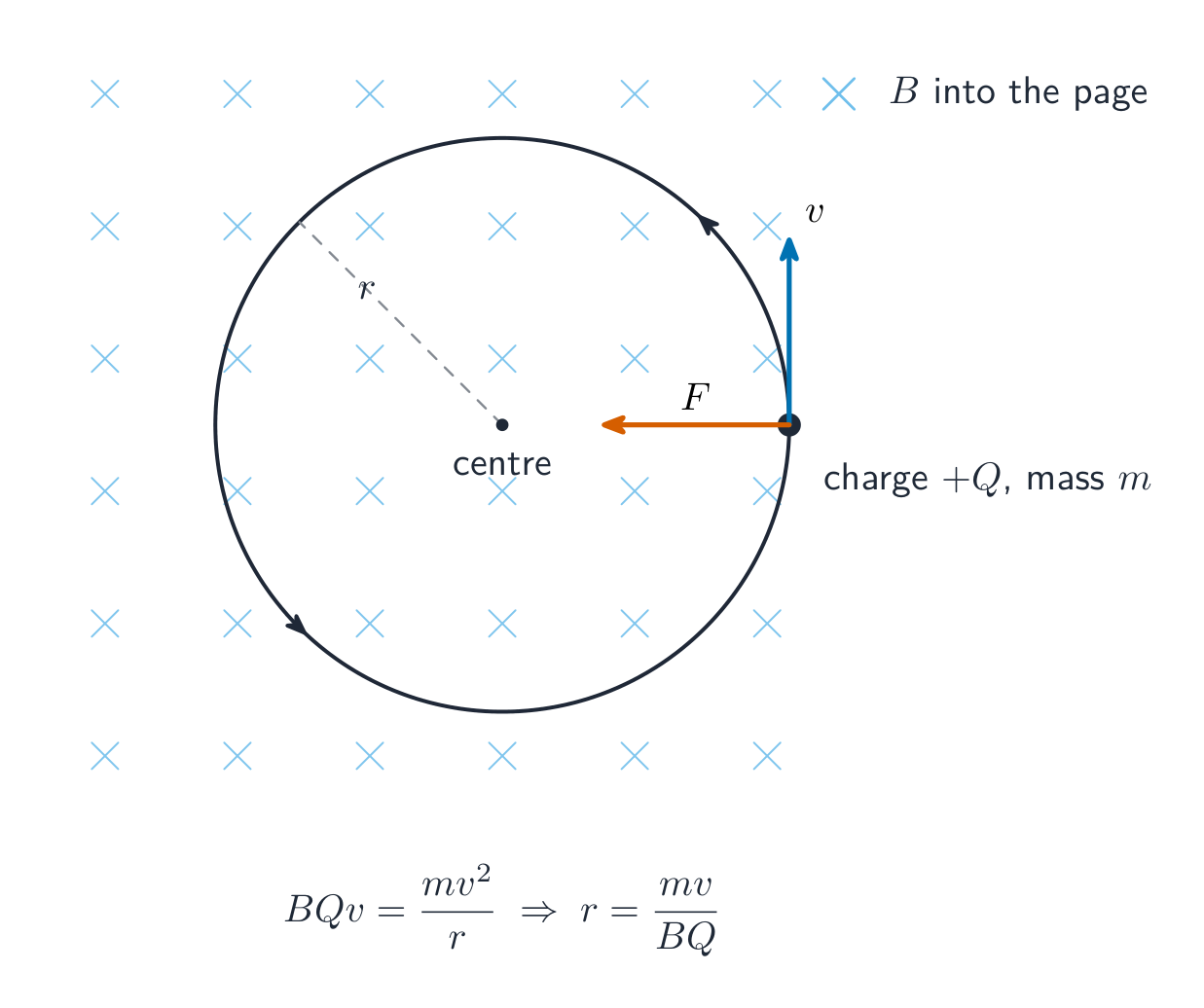
这个力扭转速度,却从不给它增添
运动电荷受力
F = BQv
电荷受到的磁力与其速度成正比(对于固定的场和电荷)。
The magnetic force does no work on a charge moving in a circle.
难度 1/5 · 今日首次完成可获 100 金币及少量额外奖励
The force is always perpendicular to the velocity, so it changes direction but not speed — no work done.
The radius of a charge's circular path in a magnetic field is:
难度 1/5 · 今日首次完成可获 100 金币及少量额外奖励
Setting $BQv = \dfrac{mv^{2}}{r}$ gives $r = \dfrac{mv}{BQ}$ — bigger momentum, bigger circle.
周期与速率无关
- 把 $v = 2\pi r/T$ 代入 $r = mv/(BQ)$,得到:
- 速率被约掉了。更快的粒子走更大的圆,用的时间恰好相同。
- 这个出人意料的事实让回旋加速器成为可能:一个固定的加速频率对该粒子全程有效,不管它变得多快。
The time for one circular orbit does not depend on the speed.
难度 1/5 · 今日首次完成可获 100 金币及少量额外奖励
$T = \dfrac{2\pi m}{BQ}$ — a faster particle just goes round a bigger circle in the same time.
A charged particle moves in a circle in a magnetic field. Which quantities stay constant? Select 所有 that apply.
难度 2/5 · 今日首次完成可获 140 金币及少量额外奖励
The force does no work, so speed and kinetic energy cannot change; only the direction does, which is what makes the path circular.
例题:弯折电子束
- 一个速率 $2.0 \times 10^7\ \text{m/s}$ 的电子垂直进入 $1.5\ \text{mT}$ 的磁场。求它路径的半径。($m_{\text{e}} = 9.11 \times 10^{-31}\ \text{kg}$,$e = 1.60 \times 10^{-19}\ \text{C}$。)
- *如果速率加倍呢?*半径加倍,但周期不变,因为 $T = 2\pi m/(BQ)$ 里没有 $v$。
- *那动能呢?*不受磁力影响,因为它不做功。只有电场才能改变速率。
An electron at $2.0 \times 10^{7}\ \dfrac{\text{m}}{\text{s}}$ enters a $1.5\ \text{mT}$ field at right angles. What is the radius of its path, in metres? ($m = 9.11 \times 10^{-31}\ \text{kg}$, $e = 1.60 \times 10^{-19}\ \text{C}$)
难度 2/5 · 今日首次完成可获 140 金币及少量额外奖励
$r = \dfrac{mv}{BQ} = \dfrac{9.11 \times 10^{-31} \times 2.0 \times 10^{7}}{1.5 \times 10^{-3} \times 1.60 \times 10^{-19}} = 0.076\ \text{m}$. Doubling the speed doubles $r$ but leaves the period unchanged.
速度选择器
- 让电场与磁场交叉,使它们对运动电荷的作用力方向相反。
- 电场力 $QE$ 与速率无关;磁力 $BQv$ 与速率有关。所以它们恰好对一个速率平衡:
- 具有这个速率的粒子径直穿过狭缝。更快的被推向一边,更慢的被推向另一边,不论它们的电荷或质量如何。这就是速度选择器(velocity selector)。
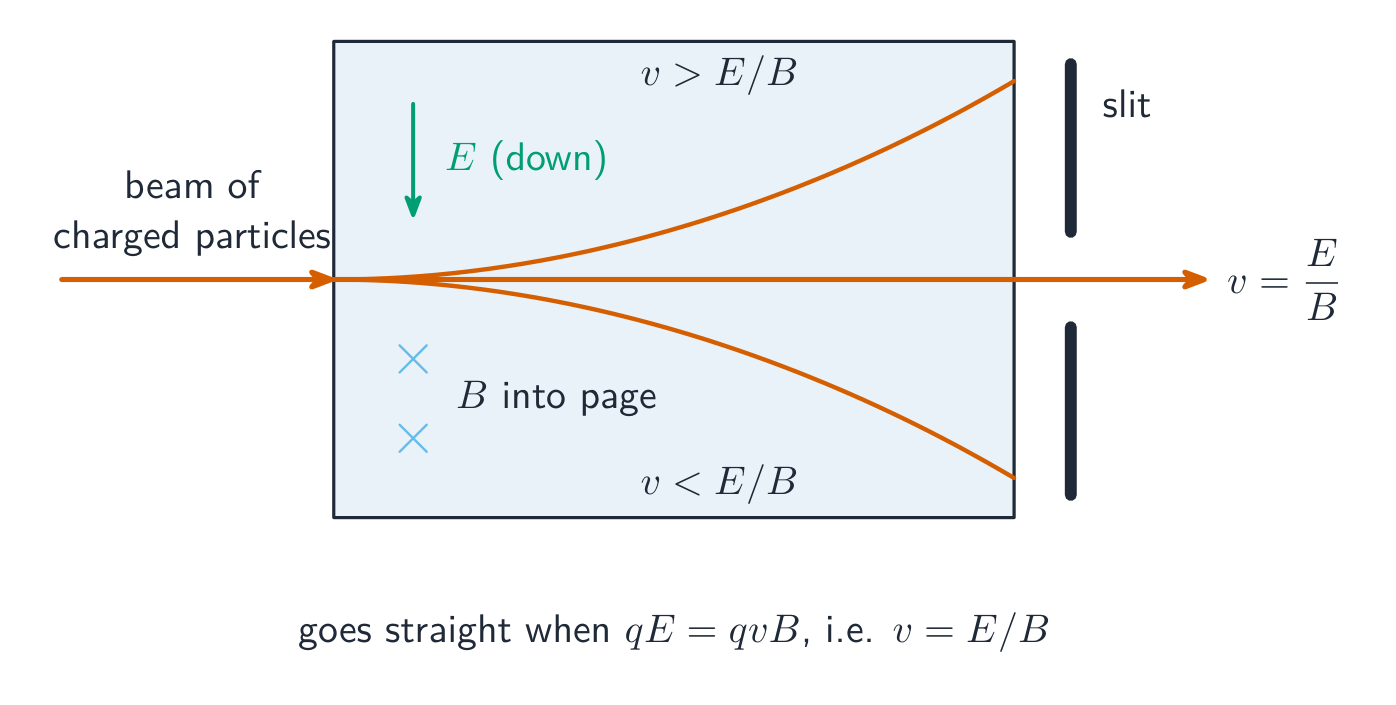
一个速率直着走;其余的都被偏折
A velocity selector (crossed E and B fields) lets through only particles with speed:
难度 1/5 · 今日首次完成可获 100 金币及少量额外奖励
The forces balance ($qE = qvB$) only at $v = \dfrac{E}{B}$; others are deflected.
In a velocity selector the electric and magnetic forces balance for particles of speed v = ____.
难度 1/5 · 今日首次完成可获 100 金币及少量额外奖励
QE = BQv, and the charge cancels, so only one speed passes straight through whatever the particle's charge or mass.
霍尔效应
- 让电流通过垂直磁场中的一块扁平薄片。磁力把运动电荷推向一个面,电荷堆积直到它产生的电场恰好平衡磁力。
- 薄片两面之间稳定的电压就是霍尔电压(Hall effect):
- 对给定的薄片,除 $B$ 之外一切都固定,所以 $V_{\text{H}} \propto B$,这就是霍尔探头(Hall probe)测量磁场的方式。
Why can a Hall probe be used to measure magnetic flux density?
难度 1/5 · 今日首次完成可获 100 金币及少量额外奖励
Charges are pushed to one face until the electric field they build up balances the magnetic force, leaving a steady p.d. proportional to B.
容易丢掉的分
- 磁力不做功,所以速率和动能不变。变的只有方向。
- 周期与速率无关;半径则不然。看清题目问的是哪一个。
- $\theta$ 是速度与磁场之间的夹角,而静止电荷不受力。
- 对负电荷,力的方向与按常规电流用左手定则得到的方向相反。用的时候要说明。
你掌握了
- $F = BQv\sin\theta$:垂直时最大,沿场方向为零,静止电荷为零,且同时垂直于 $v$ 和 $B$
- 因为它不做功,速率恒定,路径是半径 $r = \dfrac{mv}{BQ}$ 的圆
- 周期 $T = \dfrac{2\pi m}{BQ}$ 与速率无关,这正是回旋加速器能工作的原因
- 速度选择器只放行 $v = E/B$;霍尔探头用正比于 $B$ 的 $V_{\text{H}} = BI/(ntq)$ 测量磁场