Electric potential · 电势
| English | 中文 | Pinyin · 拼音 |
|---|---|---|
| electric potential/ɪˈlektrɪk pəˈtenʃl/ | 电势 | diàn shì |
| scalar/ˈskeɪlə/ | 标量 | biāoliàng |
| electric potential energy/ɪˈlektrɪk pəˈtenʃl ˈenədʒi/ | 电势能 | diàn shì néng |
| infinity/ɪnˈfɪnɪti/ | 无穷远 | wú qióng yuǎn |
| potential gradient/pəˈtenʃl ˈɡreɪdɪənt/ | 电势梯度 | diàn shì tī dù |
| bound/baʊnd/ | 束缚 | shù fù |
The graph that answers four questions at once
- A favourite exam question draws the electric potential along the line between two charged spheres and asks four things: the signs of the charges, where the field is zero, the ratio of the charges, and the force on a charge placed at a point.
- All four come from the same curve, because potential is a scalar that simply adds, and the field is the gradient of the graph.
- Learn to read that one picture and a whole class of questions becomes routine.
- This lesson is electric potential 电势, its link to the field, and electric potential energy 电势能.
一张图同时回答四个问题
- 考试很爱考的一道题会画出两个带电球之间连线上的电势,然后问四件事:电荷的正负、场在哪里为零、两电荷之比,以及放在某点的电荷所受的力。
- 四个答案都来自同一条曲线,因为电势是可直接相加的标量,而场是这张图的梯度。
- 学会读懂这一张图,一整类题目就变成例行公事。
- 这一课讲电势(electric potential)、它与场的联系,以及电势能(electric potential energy)。
Defining potential
- The electric potential at a point is the work done per unit positive charge in bringing a small test charge from infinity 无穷远 to that point:
- Both marks: work done per unit positive charge, and from infinity to the point. The potential is zero at infinity, which is what makes the definition well posed.
- For a positive source charge $V > 0$ everywhere outside it, because work must be done on a positive test charge to push it in against the repulsion. For a negative source charge $V < 0$.
定义电势
- 某点的电势是把小检验电荷从无穷远(infinity)移到该点时,单位正电荷所做的功:
- 两分都要:单位正电荷所做的功,以及从无穷远到该点。电势在无穷远处为零,这正是这个定义得以成立的基础。
- 源电荷为正时,它外部各处 $V > 0$,因为必须对正的检验电荷做功才能顶着斥力把它推进来。源电荷为负时 $V < 0$。
Electric potential at a point is the work per unit charge to bring a positive charge from: · 某点的电势是把一个正电荷从哪里带来、每单位电荷所做的功:
Like gravitational potential, it is measured from infinity, where the potential is taken as zero. · 像引力势一样,它从无穷远处量起,那里的电势取为零。
The two-mark definition of electric potential needs which elements? Select all · 所有 that apply. · 电势的两分定义需要哪些要素?选出所有适用的。
Per unit positive charge, and from infinity. The zero at infinity is what makes the definition well posed; stationarity is not part of it. · 单位正电荷,以及从无穷远。无穷远处为零使定义成立;是否静止不是定义的一部分。
Potential of a point charge
- Note the $\dfrac{1}{r}$, where the field goes as $\dfrac{1}{r^2}$. That difference is the most-tested fact in the topic.
- $V$ is a scalar 标量. For several charges, add the potentials with their signs: no directions, no resolving, just a sum.
A curve above the axis, or below it, depending only on the sign of Q
点电荷的电势
- 注意这里是 $\dfrac{1}{r}$,而场是 $\dfrac{1}{r^2}$。这个区别是本单元被考得最多的事实。
- $V$ 是标量(scalar)。对多个电荷,带符号把电势相加:不用管方向,不用分解,就是求和。
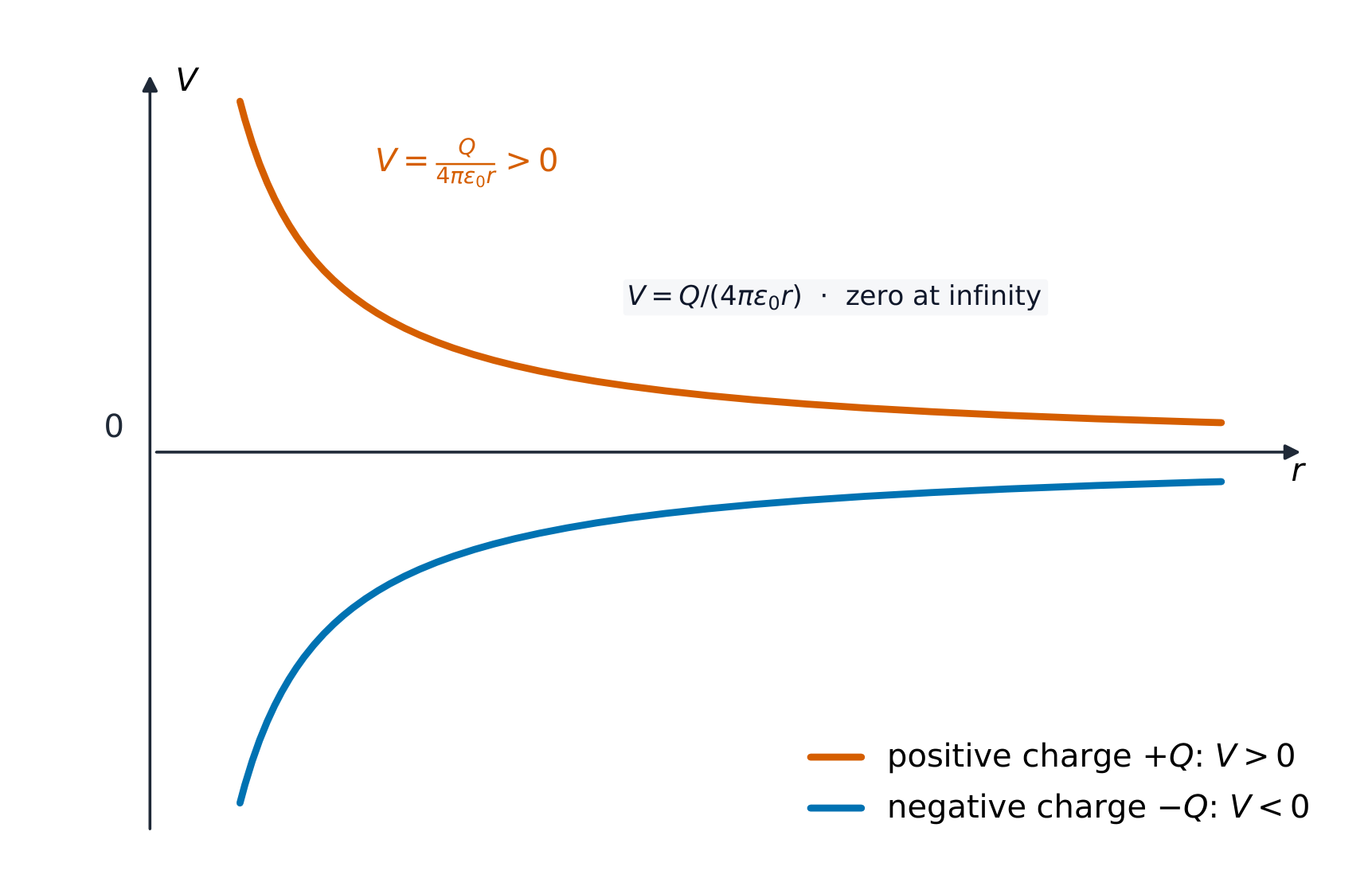
曲线在轴上方还是下方,只取决于 Q 的符号
Electric potential · 电势
V = kQ / r
Potential ∝ 1/r around a charge — steep near it, flattening out. · 电荷周围的电势 ∝ 1/r——靠近它处陡峭,远处变平。
The electric potential near a point charge varies as 1/r. · 点电荷附近的电势按 1/r 变化。
Yes — $V = \dfrac{Q}{4\pi\varepsilon_0 r}$ goes as $1/r$, while the field goes as $1/r^{2}$. · 是的——$V = \dfrac{Q}{4\pi\varepsilon_0 r}$ 按 $1/r$ 变化,而场按 $1/r^{2}$ 变化。
To find the potential at a point due to several charges, add the individual potentials with their signs. · 要求多个电荷在某点产生的电势,把各自的电势带符号相加即可。
Potential is a scalar, so there is nothing to resolve. Fields, by contrast, must be added as vectors with directions. · 电势是标量,所以没有什么要分解。相比之下,场必须按带方向的矢量相加。
Field is the negative potential gradient
- The field at a point equals minus the potential gradient 电势梯度 there:
- The minus sign says the field points towards lower potential: a positive charge released in the field runs "downhill" in $V$.
- In a uniform field the potential falls steadily, so the gradient is constant and this reduces to $E = V/d$, which is the parallel-plate result from earlier.
- Practically: to get the field from a $V$ against $x$ graph, draw a tangent and take minus its gradient.
场是电势梯度的负值
- 某点的场等于该处电势梯度(potential gradient)的负值:
- 负号表示场指向更低的电势:在场中释放的正电荷会沿 $V$ 的"下坡"跑。
- 在匀强场中电势均匀下降,所以梯度恒定,这就退化为 $E = V/d$,即前面平行板的结果。
- 实用做法:要从 $V$ 对 $x$ 的图上求场,画一条切线取它斜率的负值。
The electric field equals minus the potential ____ (E = −dV/dx). · 电场等于电势 ____ 的负值(E = −dV/dx)。
The field points "downhill" in potential, toward lower V. · 场在电势上指向“下坡”,朝向更低的 V。
How is the electric field found from a graph of potential against distance? · 怎样从电势对距离的图上求出电场?
E = -dV/dx. The minus sign says the field points towards lower potential, and in a uniform field the constant gradient gives E = V/d. · E = -dV/dx。负号表示场指向更低的电势,而在匀强场中恒定的梯度给出 E = V/d。
Worked example: reading the two-sphere graph
- The potential along the line between spheres X and Y, $1.2\ \text{m}$ apart, is positive everywhere and has a minimum at $0.50\ \text{m}$ from X. State three conclusions.
- Both charges are positive, because the potential is positive everywhere along the line.
- The field is zero at $x = 0.50\ \text{m}$, because the gradient is zero there and $E = -dV/dx$.
- Y carries the larger charge, because the zero-field point lies closer to X. Quantitatively $Q_{\text{Y}}/Q_{\text{X}} = (0.70/0.50)^2 = 2.0$.
- If instead the curve crossed zero, the charges would be opposite, and there the ratio comes from $Q_{\text{X}}/x = Q_{\text{Y}}/(d-x)$, without the square.
例题:读两球之间的电势图
- 相距 $1.2\ \text{m}$ 的球 X 和 Y 之间连线上的电势处处为正,并在距 X $0.50\ \text{m}$ 处有一个极小值。给出三条结论。
- 两个电荷都是正的,因为沿整条线电势都为正。
- 在 $x = 0.50\ \text{m}$ 处场为零,因为那里梯度为零,而 $E = -dV/dx$。
- Y 带的电荷更大,因为零场点更靠近 X。定量地说 $Q_{\text{Y}}/Q_{\text{X}} = (0.70/0.50)^2 = 2.0$。
- 如果曲线改为穿过零,那么两电荷是异号的;那时的比值来自 $Q_{\text{X}}/x = Q_{\text{Y}}/(d-x)$,不带平方。
The potential between two spheres is positive everywhere with a minimum nearer sphere X. Which conclusions follow? Select all · 所有 that apply. · 两球之间的电势处处为正,且极小值更靠近球 X。可以得出哪些结论?选出所有适用的。
A minimum in V is where the gradient, and so the field, is zero; it lies nearer the smaller charge. The potential there is a minimum, not zero, so qV is not zero either. · V 的极小值处梯度为零,因而场为零;它更靠近较小的电荷。那里的电势是极小值而不是零,所以 qV 也不是零。
Electric potential energy
- A charge $q$ placed at a point of potential $V$ has electric potential energy $E_{\text{P}} = qV$. For two point charges:
- Like charges give positive potential energy: released, they fly apart. Opposite charges give negative energy, a bound 束缚 system, and work must be done to separate them to infinity.
- This is the same pattern as gravitational potential energy, which is always negative because gravity always attracts.
Above the axis they would fly apart; below it they are bound
电势能
- 放在电势为 $V$ 处的电荷 $q$ 具有电势能 $E_{\text{P}} = qV$。对两个点电荷:
- 同号电荷给出正的势能:一放开它们就飞散。异号电荷给出负的能量,是一个束缚(bound)系统,要把它们分开到无穷远必须做功。
- 这与引力势能的规律相同——引力势能总是负的,因为引力永远吸引。
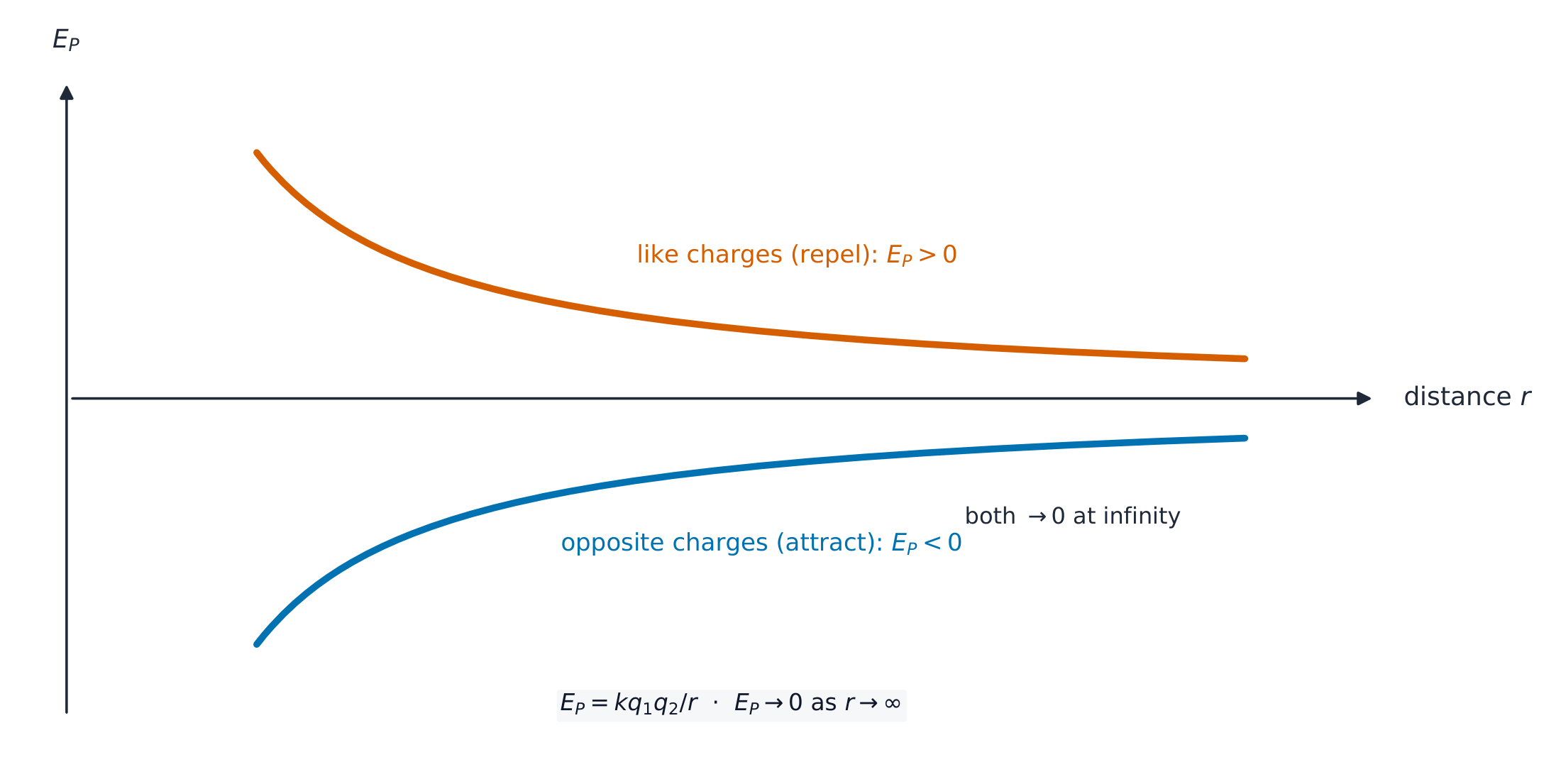
在轴上方它们会飞散;在轴下方它们被束缚
The electric potential energy of a charge $q$ at a point of potential $V$ is: · 处于电势 $V$ 的某点的电荷 $q$ 的电势能是:
$E_{\text{P}} = qV$; for two point charges this becomes $\dfrac{Qq}{4\pi\varepsilon_0 r}$. · $E_{\text{P}} = qV$;对于两个点电荷这变成 $\dfrac{Qq}{4\pi\varepsilon_0 r}$。
Two opposite charges have a negative electric potential energy (a bound system). · 两个异号电荷有负的电势能(一个束缚系统)。
Negative PE means energy must be supplied to pull them apart — they are bound, like an electron and a nucleus. · 负的势能意味着必须提供能量才能把它们拉开——它们是束缚的,像电子和原子核。
Two opposite charges have a negative electric potential energy, so the system is described as ____. · 两个异号电荷的电势能为负,所以这个系统被称为____的。
Work must be done to separate them to infinity, where the energy is zero. Like charges have positive energy and would fly apart if released. · 必须做功才能把它们分开到能量为零的无穷远。同号电荷能量为正,一放开就会飞散。
Electric and gravitational, side by side
| gravitational | electric | |
|---|---|---|
| force | $F = \dfrac{Gm_1m_2}{r^2}$ | $F = \dfrac{Q_1Q_2}{4\pi\varepsilon_0 r^2}$ |
| field | $g = \dfrac{GM}{r^2}$ | $E = \dfrac{Q}{4\pi\varepsilon_0 r^2}$ |
| potential | $\phi = -\dfrac{GM}{r}$ | $V = \dfrac{Q}{4\pi\varepsilon_0 r}$ |
- Identical shapes throughout. The one difference: mass has a single sign so gravity always attracts and $\phi$ is always negative, while charge has two signs so the electric quantities can be either.
电与引力,并排看
| 引力 | 电 | |
|---|---|---|
| 力 | $F = \dfrac{Gm_1m_2}{r^2}$ | $F = \dfrac{Q_1Q_2}{4\pi\varepsilon_0 r^2}$ |
| 场 | $g = \dfrac{GM}{r^2}$ | $E = \dfrac{Q}{4\pi\varepsilon_0 r^2}$ |
| 势 | $\phi = -\dfrac{GM}{r}$ | $V = \dfrac{Q}{4\pi\varepsilon_0 r}$ |
- 通篇形状相同。唯一的区别:质量只有一种符号,所以引力永远吸引、$\phi$ 永远为负;而电荷有两种符号,所以这些电学量正负皆可。
Match each quantity to how it changes with distance from a point charge. · 把每个量与它随到点电荷的距离如何变化配对。
The field is inverse-square; the potential is inverse (one power of r gentler). · 场是平方反比的;电势是反比的(在 r 上缓一个幂次)。
Worked example: describe the motion
- A positive charge is placed at a point P on the two-sphere line and released. Describe and explain its motion.
- It moves towards lower potential, that is, down the slope of the $V$ graph, because the field points that way and the force on a positive charge is along the field.
- The force, and so the acceleration, is not constant: it equals $-q\,dV/dx$, and the gradient changes along the line.
- It speeds up wherever it moves to lower potential, gaining kinetic energy equal to $q\Delta V$ lost in potential energy.
例题:描述运动
- 在两球连线上的 P 点放一个正电荷并释放。描述并解释它的运动。
- 它朝更低的电势运动,也就是沿 $V$ 图的下坡走,因为场指向那边,而正电荷所受的力沿场的方向。
- 力因而加速度不恒定:它等于 $-q\,dV/dx$,而梯度沿线是变化的。
- 只要它移向更低的电势就会加速,获得的动能等于失去的势能 $q\Delta V$。
Marks that slip away
- Potential is $\dfrac{1}{r}$; field is $\dfrac{1}{r^2}$. Check which the question wants before substituting.
- The definition needs per unit positive charge and from infinity. Zero at infinity is what the definition rests on.
- Potentials add as scalars with signs; fields add as vectors. Never resolve potentials.
- Zero field is where the $V$ graph has zero gradient, not where $V$ itself is zero. Between opposite charges the curve crosses zero while its gradient is not zero.
容易丢掉的分
- 电势是 $\dfrac{1}{r}$;场是 $\dfrac{1}{r^2}$。代入前先确认题目要哪一个。
- 定义需要单位正电荷和从无穷远。无穷远处为零正是这个定义的立足点。
- 电势按带符号的标量相加;场按矢量相加。绝不要去分解电势。
- 场为零的地方是 $V$ 图梯度为零处,不是 $V$ 本身为零处。在异号电荷之间,曲线穿过零而它的梯度并不为零。
You've got it
- electric potential is the work done per unit positive charge bringing a small test charge from infinity; it is zero at infinity, positive near a positive charge
- $V = \dfrac{Q}{4\pi\varepsilon_0 r}$ varies as $\dfrac{1}{r}$ and is a scalar, so several charges add with signs
- $E = -\dfrac{dV}{dx}$: the field is minus the potential gradient, so zero field means zero gradient, and in a uniform field this gives $E = V/d$
- electric potential energy $E_{\text{P}} = qV = \dfrac{Qq}{4\pi\varepsilon_0 r}$: positive for like charges, negative for opposite ones, which are bound
你掌握了
- 电势是把小检验电荷从无穷远移来时单位正电荷所做的功;无穷远处为零,正电荷附近为正
- $V = \dfrac{Q}{4\pi\varepsilon_0 r}$ 按 $\dfrac{1}{r}$ 变化且是标量,所以多个电荷带符号相加
- $E = -\dfrac{dV}{dx}$:场是电势梯度的负值,所以场为零意味着梯度为零,而在匀强场中这给出 $E = V/d$
- 电势能 $E_{\text{P}} = qV = \dfrac{Qq}{4\pi\varepsilon_0 r}$:同号为正,异号为负而且是束缚的