Capacitors and capacitance · 电容器与电容
| English | 中文 | Pinyin · 拼音 |
|---|---|---|
| capacitance/kəˈpæsɪtəns/ | 电容 | diàn róng |
| parallel/ˈpærəlel/ | 并联 | bìng lián |
| farad/ˈfæræd/ | 法拉 | fǎ lā |
| dielectric/ˌdaɪɪˈlektrɪk/ | 电介质 | diàn jiè zhì |
| series/ˈsɪəriːz/ | 串联 | chuàn lián |
A store that fills up and then stops
- Connect a capacitor to a battery and charge flows for a moment, then stops completely, even though the battery is still connected.
- It stops because the two plates are not joined. Electrons leave one plate and arrive at the other through the battery, and the flow ceases when the p.d. across the gap has grown to match the battery's.
- So the capacitor is left holding $+Q$ on one plate and $-Q$ on the other, always equal and opposite, and the device as a whole is still neutral.
- This lesson is capacitance 电容, what sets it, and how capacitors combine.
充满之后就停下的储存器
- 把电容器接到电池上,电荷流动一瞬间就完全停止,尽管电池还连着。
- 它停止是因为两块板没有连通。电子离开一块板、经过电池到达另一块,而当间隙上的电压增长到与电池相等时,流动就终止。
- 于是电容器一块板上留着 $+Q$、另一块上是 $-Q$,永远等量异号,而整个器件仍是中性的。
- 这一课讲电容(capacitance)、什么决定它,以及电容器怎样组合。
Defining capacitance
- The capacitance of a capacitor, or of any isolated conductor, is the charge per unit potential difference:
- The two-mark definitions differ slightly. For a parallel-plate capacitor: the charge on one plate per unit potential difference between the plates. For an isolated sphere: the charge on the conductor per unit potential.
- The unit is the farad 法拉, $1\ \text{F} = 1\ \text{C/V}$. A farad is enormous, so real capacitors run from picofarads to millifarads.
Two plates, an insulator between, and charge that cannot cross
定义电容
- 电容器——或任何孤立导体——的电容是单位电势差所储存的电荷:
- 两分的定义略有差别。对平行板电容器:两板之间单位电势差下一块板上的电荷。对孤立球:该导体单位电势下的电荷。
- 单位是法拉(farad),$1\ \text{F} = 1\ \text{C/V}$。法拉极大,所以真实的电容器从皮法到毫法不等。

两块板,中间是绝缘体,电荷过不去
Capacitance · 电容
Q = C·V
Charge stored is proportional to voltage — the gradient is the capacitance C. · 储存的电荷与电压 成正比——斜率是电容 C。
Capacitance is the charge stored per unit: · 电容是每单位什么所储存的电荷:
$C = \dfrac{Q}{V}$ — charge per volt, in farads. · $C = \dfrac{Q}{V}$——每伏特的电荷,单位法拉。
A capacitor holds $0.012\ \text{C}$ at $4.0\ \text{V}$. What is its capacitance, in mF? · 一个电容器在 $4.0\ \text{V}$ 下储存 $0.012\ \text{C}$。它的电容是多少(用 mF)?
$C = \dfrac{Q}{V} = \dfrac{0.012}{4.0} = 0.0030\ \text{F} = 3.0\ \text{mF}$. · $C = \dfrac{Q}{V} = \dfrac{0.012}{4.0} = 0.0030\ \text{F} = 3.0\ \text{mF}$。
A charged capacitor holds +Q on one plate and -Q on the other, so the capacitor as a whole is neutral. · 充了电的电容器一块板上是 +Q、另一块上是 -Q,所以电容器整体是中性的。
Electrons move from one plate to the other through the battery, so the charges are always equal and opposite. The stored charge Q means the charge on one plate. · 电子经过电池从一块板移到另一块,所以电荷永远等量异号。所存电荷 Q 指的是一块板上的电荷。
What sets the capacitance
- $C$ is a constant for a given capacitor. Double the charge and the p.d. doubles too, so the ratio does not change. That is why $Q$ against $V$ is a straight line through the origin.
- For parallel plates, $C$ is proportional to the plate area and inversely proportional to the separation: halve the gap and the capacitance doubles. Replacing the air with a dielectric 电介质 raises it further.
- For an isolated sphere of radius $r$, $V = Q/(4\pi\varepsilon_0 r)$, so $C = 4\pi\varepsilon_0 r$: the capacitance depends only on its size.
什么决定电容
- 对给定的电容器,$C$ 是常数。电荷加倍,电压也加倍,所以比值不变。这就是 $Q$ 对 $V$ 是一条过原点直线的原因。
- 对平行板,$C$ 与板的面积成正比、与间距成反比:间距减半电容加倍。用电介质(dielectric)代替空气会让它更大。
- 对半径为 $r$ 的孤立球,$V = Q/(4\pi\varepsilon_0 r)$,所以 $C = 4\pi\varepsilon_0 r$:电容只取决于它的大小。
Doubling the charge on a capacitor doubles the voltage, so its capacitance stays the same. · 把电容器上的电荷加倍会使电压加倍,所以它的电容保持不变。
$C = \dfrac{Q}{V}$ is fixed by the capacitor's size and dielectric — $Q$ and $V$ rise together. · $C = \dfrac{Q}{V}$ 由电容器的尺寸和电介质决定——$Q$ 和 $V$ 一起上升。
Worked example: the charged sphere
- An isolated metal sphere of radius $15\ \text{cm}$ is charged to $9.0 \times 10^3\ \text{V}$. Find its capacitance and its charge.
- $C = 4\pi\varepsilon_0 r = \dfrac{0.15}{8.99 \times 10^9} = 1.7 \times 10^{-11}\ \text{F}$, which is $17\ \text{pF}$.
- $Q = CV = (1.67 \times 10^{-11})(9.0 \times 10^3) = 1.5 \times 10^{-7}\ \text{C}$.
- Useful shortcut: since $4\pi\varepsilon_0 = 1/(8.99 \times 10^9)$, the capacitance of a sphere is simply $r/(8.99 \times 10^9)$ with $r$ in metres. Nine thousand volts stores only a seventh of a microcoulomb, because a sphere is a very poor capacitor.
例题:带电的球
- 一个半径 $15\ \text{cm}$ 的孤立金属球被充电到 $9.0 \times 10^3\ \text{V}$。求它的电容和电荷量。
- $C = 4\pi\varepsilon_0 r = \dfrac{0.15}{8.99 \times 10^9} = 1.7 \times 10^{-11}\ \text{F}$,即 $17\ \text{pF}$。
- $Q = CV = (1.67 \times 10^{-11})(9.0 \times 10^3) = 1.5 \times 10^{-7}\ \text{C}$。
- 有用的捷径:因为 $4\pi\varepsilon_0 = 1/(8.99 \times 10^9)$,球的电容就是 $r/(8.99 \times 10^9)$,$r$ 以米计。九千伏只存下七分之一微库,因为球是极差的电容器。
Capacitors in parallel
- Capacitors in parallel all have the same p.d. across them, so each stores $C_nV$ and the charges add:
- The combination has a larger capacitance than any one of them, because the effect is like enlarging the plate area.
Parallel adds capacitance; series reduces it
并联的电容器
- 并联(parallel)的电容器两端电压相同,所以每个存 $C_nV$,而电荷相加:
- 组合后的电容比其中任何一个都大,因为效果相当于把板的面积加大了。
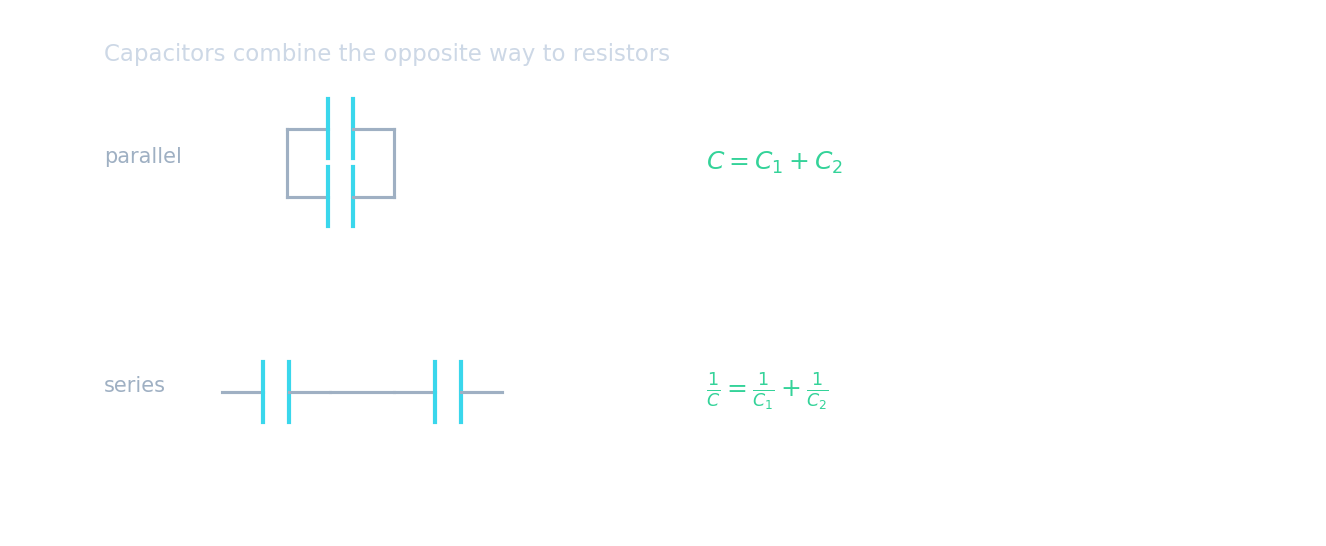
并联增大电容;串联减小电容
A $2.0\ \mu\text{F}$ and a $3.0\ \mu\text{F}$ capacitor are in parallel. What is the total capacitance, in µF? · 一个 $2.0\ \mu\text{F}$ 和一个 $3.0\ \mu\text{F}$ 的电容器并联。总电容是多少(用 µF)?
In parallel capacitances add: $2.0 + 3.0 = 5.0\ \mu\text{F}$. · 并联时电容相加:$2.0 + 3.0 = 5.0\ \mu\text{F}$。
Two capacitors in parallel give a combined capacitance that is: · 两个并联的电容器给出的合并电容是:
Parallel capacitors add ($C_1 + C_2$) — the opposite of resistors, which add in series. · 并联的电容器相加($C_1 + C_2$)——与电阻相反,电阻是串联相加。
An isolated sphere of radius 0.15 m has capacitance C = 4 pi eps0 r. What is C in picofarads? (1/4 pi eps0 = 8.99e9) · 一个半径 0.15 m 的孤立球的电容 C = 4 pi eps0 r。C 是多少皮法?(1/4 pi eps0 = 8.99e9)
C = r / 8.99e9 = 0.15 / 8.99e9 = 1.7e-11 F = 17 pF. A sphere is a very poor capacitor: 9000 V stores only about 0.15 microcoulombs. · C = r / 8.99e9 = 0.15 / 8.99e9 = 1.7e-11 F = 17 pF。球是极差的电容器:9000 V 只存下约 0.15 微库。
Capacitors in series
- Capacitors in series all carry the same charge, since the charge pushed onto one plate must come off the plate joined to it. The p.d.s add, so $V = Q/C_1 + Q/C_2$ and:
- The combination has a smaller capacitance than any one of them, as though the plate separation had increased.
- This is the opposite way round to resistors, and stating the reason, same p.d. for parallel and same charge for series, is what a "derive" question is asking for.
串联的电容器
- 串联(series)的电容器带相同的电荷,因为推到一块板上的电荷必定是从与它相连的那块板上来的。电压相加,所以 $V = Q/C_1 + Q/C_2$,于是:
- 组合后的电容比其中任何一个都小,就像板间距增大了一样。
- 这与电阻恰好相反,而说出理由——并联电压相同、串联电荷相同——正是"推导"题所要求的。
Match each capacitor arrangement to the fact that gives its combination rule. · 把每种电容器接法与给出其组合法则的那个事实配对。
Those two facts are what a "derive the formula" question wants, and they are the reason the rules are the reverse of the ones for resistors. · 这两个事实正是"推导公式"题所要的,也是这两条规则与电阻相反的原因。
Capacitors in parallel add, which is the ____ of the rule for resistors. · 并联的电容器直接相加,这与电阻的规则____。
Resistors add in series and use reciprocals in parallel; capacitors do it the other way round. Mixing them up is the commonest error in this subtopic. · 电阻串联相加、并联用倒数;电容器恰好反过来。搞混它们是本子专题最常见的错误。
Worked example: combining three
- A $2.0\ \mu\text{F}$ and a $3.0\ \mu\text{F}$ capacitor are connected in parallel, and that combination is joined in series with a $5.0\ \mu\text{F}$ capacitor. Find the total capacitance.
- The parallel pair first: $C_{\text{p}} = 2.0 + 3.0 = 5.0\ \mu\text{F}$.
- Then in series with $5.0\ \mu\text{F}$: $\dfrac{1}{C} = \dfrac{1}{5.0} + \dfrac{1}{5.0} = \dfrac{2}{5.0}$, so $C = 2.5\ \mu\text{F}$.
- Work from the inside outwards, exactly as with resistors, but with the two rules swapped. The final answer must be smaller than either part of the series pair, which is the check.
例题:三个电容器的组合
- 一个 $2.0\ \mu\text{F}$ 和一个 $3.0\ \mu\text{F}$ 的电容器并联,该组合再与一个 $5.0\ \mu\text{F}$ 的电容器串联。求总电容。
- 先算并联那一对:$C_{\text{p}} = 2.0 + 3.0 = 5.0\ \mu\text{F}$。
- 再与 $5.0\ \mu\text{F}$ 串联:$\dfrac{1}{C} = \dfrac{1}{5.0} + \dfrac{1}{5.0} = \dfrac{2}{5.0}$,所以 $C = 2.5\ \mu\text{F}$。
- 像处理电阻一样由内向外做,只是两条规则互换。最终答案必须小于串联对中的任何一个,这就是检验。
A 2.0 uF and a 3.0 uF capacitor in parallel are connected in series with a 5.0 uF capacitor. What is the total capacitance in uF? · 一个 2.0 uF 和一个 3.0 uF 的电容器并联后,与一个 5.0 uF 的电容器串联。总电容是多少 uF?
The parallel pair gives 5.0 uF, then in series with 5.0 uF: 1/C = 1/5 + 1/5, so C = 2.5 uF. The result must be smaller than either series element. · 并联那一对给出 5.0 uF,再与 5.0 uF 串联:1/C = 1/5 + 1/5,所以 C = 2.5 uF。结果必定小于串联中的任一个。
Marks that slip away
- Parallel capacitors add; series capacitors use the reciprocal rule. This is the reverse of resistors and is the single commonest error here.
- The definition is charge per unit potential difference, and for plates it is the charge on one plate.
- The charges on the two plates are equal and opposite, so the capacitor is neutral overall. Never write $2Q$.
- $C$ is fixed by the capacitor's geometry. Charging it more does not change $C$; it changes $Q$ and $V$ together.
容易丢掉的分
- **并联电容相加;串联电容用倒数法则。**这与电阻相反,是这里唯一最常见的错误。
- 定义是单位电势差下的电荷,而对平行板是一块板上的电荷。
- 两块板上的电荷等量异号,所以电容器整体是中性的。绝不要写成 $2Q$。
- $C$ 由电容器的几何形状决定。多充电不会改变 $C$;它同时改变 $Q$ 和 $V$。
You've got it
- capacitance is charge per unit p.d., $C = Q/V$, in farads; for plates it is the charge on one plate
- $C$ depends on geometry: plate area over separation for a capacitor, and $C = 4\pi\varepsilon_0 r$ for an isolated sphere
- parallel: same p.d., charges add, $C = C_1 + C_2$, a larger capacitance
- series: same charge, p.d.s add, $\dfrac{1}{C} = \dfrac{1}{C_1} + \dfrac{1}{C_2}$, a smaller capacitance, the opposite of resistors
你掌握了
- 电容是单位电压下的电荷,$C = Q/V$,单位法拉;对平行板是一块板上的电荷
- $C$ 取决于几何:电容器是板面积除以间距,孤立球是 $C = 4\pi\varepsilon_0 r$
- 并联:电压相同、电荷相加,$C = C_1 + C_2$,电容更大
- 串联:电荷相同、电压相加,$\dfrac{1}{C} = \dfrac{1}{C_1} + \dfrac{1}{C_2}$,电容更小,与电阻相反