| English | 释义 | 拼音 |
|---|---|---|
| thermometer/θɜːˈmɒmɪtə/ | 温度计 | wēn dù jì |
| thermocouple/ˈθɜːməkʌpl/ | 热电偶 | rè diàn ǒu |
| thermodynamic/ˌθɜːməʊdaɪˈnæmɪk/ | 热力学 | rè lì xué |
| kelvin/ˈkelvɪn/ | 开尔文 | kāi'ěrwén |
| absolute zero/ˈæbsəluːt ˈzɪərəʊ/ | 绝对零度 | jué duì líng dù |
| Celsius/ˈselsɪəs/ | 摄氏度 | shè shì dù |
How a thermometer 温度计 works
- A thermometer needs something that changes with temperature.
- A liquid expands, a metal's resistance rises, a gas swells.
- Read that change and you read the temperature.
温标实验室
开尔文索引 = 摄氏索引 + 2.73
滑动摄氏温度并观察开尔文刻度如何平移 273。
Kinds of thermometer
- Anything that changes repeatably with temperature works:
- expansion of a liquid, resistance of a metal, e.m.f. of a thermocouple 热电偶, volume of a gas.
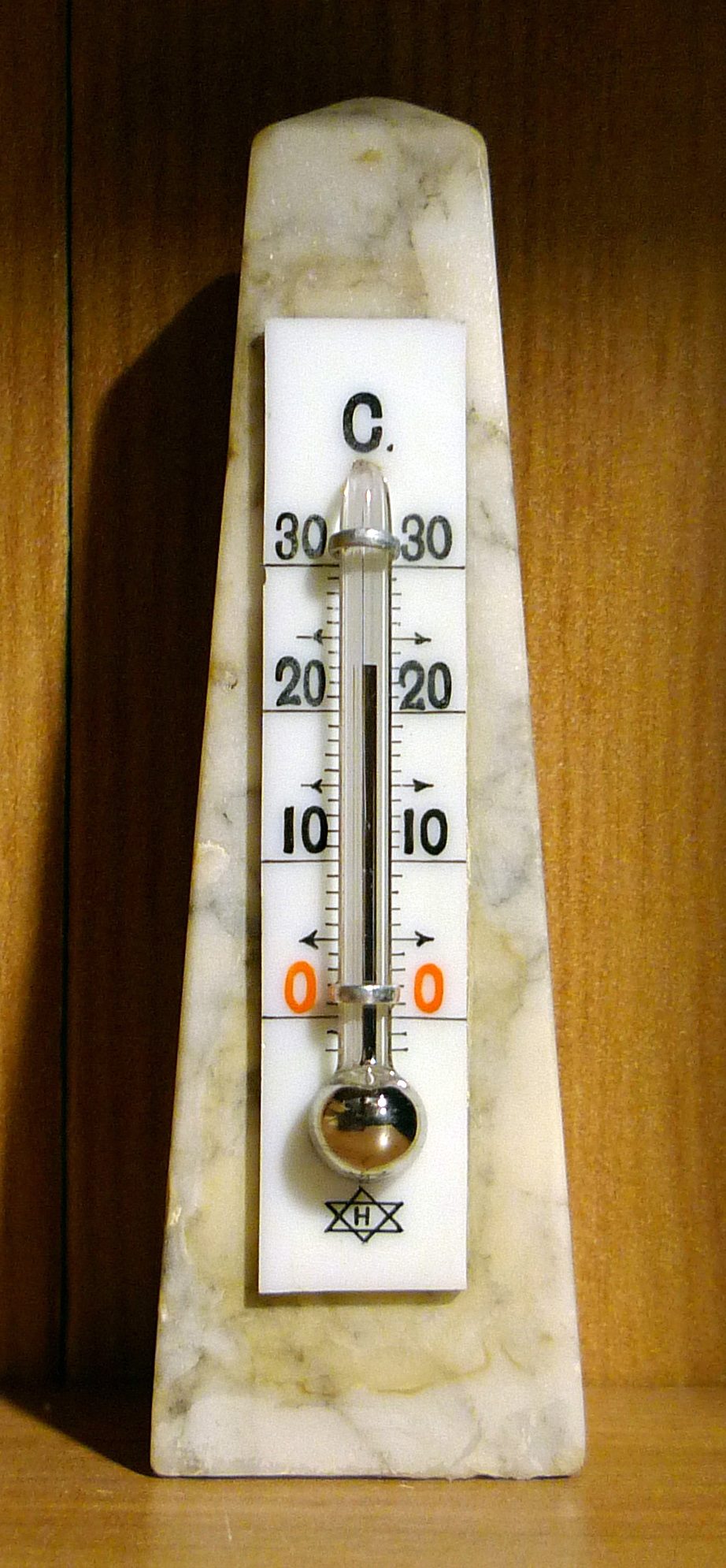
A thermometer measures temperature on a defined scale
选择 所有 可用于测量温度的属性。
难度 2/5 · 今日首次完成可获 140 金币及少量额外奖励
任何随温度可重复变化的属性均可使用。外壳固定的颜色不行。
The absolute scale
- The thermodynamic 热力学 (absolute) scale uses the kelvin 开尔文 (K) and depends on no single substance.
- Absolute zero 绝对零度 ($0\ \text{K}$) is the lowest possible temperature — least internal energy. Nothing is colder.
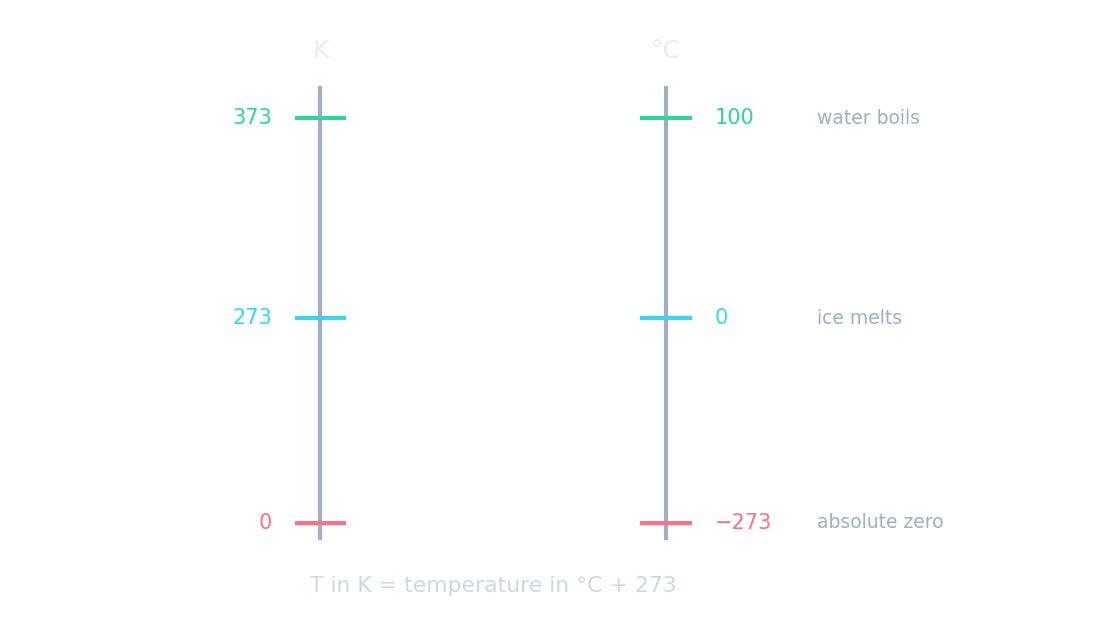
绝对零度 (0 K) 是:
难度 1/5 · 今日首次完成可获 100 金币及少量额外奖励
在 0 K 时,系统具有最小的可能内能;无法变得更冷。
Kelvin and Celsius 摄氏度
- $T/\text{K} = \theta/°\text{C} + 273.15$. So $0\ °\text{C} = 273\ \text{K}$.
- A kelvin and a Celsius degree are the same size, so a change of $1\ \text{K} = 1\ °\text{C}$.
- Always use kelvin in gas-law calculations.
$27\ °\text{C}$ 等于多少开尔文?
难度 2/5 · 今日首次完成可获 140 金币及少量额外奖励
$T/\text{K} = \theta/°\text{C} + 273 = 27 + 273 = 300\ \text{K}$.
升高 1 K 等同于升高 1 °C。
难度 1/5 · 今日首次完成可获 100 金币及少量额外奖励
两个刻度的分度值大小相同——仅零点不同(相差 273.15)。
在气体定律计算中,温度必须是:
难度 1/5 · 今日首次完成可获 100 金币及少量额外奖励
气体定律使用绝对温度——开尔文。使用 °C 会得到错误答案。
某温度是 27 摄氏度。换算成开尔文是多少?
难度 2/5 · 今日首次完成可获 140 金币及少量额外奖励
T = 27 + 273 = 300 K。不过,一个温度差值在两个刻度上是相同的数值:升高 27 C 等同于升高 27 K。
Why the thermodynamic scale is special
- It does not depend on the property of any particular substance — it is defined from the behaviour of an ideal gas, with absolute zero and the triple point of water as its fixed points.
- A liquid-in-glass thermometer assumes its liquid expands uniformly with temperature. That is only approximately true, so it agrees with the thermodynamic scale exactly only at the points where it was calibrated.
- That is the exam's "explain why a liquid-in-glass thermometer does not measure thermodynamic temperature".
什么使热力学温标特别?选择 所有 适用的选项。
难度 2/5 · 今日首次完成可获 140 金币及少量额外奖励
单位是结果而非定义特征。水银温度计的刻度取决于水银如何膨胀;而这个温标与此无关。
Choosing a thermometer
- Platinum resistance: resistance varies linearly and repeatably with temperature over a wide range — very accurate. But it has a large thermal capacity, so it is slow and cannot follow a rapidly changing temperature.
- Thermocouple: two metal junctions give an e.m.f.; tiny, fast, wide range, measures at a point — ideal for a changing temperature.
- Liquid in glass: cheap and simple; limited range, slow, and reads only where the bulb is.
将每种温度计与其关键特性匹配。
难度 2/5 · 今日首次完成可获 140 金币及少量额外奖励
较大的热容量使电阻温度计准确但响应慢;热电偶微小的接点响应快;绝对温标由理想气体行为定义,而非某种材料。
将每种温度计与其使用的属性匹配。
难度 2/5 · 今日首次完成可获 140 金币及少量额外奖励
热电偶的热容量小且响应快,因此被选用于测量快速变化的温度。
Worked example: finding absolute zero, then converting
A fixed volume of gas has pressure $100\ \text{kPa}$ at $0\ °\text{C}$ and $136.6\ \text{kPa}$ at $100\ °\text{C}$. Then: a gas is heated from $27\ °\text{C}$ to $742\ °\text{C}$.
- Gradient: $\dfrac{136.6 - 100}{100} = 0.366\ \dfrac{\text{kPa}}{°\text{C}}$; pressure is a straight line in temperature.
- Extrapolate to zero pressure: $\theta = -\dfrac{100}{0.366} = -273\ °\text{C}$ — absolute zero.
- Convert: $27\ °\text{C} = 300\ \text{K}$; $742\ °\text{C} = 1015\ \text{K}$.
- Temperature change: $742 - 27 = 715\ °\text{C} = 715\ \text{K}$ — a difference is the same number on both scales.
- Check: absolute zero is where the pressure of an ideal gas would fall to zero; the gas would liquefy long before, which is why the point is found by extrapolation, not by cooling.

Extrapolating the pressure-temperature line back to zero pressure gives absolute zero, about -273 degC
气体从 $20\ °\text{C}$ 加热到 $95\ °\text{C}$。温度变化是多少开尔文 (K)?
难度 2/5 · 今日首次完成可获 140 金币及少量额外奖励
两个温标上相同的数值是:$95 - 20 = 75\ °\text{C} = 75\ \text{K}$。在此处加 273 是错误的。
Add $273$ to convert a Celsius temperature to kelvin, but a temperature difference is the same number on both scales — do not add $273$ to a $\Delta T$. A kelvin temperature can never be negative. And absolute zero is the temperature of minimum internal energy, not zero energy — "the molecules stop moving" is not an accepted answer.
绝对零度是指物质具有 ____ 内能时的温度。
难度 1/5 · 今日首次完成可获 100 金币及少量额外奖励
不是零能量——而是可能的最小值。这就是为什么“分子停止运动”的说法不被接受。
You've got it
- a thermometer uses any property that changes repeatably with temperature; the thermodynamic scale depends on no substance
- absolute zero $= 0\ \text{K} = -273.15\ °\text{C}$, the lowest possible temperature (minimum internal energy)
- $T/\text{K} = \theta/°\text{C} + 273$; a difference is the same in K and °C; use kelvin in gas laws