Radioactive decay · 放射性衰变
| English | 中文 | Pinyin · 拼音 |
|---|---|---|
| radiation/ˌreɪdɪˈeɪʃn/ | 辐射 | fú shè |
| positron/ˈpɒzɪtrɒn/ | 正电子 | zhèng diàn zi |
| photon/ˈfəʊtɒn/ | 光子 | guāng zi |
| penetration/ˌpenɪˈtreɪʃn/ | 穿透 | chuān tòu |
| ionising/ˈaɪənaɪzɪŋ/ | 电离 | diàn lí |
| deflected/dɪˈflektɪd/ | 偏转 | piān zhuǎn |
| antiparticles/ˌæntɪˈpɑːtɪklz/ | 反粒子 | fǎn lì zi |
| neutrinos/njuːˈtriːnəʊz/ | 中微子 | zhōng wēi zǐ |
Three kinds of radiation 辐射
- An unstable nucleus settles down by throwing out radiation.
- There are three kinds — alpha, beta and gamma — and they behave very differently.
- Telling them apart is the heart of this topic.
三种辐射
- 不稳定的原子核通过抛出 辐射(radiation) 来安定下来。
- 有三种——阿尔法、贝塔和伽马——它们的行为非常不同。
- 区分它们是这个主题的核心。
What each one is
- α: a helium nucleus ($^{4}_{2}\alpha$), charge $+2e$, mass $\approx 4\ \text{u}$.
- β: a fast electron ($\beta^{-}$) or positron 正电子 ($\beta^{+}$), charge $\mp e$, tiny mass.
- γ: a high-energy photon 光子, no charge, no mass.
每一种是什么
- α:氦核($^{4}_{2}\alpha$),电荷 $+2e$,质量 $\approx 4\ \text{u}$。
- β:高速电子($\beta^{-}$)或正电子(positron)($\beta^{+}$),电荷 $\mp e$,质量极小。
- γ:高能 光子(photon),不带电,无质量。
Radioactive decay · 放射性衰变
A = A₀·bᵗ
Activity decays · 衰变 exponentially — set the base b below 1. · 放射性活度 指数衰减——把底数 b 设为小于 1。
An α-particle is: · α 粒子是:
An α-particle is $^{4}_{2}\alpha$ — a helium-4 nucleus with charge $+2e$. · α 粒子是 $^{4}_{2}\alpha$——一个电荷为 $+2e$ 的氦-4 核。
Penetration 穿透 and ionising 电离
- α: stopped by paper; strongly ionising.
- β: stopped by a few mm of aluminium.
- γ: only reduced by thick lead; weakly ionising.
穿透与电离
- α:被纸挡住;电离能力强。
- β:被几毫米铝挡住。
- γ:只能被厚铅削弱;电离能力弱。
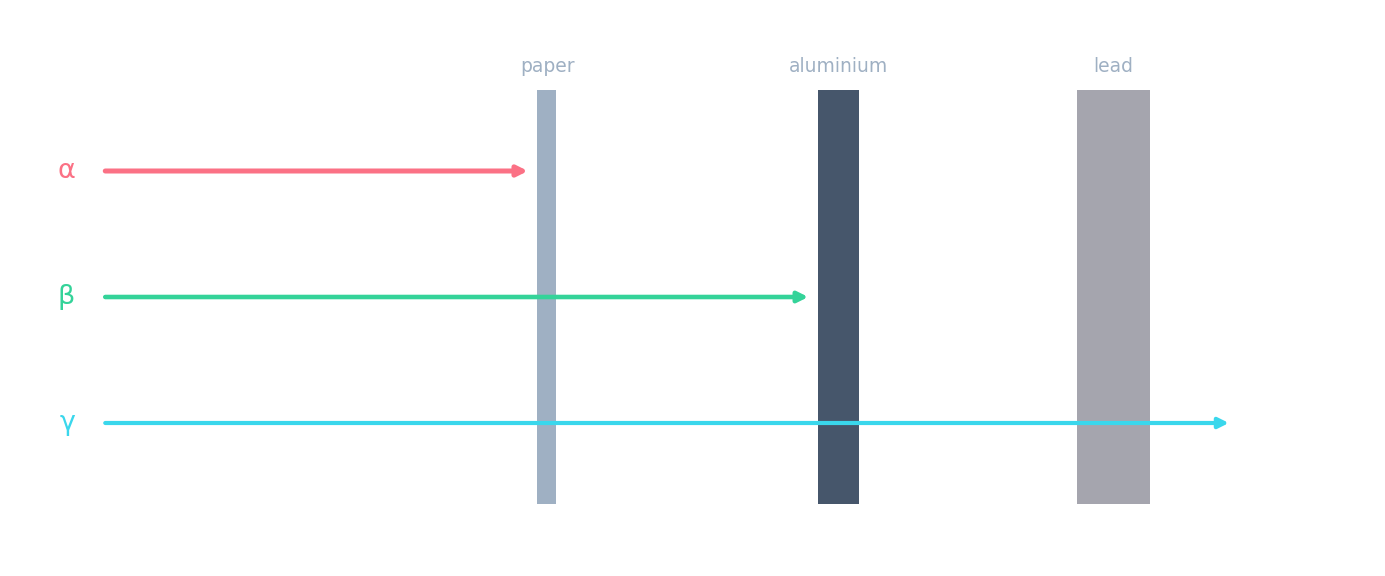
Match each radiation to what stops it. · 把每种辐射与挡住它的东西配对。
Penetration goes α < β < γ; ionising power goes the other way (α is the strongest ioniser). · 穿透力是 α < β < γ;电离能力则相反(α 是最强的电离体)。
Of the three, α radiation is the most strongly ionising. · 三者之中,α 辐射的电离能力最强。
Yes — α is the strongest ioniser (and so the least penetrating); γ is the weakest ioniser (and most penetrating). · 是的——α 是最强的电离体(所以穿透力最弱);γ 是最弱的电离体(穿透力最强)。
In an electric field
- The field pushes charges: α is deflected 偏转 towards the negative plate, β$^{-}$ the opposite way, γ not at all.
- The force is $F = Eq$, so the α feels twice the force of a β — but its mass is thousands of times larger, so it curves far less.
- Same rule for any two charged particles in the same field: compare the forces by charge, the accelerations by $\dfrac{q}{m}$.
在电场中
- 电场推动电荷:α 向负极板 偏转(deflected),β$^{-}$ 向相反方向,γ 完全不偏转。
- 力为 $F = Eq$,所以 α 受到的力是 β 的 两倍——但它的质量大几千倍,所以弯曲得 少得多。
- 同一电场中任意两个带电粒子都是这条规则:用电荷比较力,用 $\dfrac{q}{m}$ 比较加速度。
An α-particle, a β⁻ particle and a γ-ray enter the same uniform electric field side by side. Which statement is correct? · 一个 α 粒子、一个 β⁻ 粒子和一条 γ 射线并排进入同一个匀强电场。哪个说法正确?
Opposite charges are pushed opposite ways. The β⁻ has a far larger charge-to-mass ratio, so it accelerates far more; the uncharged γ feels no force. · 相反的电荷被推向相反方向。β⁻ 的荷质比大得多,所以加速度大得多;不带电的 γ 不受力。
Antiparticles 反粒子 and neutrinos 中微子
- Every particle has an antiparticle — same mass, opposite charge (the positron is the electron's).
- β-decay always emits a (anti)neutrino too: nearly massless, no charge, very hard to detect.
反粒子与中微子
- 每种粒子都有 反粒子(antiparticle)——质量相同,电荷相反(正电子是电子的反粒子)。
- β 衰变总是同时发射一个 (反)中微子(neutrino):质量几乎为零,不带电,极难探测。
The positron is the ____ of the electron. · 正电子是电子的 ____。
An antiparticle has the same mass but opposite charge — the positron is $+e$ to the electron's $-e$. · 反粒子质量相同但电荷相反——正电子是 $+e$,对应电子的 $-e$。
Why β is continuous
- α-decay shares energy between two particles → the α has one fixed energy (discrete).
- β-decay shares energy between three (with the neutrino) → β energies range from zero up to a maximum (continuous).
为什么 β 能谱是连续的
- α 衰变 把能量分给 两个 粒子 → α 有一个固定的能量(分立)。
- β 衰变 把能量分给 三个(包括中微子)→ β 的能量从零到最大值连续分布(连续)。
β-particles come out with a continuous range of energies because the energy is shared among: · β 粒子以连续的能量范围射出,因为能量被分享给:
With three particles sharing, the β can take any share up to a maximum. α-decay shares between two, fixing the α energy. · 三个粒子分享时,β 可以取从零到最大值的任意份额。α 衰变在两个之间分享,固定了 α 的能量。
Decay equations
- α: $^{A}_{Z}\text{X} \to {}^{A-4}_{Z-2}\text{Y} + {}^{4}_{2}\alpha$.
- β$^{-}$: $^{A}_{Z}\text{X} \to {}^{A}_{Z+1}\text{Y} + {}^{0}_{-1}\beta + \bar{\nu}_{e}$ (a neutron becomes a proton).
- β$^{+}$: $^{A}_{Z}\text{X} \to {}^{A}_{Z-1}\text{Y} + {}^{0}_{+1}\beta + \nu_{e}$ (a proton becomes a neutron).
衰变方程
- α:$^{A}_{Z}\text{X} \to {}^{A-4}_{Z-2}\text{Y} + {}^{4}_{2}\alpha$。
- β$^{-}$:$^{A}_{Z}\text{X} \to {}^{A}_{Z+1}\text{Y} + {}^{0}_{-1}\beta + \bar{\nu}_{e}$(一个中子变成质子)。
- β$^{+}$:$^{A}_{Z}\text{X} \to {}^{A}_{Z-1}\text{Y} + {}^{0}_{+1}\beta + \nu_{e}$(一个质子变成中子)。
In α-decay, by how much does the nucleon number $A$ decrease? · 在 α 衰变中,核子数 $A$ 减少多少?
The α carries away 4 nucleons (2 protons + 2 neutrons), so $A$ falls by 4 (and $Z$ by 2). · α 带走 4 个核子(2 个质子 + 2 个中子),所以 $A$ 减少 4(且 $Z$ 减少 2)。
In β$^{-}$ decay, the proton number $Z$: · 在 β$^{-}$ 衰变中,质子数 $Z$:
A neutron turns into a proton, so $Z$ rises by 1 while $A$ stays the same. · 一个中子变成一个质子,所以 $Z$ 增加 1,而 $A$ 保持不变。
Worked example: nitrogen-12 and a field
Nitrogen-12, $^{12}_{7}\text{N}$, decays by emitting a positron. The emitted positron and an α-particle then pass through the same uniform electric field.
- Equation: $^{12}_{7}\text{N} \to {}^{12}_{6}\text{C} + {}^{0}_{+1}\beta + \nu_{e}$. Check: $12 = 12 + 0$ and $7 = 6 + 1$.
- Charge on the positron: $+e$ — the electron's antiparticle.
- Forces in the field: $F = Eq$, so $\dfrac{F_{\alpha}}{F_{\beta}} = \dfrac{2e}{e} = 2$.
- Accelerations: $a = \dfrac{Eq}{m}$, so $\dfrac{a_{\alpha}}{a_{\beta}} = \dfrac{2e / 4\,\text{u}}{e / (\text{u}/1840)} \approx \dfrac{1}{3700}$ — the positron accelerates thousands of times more.
- Check: twice the force but four thousand times the mass: the α barely bends. Both are pushed the same way, because both are positive.
例题:氮-12 与电场
氮-12,$^{12}_{7}\text{N}$,通过发射正电子衰变。发射出的正电子和一个 α 粒子随后通过同一个匀强电场。
- 方程: $^{12}_{7}\text{N} \to {}^{12}_{6}\text{C} + {}^{0}_{+1}\beta + \nu_{e}$。检查:$12 = 12 + 0$ 且 $7 = 6 + 1$。
- 正电子的电荷: $+e$——电子的反粒子。
- 电场中的力: $F = Eq$,所以 $\dfrac{F_{\alpha}}{F_{\beta}} = \dfrac{2e}{e} = 2$。
- 加速度: $a = \dfrac{Eq}{m}$,所以 $\dfrac{a_{\alpha}}{a_{\beta}} = \dfrac{2e / 4\,\text{u}}{e / (\text{u}/1840)} \approx \dfrac{1}{3700}$——正电子的加速度大几千倍。
- 检查: 力是两倍,但质量是四千倍:α 几乎不弯。两者被推向 同一 方向,因为都带正电。
Nucleus X (charge $+2e$, mass $4\ \text{u}$) and nucleus Y (charge $+e$, mass $3\ \text{u}$) are in the same uniform electric field. What is the ratio acceleration of X : acceleration of Y? · 原子核 X(电荷 $+2e$,质量 $4\ \text{u}$)和原子核 Y(电荷 $+e$,质量 $3\ \text{u}$)处在同一个匀强电场中。X 的加速度与 Y 的加速度之比是多少?
$a = \dfrac{Eq}{m}$, so the ratio is $\dfrac{2/4}{1/3} = \dfrac{0.5}{0.333} = 1.5$. The force ratio alone would be $2$; the masses change it. · $a = \dfrac{Eq}{m}$,所以比值为 $\dfrac{2/4}{1/3} = \dfrac{0.5}{0.333} = 1.5$。单看力的比值是 $2$;质量改变了它。
A β$^{-}$ particle comes from the nucleus — a neutron turns into a proton — not from the orbiting electrons. A γ-ray changes neither $A$ nor $Z$; it only carries away energy. And the reason β energies are continuous is the (anti)neutrino sharing the energy — that is the exam's favourite "explain" question in this topic.
β$^{-}$ 粒子来自 原子核——一个中子变成质子——而不是来自轨道上的电子。γ 射线 既不 改变 $A$ 也不 改变 $Z$;它只带走能量。而 β 能量 连续 的原因是(反)中微子分享了能量——这是本主题考试最喜欢的"解释"题。
You've got it
- α = He nucleus, $+2e$, $4\ \text{u}$ (paper-stopped, strong ioniser); β = electron/positron (Al-stopped); γ = photon (lead)
- in a field: force $\propto q$, acceleration $\propto \dfrac{q}{m}$; α and β$^{-}$ bend opposite ways, γ does not bend
- β-decay emits a (anti)neutrino, which is why its energy spectrum is continuous; α: $A{-}4, Z{-}2$; β$^{-}$: $Z{+}1$; β$^{+}$: $Z{-}1$
你掌握了
- α = 氦核,$+2e$,$4\ \text{u}$(被纸挡住,强电离);β = 电子/正电子(被铝挡住);γ = 光子(铅)
- 在电场中:力 $\propto q$,加速度 $\propto \dfrac{q}{m}$;α 和 β$^{-}$ 向相反方向弯曲,γ 不弯曲
- β 衰变发射 (反)中微子,这就是它的能谱 连续 的原因;α:$A{-}4, Z{-}2$;β$^{-}$:$Z{+}1$;β$^{+}$:$Z{-}1$