Practical circuits and internal resistance · 实用电路与内阻
| English | 中文 | Pinyin · 拼音 |
|---|---|---|
| internal resistance/ɪnˈtɜːnl rɪˈzɪstəns/ | 内阻 | nèi zǔ |
| terminal potential difference/ˈtɜːmɪnl pəˈtenʃl ˈdɪfrəns/ | 端电压 | duān diàn yā |
| lost volts/lɒst vəʊlts/ | 内阻压降 | nèi zǔ yā jiàng |
| short circuit/ʃɔːt ˈsɜːkɪt/ | 短路 | duǎn lù |
| parallel/ˈpærəlel/ | 并联 | bìng lián |
| ammeters/ˈæmiːtəz/ | 电流表 | diàn liú biǎo |
| voltmeters/ˈvəʊltmiːtəz/ | 电压表 | diàn yā biǎo |
| series/ˈsɪəriːz/ | 串联 | chuàn lián |
Why the headlights dim
- Start a car and the headlights dim for a moment.
- The starter motor draws a huge current, and the battery's own voltage sags.
- Every real source has some internal resistance 内阻.
为什么车灯会变暗
- 发动汽车时,车灯会暗一下。
- 起动机吸取巨大的电流,电池自己的电压就下垂了。
- 每个真实的电源都有一些 内阻(internal resistance)。
e.m.f. and p.d.
- e.m.f. $\varepsilon$ — energy each coulomb is given by the source.
- p.d. — energy each coulomb gives up to a component. Both in volts.
A real circuit built on a breadboard, being measured with a multimeter
电动势与电势差
- 电动势 $\varepsilon$——电源 给予 每库仑电荷的能量。
- 电势差——每库仑电荷 交给 元件的能量。两者都用伏特。

在面包板上搭建的真实电路,正在用万用表测量
Internal resistance · 内阻
V = ε − I·r
Terminal p.d. falls with current: it starts at the e.m.f. ε and drops by I·r. · 端电压随电流下降:它从电动势 ε 开始,下降 I·r。
The e.m.f. is the energy given to each unit of charge by the ____. · 电动势是 ____ 给每单位电荷的能量。
The source (battery, cell, generator) supplies energy to the charge; a component takes it back out (the p.d.). · 电源(电池、电池组、发电机)给电荷提供能量;元件再把它取出来(电势差)。
Internal resistance
- A real source has internal resistance $r$, so some energy is lost inside it.
- The terminal potential difference 端电压 (terminal p.d.) delivered outside is $V = \varepsilon - Ir$.
- The $Ir$ is called the lost volts 内阻压降 — energy per coulomb turned to heat inside the source.
内阻
- 真实的电源有内阻 $r$,所以有一些能量在它内部损失了。
- 输出到外部的 端电压(terminal potential difference) 是 $V = \varepsilon - Ir$。
- $Ir$ 叫做 内阻压降(lost volts)——每库仑在电源内部变成热的能量。
A cell of e.m.f. $12\ \text{V}$ and internal resistance $0.50\ \Omega$ drives a current of $2.0\ \text{A}$. What is the terminal p.d.? · 一个电动势 $12\ \text{V}$、内阻 $0.50\ \Omega$ 的电池驱动 $2.0\ \text{A}$ 的电流。端电压是多少?
$V = \varepsilon - Ir = 12 - 2.0 \times 0.50 = 11\ \text{V}$. · $V = \varepsilon - Ir = 12 - 2.0 \times 0.50 = 11\ \text{V}$。
What happens as current changes
- No current ($I = 0$): terminal p.d. equals the e.m.f.
- More current: the terminal p.d. drops (that $Ir$ loss grows).
- Short circuit 短路 ($R_{\text{ext}} \to 0$): $I = \dfrac{\varepsilon}{r}$ — a large current.
电流变化时会怎样
- 无电流($I = 0$):端电压等于电动势。
- 电流更大:端电压下降(那个 $Ir$ 损失增大)。
- 短路($R_{\text{ext}} \to 0$):$I = \dfrac{\varepsilon}{r}$——一个很大的电流。
A cell of e.m.f. $6.0\ \text{V}$ and internal resistance $0.50\ \Omega$ is short-circuited. What current flows? · 一个电动势 $6.0\ \text{V}$、内阻 $0.50\ \Omega$ 的电池被短路。流过多大的电流?
With $R_{\text{ext}} \to 0$, $I = \dfrac{\varepsilon}{r} = \dfrac{6.0}{0.50} = 12\ \text{A}$. · 当 $R_{\text{ext}} \to 0$ 时,$I = \dfrac{\varepsilon}{r} = \dfrac{6.0}{0.50} = 12\ \text{A}$。
Worked example: a battery and two lamps
A battery of e.m.f. $6.0\ \text{V}$ and internal resistance $0.80\ \Omega$ drives a current of $1.5\ \text{A}$ through two lamps X and Y in parallel. X has resistance $4.0\ \Omega$.
- Terminal p.d.: $V = \varepsilon - Ir = 6.0 - 1.5 \times 0.80 = 4.8\ \text{V}$.
- Current in X: the parallel lamps share the terminal p.d., so $I_{\text{X}} = \dfrac{4.8}{4.0} = 1.2\ \text{A}$.
- Current in Y: Kirchhoff's first law at the junction: $I_{\text{Y}} = 1.5 - 1.2 = 0.30\ \text{A}$.
- Power in Y: $P = VI = 4.8 \times 0.30 = 1.4\ \text{W}$.
- Check: $1.2\ \text{V}$ is lost inside the battery, so only $4.8\ \text{V}$ of the $6.0\ \text{V}$ reaches the lamps. Both lamps see the same p.d. because they are in parallel.
例题:一个电池和两盏灯
电动势 $6.0\ \text{V}$、内阻 $0.80\ \Omega$ 的电池驱动 $1.5\ \text{A}$ 的电流通过并联的两盏灯 X 和 Y。X 的电阻为 $4.0\ \Omega$。
- 端电压: $V = \varepsilon - Ir = 6.0 - 1.5 \times 0.80 = 4.8\ \text{V}$。
- X 中的电流: 并联的灯共享端电压,所以 $I_{\text{X}} = \dfrac{4.8}{4.0} = 1.2\ \text{A}$。
- Y 中的电流: 在节点处用基尔霍夫第一定律:$I_{\text{Y}} = 1.5 - 1.2 = 0.30\ \text{A}$。
- Y 的功率: $P = VI = 4.8 \times 0.30 = 1.4\ \text{W}$。
- 检查: 有 $1.2\ \text{V}$ 损失在电池内部,所以 $6.0\ \text{V}$ 中只有 $4.8\ \text{V}$ 到达灯。两盏灯看到的电势差 相同,因为它们并联。
A battery of e.m.f. $9.0\ \text{V}$ and internal resistance $1.0\ \Omega$ delivers $2.0\ \text{A}$ to two resistors in parallel. One of them, of resistance $10\ \Omega$, takes part of the current. What current, in A, flows in the other resistor? · 电动势 $9.0\ \text{V}$、内阻 $1.0\ \Omega$ 的电池向两个并联电阻输出 $2.0\ \text{A}$。其中一个电阻为 $10\ \Omega$,分走一部分电流。另一个电阻中的电流是多少(单位 A)?
Terminal p.d. $= 9.0 - 2.0 \times 1.0 = 7.0\ \text{V}$; the $10\ \Omega$ resistor takes $\dfrac{7.0}{10} = 0.70\ \text{A}$; the other takes $2.0 - 0.70 = 1.3\ \text{A}$. · 端电压 $= 9.0 - 2.0 \times 1.0 = 7.0\ \text{V}$;$10\ \Omega$ 电阻分走 $\dfrac{7.0}{10} = 0.70\ \text{A}$;另一个分走 $2.0 - 0.70 = 1.3\ \text{A}$。
Measuring the internal resistance
- Vary the external resistor and plot terminal p.d. $V$ against current $I$.
- The line's intercept is $\varepsilon$ and its gradient is $-r$.
测量内阻
- 改变外电阻,画出端电压 $V$ 随电流 $I$ 变化的图。
- 直线的 截距是 $\varepsilon$,斜率是 $-r$。
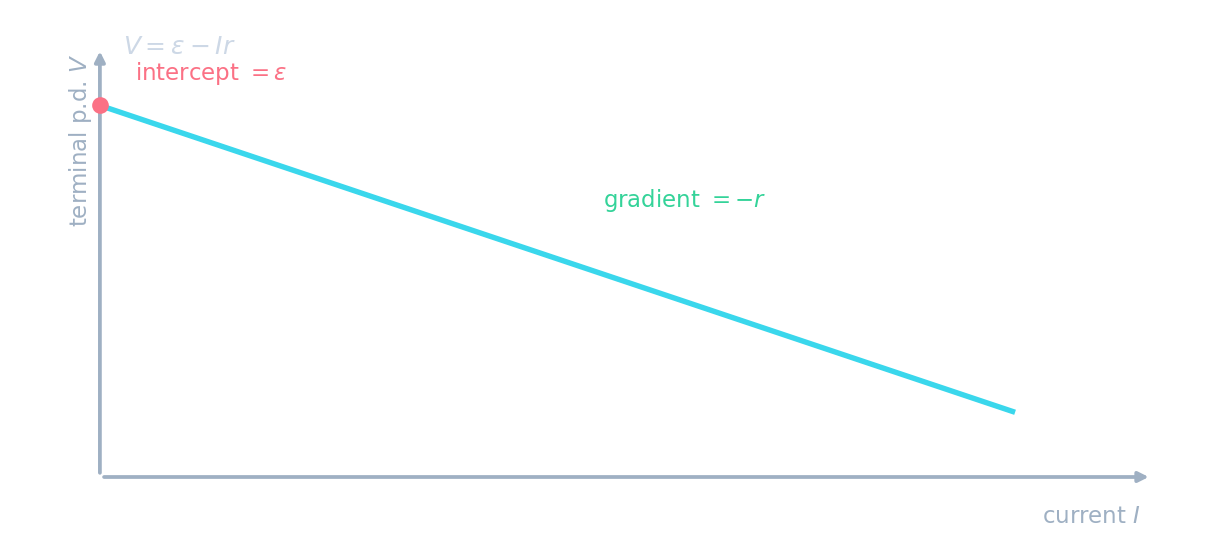
On a terminal-p.d.-against-current graph, match each feature. · 在端电压对电流的图上,把每个特征配对。
From $V = \varepsilon - Ir$: at $I = 0$, $V = \varepsilon$ (intercept); the slope is $-r$. · 由 $V = \varepsilon - Ir$:当 $I = 0$ 时,$V = \varepsilon$(截距);斜率是 $-r$。
Worked example: reading the graph
A $V$–$I$ graph for a cell is a straight line from $(0,\ 1.5\ \text{V})$ to $(3.0\ \text{A},\ 0)$. The external resistor is then made smaller.
- e.m.f.: the intercept, $\varepsilon = 1.5\ \text{V}$.
- Internal resistance: gradient $= \dfrac{0 - 1.5}{3.0 - 0} = -0.50\ \dfrac{\text{V}}{\text{A}}$, so $r = 0.50\ \Omega$.
- Short-circuit current: where the line meets the $I$ axis, $\dfrac{\varepsilon}{r} = 3.0\ \text{A}$.
- Smaller external resistor: the current increases, so the lost volts $Ir$ increase and the terminal p.d. falls — you move down the line to the right.
- Check: the gradient is negative but a resistance is positive; write $r = 0.50\ \Omega$, not $-0.50\ \Omega$.
例题:读图
某电池的 $V$–$I$ 图是一条从 $(0,\ 1.5\ \text{V})$ 到 $(3.0\ \text{A},\ 0)$ 的直线。然后把外电阻调小。
- 电动势: 截距,$\varepsilon = 1.5\ \text{V}$。
- 内阻: 斜率 $= \dfrac{0 - 1.5}{3.0 - 0} = -0.50\ \dfrac{\text{V}}{\text{A}}$,所以 $r = 0.50\ \Omega$。
- 短路电流: 直线与 $I$ 轴的交点,$\dfrac{\varepsilon}{r} = 3.0\ \text{A}$。
- 外电阻调小: 电流 增大,所以内阻压降 $Ir$ 增大,端电压 下降——你沿直线向右下方移动。
- 检查: 斜率为负,但电阻为正;写 $r = 0.50\ \Omega$,不是 $-0.50\ \Omega$。
The external resistance connected to a real cell is decreased. What happens to the terminal p.d., and why? · 接在真实电池上的外电阻减小了。端电压会怎样,为什么?
Smaller external resistance → larger current → larger lost volts $Ir$ → smaller terminal p.d. $\varepsilon - Ir$. The e.m.f. is fixed, but the terminal p.d. is not. · 外电阻更小 → 电流更大 → 内阻压降 $Ir$ 更大 → 端电压 $\varepsilon - Ir$ 更小。电动势固定,但端电压不固定。
The e.m.f. is not "the voltage of the battery" read by any voltmeter. A voltmeter across the terminals reads the terminal p.d., which equals $\varepsilon$ only when no current flows — an ideal voltmeter alone across the cell. Once a load is connected the reading drops by $Ir$. And the gradient of the $V$–$I$ line is $-r$: quote the resistance as a positive number.
电动势 不是 任何电压表读到的"电池的电压"。接在两端的电压表读的是 端电压,它只有在 没有电流 时才等于 $\varepsilon$——即理想电压表单独接在电池上。一旦接上负载,读数就下降 $Ir$。另外,$V$–$I$ 直线的斜率是 $-r$:把电阻写成正数。
When does a voltmeter across a cell's terminals read the e.m.f.? Select all that apply. · 接在电池两端的电压表在什么情况下读出电动势?选出所有正确的。
The reading is $\varepsilon - Ir$. It equals $\varepsilon$ if $r = 0$ or if $I = 0$. With a lamp connected, current flows and the reading drops; on a short circuit it falls to zero. · 读数是 $\varepsilon - Ir$。当 $r = 0$ 或 $I = 0$ 时它等于 $\varepsilon$。接上灯后有电流,读数下降;短路时读数降为零。
Ammeters 电流表, voltmeters 电压表 and the diagram
- An ideal ammeter has zero resistance and goes in series 串联.
- An ideal voltmeter has infinite resistance and goes in parallel 并联.
- When asked to draw the circuit, use the standard symbols and show the internal resistance as a resistor next to the cell.
The standard circuit symbols you need to recognise and draw
电流表、电压表与电路图
- 理想 电流表 电阻为 零,串联 接入。
- 理想 电压表 电阻为 无穷大,并联 接入。
- 当要求 画 电路时,使用标准符号,并把内阻画成电池旁边的一个电阻。

你需要认识并会画的标准电路符号
An ideal ammeter has: · 理想的电流表具有:
An ammeter goes in series and should add no resistance, so an ideal one has zero resistance. · 电流表串联接入,且不应增加任何电阻,所以理想的电流表电阻为零。
An ideal voltmeter has infinite resistance and is connected in parallel. · 理想的电压表有无穷大电阻,并联接入。
Yes — in parallel, with infinite resistance so it draws no current from the component it measures. · 是的——并联接入,电阻无穷大,所以它不从被测元件抽取电流。
You've got it
- terminal p.d. $V = \varepsilon - Ir$ (drops as current rises); $Ir$ is the lost volts
- a $V$–$I$ graph gives $\varepsilon$ (intercept) and $-r$ (gradient); short-circuit current $= \dfrac{\varepsilon}{r}$
- ideal ammeter: 0 Ω in series; ideal voltmeter: ∞ Ω in parallel — it reads $\varepsilon$ only with no current
你掌握了
- 端电压 $V = \varepsilon - Ir$(随电流增大而下降);$Ir$ 是内阻压降
- $V$–$I$ 图给出 $\varepsilon$(截距)和 $-r$(斜率);短路电流 $= \dfrac{\varepsilon}{r}$
- 理想 电流表:0 Ω 串联;理想 电压表:∞ Ω 并联——只有无电流时它才读出 $\varepsilon$