Kirchhoff's laws · 基尔霍夫定律
| English | 中文 | Pinyin · 拼音 |
|---|---|---|
| Kirchhoff's laws/ˈkɜːkhɒfs lɔːz/ | 基尔霍夫定律 | jī ěr huò fū dìng lǜ |
| junctions/ˈdʒʌŋkʃnz/ | 节点 | jié diǎn |
| conservation of charge/ˌkɒnsəˈveɪʃn ɒv tʃɑːdʒ/ | 电荷守恒 | diàn hè shǒu héng |
| conservation of energy/ˌkɒnsəˈveɪʃn ɒv ˈenədʒi/ | 能量守恒 | néng liàng shǒu héng |
| series/ˈsɪəriːz/ | 串联 | chuàn lián |
| parallel/ˈpærəlel/ | 并联 | bìng lián |
Two rules for any circuit
- A tangle of wires can look impossible to solve.
- But just two rules — Kirchhoff's laws 基尔霍夫定律 — crack any of them.
- Each is really a conservation law in disguise.
适用于任何电路的两条规则
- 一团乱麻般的导线看起来不可能求解。
- 但只需 两条规则——基尔霍夫定律(Kirchhoff's laws)——就能破解任何电路。
- 每一条其实都是伪装起来的守恒定律。
First law: junctions 节点
- At any junction, current in = current out.
- It comes from conservation of charge 电荷守恒 — charge cannot pile up at a point.
第一定律:节点
- 在任何节点,流入的电流 = 流出的电流。
- 它来自 电荷守恒——电荷不能在一点堆积。
Series & parallel circuits · 串联和并联电路
Switch between series and parallel and add bulbs. In series they share the voltage and one break kills them all; in parallel each gets the full voltage and a break only loses its branch. · 在串联和并联之间切换并添加灯泡。串联时它们共享电压,一处断开会导致所有灯泡熄灭;并联时每个灯泡获得全电压,一处断开仅影响该支路。
$5.0\ \text{A}$ flows into a junction and splits into two branches; one carries $2.0\ \text{A}$. What does the other carry? · $5.0\ \text{A}$ 流入一个节点并分成两条支路;一条载 $2.0\ \text{A}$。另一条载多少?
Current in = current out: $5.0 = 2.0 + I$, so $I = 3.0\ \text{A}$. · 流入电流 = 流出电流:$5.0 = 2.0 + I$,所以 $I = 3.0\ \text{A}$。
Second law: loops
- Around any closed loop, total e.m.f. = total p.d. across the components.
- It comes from conservation of energy 能量守恒 — each coulomb gives back what it gained.
- Go round the loop in one direction: an e.m.f. counts positive if you pass through the source from $-$ to $+$; a p.d. $IR$ counts positive if you go with the current.
第二定律:回路
- 绕任何闭合回路一周,总电动势 = 各元件上的总电势差。
- 它来自 能量守恒——每库仑电荷交回它所获得的。
- 沿一个方向绕回路:从电源的 $-$ 极穿到 $+$ 极时电动势记为正;顺着电流方向时电势差 $IR$ 记为正。
Match each Kirchhoff law to the conservation law behind it. · 把每条基尔霍夫定律与它背后的守恒定律配对。
Charge cannot build up at a junction; energy a charge gains from sources equals what it gives to components round a loop. · 电荷不能在节点堆积;电荷从电源获得的能量等于它沿回路交给各元件的能量。
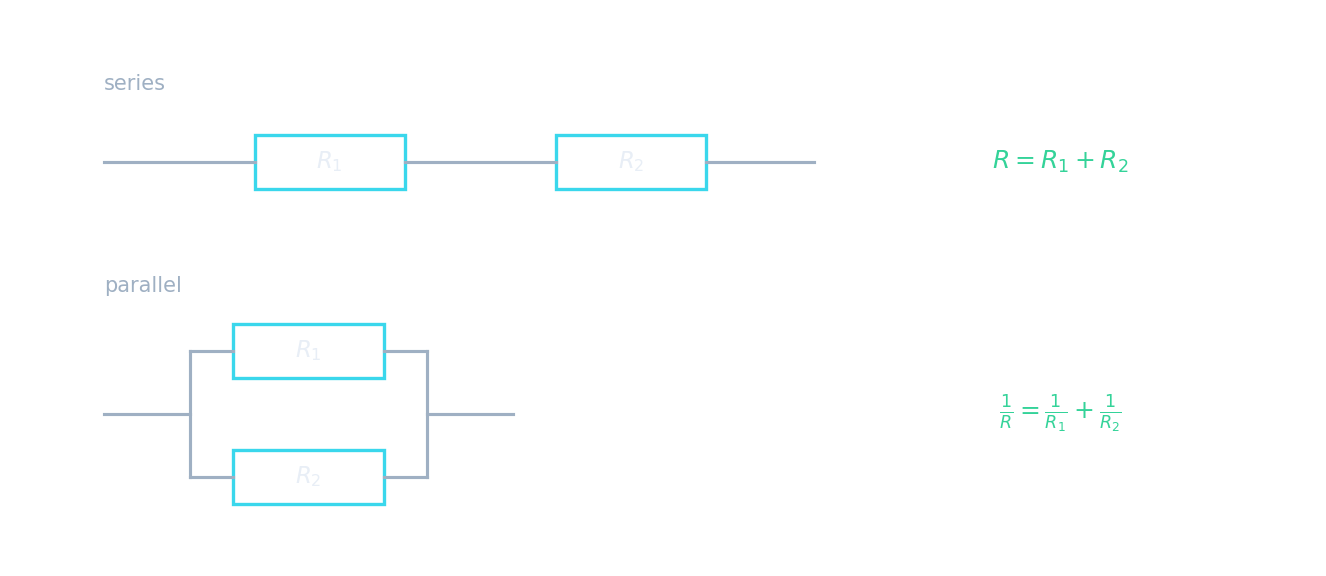
Resistors in series 串联
- Same current through each; the p.d.s add.
- $R_{\text{series}} = R_1 + R_2 + \ldots$ — always larger than each one.
Two resistors in series and their single equivalent resistor
串联电阻
- 每个电阻通过相同的电流;电势差相加。
- $R_{\text{series}} = R_1 + R_2 + \ldots$——总是比其中每一个 更大。

两个串联电阻及其单个等效电阻
A $3.0\ \Omega$ and a $6.0\ \Omega$ resistor are in series. What is the total resistance? · 一个 $3.0\ \Omega$ 和一个 $6.0\ \Omega$ 的电阻串联。总电阻是多少?
$R = R_1 + R_2 = 3.0 + 6.0 = 9.0\ \Omega$. · $R = R_1 + R_2 = 3.0 + 6.0 = 9.0\ \Omega$。
Resistors in parallel 并联
- Same p.d. across each; the currents add.
- $\dfrac{1}{R_{\text{parallel}}} = \dfrac{1}{R_1} + \dfrac{1}{R_2} + \ldots$ — always smaller than the smallest one.
Two resistors in parallel and their single equivalent resistor
并联电阻
- 每个电阻两端电势差相同;电流相加。
- $\dfrac{1}{R_{\text{parallel}}} = \dfrac{1}{R_1} + \dfrac{1}{R_2} + \ldots$——总是比最小的那个 更小。

两个并联电阻及其单个等效电阻
A $3.0\ \Omega$ and a $6.0\ \Omega$ resistor are in parallel. What is the total resistance? · 一个 $3.0\ \Omega$ 和一个 $6.0\ \Omega$ 的电阻并联。总电阻是多少?
$\dfrac{1}{R} = \dfrac{1}{3.0} + \dfrac{1}{6.0} = \dfrac{1}{2.0}$, so $R = 2.0\ \Omega$ — smaller than either. · $\dfrac{1}{R} = \dfrac{1}{3.0} + \dfrac{1}{6.0} = \dfrac{1}{2.0}$,所以 $R = 2.0\ \Omega$——比任何一个都小。
A parallel combination is always smaller than the smallest resistor in it. · 并联组合总是小于其中最小的电阻。
Yes — adding a parallel path gives the current another route, lowering the overall resistance. · 是的——增加一条并联路径给电流多一条通路,降低了总电阻。
Worked example: a cell with a parallel pair
A cell of e.m.f. $6.0\ \text{V}$ and internal resistance $1.0\ \Omega$ is connected to a $4.0\ \Omega$ and a $6.0\ \Omega$ resistor in parallel. Find the current in the cell, the terminal p.d., and the current in each resistor.
- Parallel pair: $\dfrac{1}{R} = \dfrac{1}{4.0} + \dfrac{1}{6.0} = \dfrac{5}{12}$, so $R = 2.4\ \Omega$.
- Whole circuit: $R_{\text{total}} = 2.4 + 1.0 = 3.4\ \Omega$, so $I = \dfrac{6.0}{3.4} = 1.8\ \text{A}$ (second law: $\varepsilon = I(R + r)$).
- Terminal p.d.: $V = 6.0 - 1.8 \times 1.0 = 4.2\ \text{V}$ — the p.d. across both resistors.
- Branch currents: $\dfrac{4.2}{4.0} = 1.1\ \text{A}$ and $\dfrac{4.2}{6.0} = 0.70\ \text{A}$.
- Check (first law): $1.1 + 0.70 = 1.8\ \text{A}$, the current in the cell. The smaller resistor takes the larger share.
例题:电池接一对并联电阻
电动势 $6.0\ \text{V}$、内阻 $1.0\ \Omega$ 的电池接到并联的 $4.0\ \Omega$ 和 $6.0\ \Omega$ 电阻上。求电池中的电流、端电压和每个电阻中的电流。
- 并联对: $\dfrac{1}{R} = \dfrac{1}{4.0} + \dfrac{1}{6.0} = \dfrac{5}{12}$,所以 $R = 2.4\ \Omega$。
- 整个电路: $R_{\text{total}} = 2.4 + 1.0 = 3.4\ \Omega$,所以 $I = \dfrac{6.0}{3.4} = 1.8\ \text{A}$(第二定律:$\varepsilon = I(R + r)$)。
- 端电压: $V = 6.0 - 1.8 \times 1.0 = 4.2\ \text{V}$——两个 电阻两端的电势差。
- 支路电流: $\dfrac{4.2}{4.0} = 1.1\ \text{A}$ 和 $\dfrac{4.2}{6.0} = 0.70\ \text{A}$。
- 检查(第一定律): $1.1 + 0.70 = 1.8\ \text{A}$,即电池中的电流。较小的电阻分得较大的份额。
A cell of e.m.f. $12\ \text{V}$ and internal resistance $2.0\ \Omega$ is connected to two $8.0\ \Omega$ resistors in parallel. What is the terminal p.d., in V? · 电动势 $12\ \text{V}$、内阻 $2.0\ \Omega$ 的电池接到两个并联的 $8.0\ \Omega$ 电阻上。端电压是多少(单位 V)?
Two equal $8.0\ \Omega$ resistors in parallel give $4.0\ \Omega$. $I = \dfrac{12}{4.0 + 2.0} = 2.0\ \text{A}$, so $V = 12 - 2.0 \times 2.0 = 8.0\ \text{V}$. · 两个相等的 $8.0\ \Omega$ 电阻并联得 $4.0\ \Omega$。$I = \dfrac{12}{4.0 + 2.0} = 2.0\ \text{A}$,所以 $V = 12 - 2.0 \times 2.0 = 8.0\ \text{V}$。
Explaining a change with the laws
- A thermistor in parallel with a resistor R, across a real cell. Temperature rises — why does the current in R fall?
- Chain it: thermistor resistance ↓ → total circuit resistance ↓ → current in the cell ↑ → lost volts $Ir$ ↑ → terminal p.d. ↓ → current in R $= \dfrac{V}{R}$ ↓.
- Every arrow is a mark. The current in the cell goes up while the current in R goes down — both at once.
用定律解释一个变化
- 热敏电阻与电阻 R 并联,接在真实电池上。温度升高——R 中的电流为什么 减小?
- 串成链:热敏电阻的电阻 ↓ → 电路总电阻 ↓ → 电池中的电流 ↑ → 内阻压降 $Ir$ ↑ → 端电压 ↓ → R 中的电流 $= \dfrac{V}{R}$ ↓。
- 每个箭头都是一分。电池 中的电流上升,而 R 中的电流下降——两者同时发生。
A thermistor is in parallel with a resistor R across a real cell, and the temperature rises. Put the chain of reasoning in order. · 热敏电阻与电阻 R 并联接在真实电池上,温度升高。把推理链按顺序排列。
Less resistance → more cell current → more lost volts → less terminal p.d. → less current in R. Note the cell current rises while the current in R falls. · 电阻更小 → 电池电流更大 → 内阻压降更大 → 端电压更小 → R 中电流更小。注意电池电流上升而 R 中电流下降。
Solving a circuit
- Label every current with a direction.
- Apply the junction rule and the loop rule, plus $V = IR$, then solve together.
求解电路
- 给每个电流标上方向。
- 应用 节点 规则和 回路 规则,加上 $V = IR$,然后联立求解。
Two equal resistors $R$ in parallel give a combined resistance of: · 两个相等的电阻 $R$ 并联,合并电阻是:
$\dfrac{1}{R_{\text{tot}}} = \dfrac{1}{R} + \dfrac{1}{R} = \dfrac{2}{R}$, so $R_{\text{tot}} = \tfrac{1}{2}R$. · $\dfrac{1}{R_{\text{tot}}} = \dfrac{1}{R} + \dfrac{1}{R} = \dfrac{2}{R}$,所以 $R_{\text{tot}} = \tfrac{1}{2}R$。
The parallel formula gives $\dfrac{1}{R}$ — invert at the end, or you will quote $0.42\ \Omega$ for a $2.4\ \Omega$ pair. Two equal resistors in parallel give exactly half. Adding any resistor in parallel always lowers the total. And all branches in parallel have the same p.d., so you never add p.d.s across parallel branches.
并联公式给出的是 $\dfrac{1}{R}$——最后要 取倒数,否则你会把 $2.4\ \Omega$ 的一对写成 $0.42\ \Omega$。两个 相等 的电阻并联恰好得到 一半。并联任何一个电阻总会 降低 总电阻。另外,并联的所有支路 电势差相同,所以绝不要把并联支路上的电势差相加。
Components connected in parallel always have the same ____ across them. · 并联的元件两端总是有相同的 ____。
Parallel branches share the same two junctions, so the p.d. across each is identical; the currents are what differ. · 并联支路共用同样的两个节点,所以每条支路两端的电势差相同;不同的是电流。
You've got it
- first law (junctions): current in = current out — conservation of charge
- second law (loops): total e.m.f. = total p.d. — conservation of energy; $\varepsilon = I(R + r)$
- series: $R = R_1 + R_2$; parallel: $\dfrac{1}{R} = \dfrac{1}{R_1} + \dfrac{1}{R_2}$ (then invert); a change anywhere alters the cell current and the terminal p.d.
你掌握了
- 第一定律(节点):流入电流 = 流出电流——电荷守恒
- 第二定律(回路):总电动势 = 总电势差——能量守恒;$\varepsilon = I(R + r)$
- 串联:$R = R_1 + R_2$;并联:$\dfrac{1}{R} = \dfrac{1}{R_1} + \dfrac{1}{R_2}$(然后取倒数);任何地方的变化都会改变电池电流和端电压