Resistance and resistivity · 电阻与电阻率
| English | 中文 | Pinyin · 拼音 |
|---|---|---|
| resistance/rɪˈzɪstəns/ | 电阻 | diàn zǔ |
| Ohm's law/əʊmz lɔː/ | 欧姆定律 | ōu mǔ dìng lǜ |
| conductor/kənˈdʌktə/ | 导体 | dǎo tǐ |
| filament lamp/ˈfɪləmənt læmp/ | 灯丝灯泡 | dēng sī dēng pào |
| diode/ˈdaɪəʊd/ | 二极管 | èr jí guǎn |
| semiconductor/ˌsemɪkənˈdʌktə/ | 半导体 | bàn dǎo tǐ |
| lattice/ˈlætɪs/ | 晶格 | jīng gé |
| resistivity/ˌriːzɪˈstɪvəti/ | 电阻率 | diàn zǔ lǜ |
| thermistor/ˈθɜːmɪstə/ | 热敏电阻 | rè mǐn diàn zǔ |
Why the kettle element glows
- A kettle's element gets red-hot, but the cable feeding it stays cool.
- The element has a high resistance 电阻 — it turns electrical energy into heat.
- Resistance controls where the energy goes.
为什么电热水壶的加热丝会发红
- 水壶的加热丝烧得通红,而给它供电的电线却是凉的。
- 加热丝有很高的 电阻(resistance)——它把电能变成热。
- 电阻决定能量去哪里。
Resistance
- Resistance $R = \dfrac{V}{I}$, in ohms ($\Omega$): the p.d. across a component divided by the current in it.
- That is the definition, and it applies to every component. It depends on the conditions — especially the temperature.
Real fixed resistors: the coloured bands code the resistance value
电阻
- 电阻 $R = \dfrac{V}{I}$,单位欧姆($\Omega$):元件两端的电势差除以通过它的电流。
- 这是 定义,适用于每一个元件。它取决于条件——尤其是 温度。

真实的定值电阻:彩色色环编码电阻值
Resistance (Ohm's law) · 电阻(欧姆定律)
V = R·I
Ohm's law: voltage is proportional to current — the gradient is the resistance R. · 欧姆定律:电压与电流 成正比——斜率是电阻 R。
A component has $12\ \text{V}$ across it and $3.0\ \text{A}$ through it. What is its resistance? · 一个元件两端是 $12\ \text{V}$,通过它的电流是 $3.0\ \text{A}$。它的电阻是多少?
$R = \dfrac{V}{I} = \dfrac{12}{3.0} = 4.0\ \Omega$. · $R = \dfrac{V}{I} = \dfrac{12}{3.0} = 4.0\ \Omega$。
Ohm's law 欧姆定律
- A conductor 导体 obeys Ohm's law when $I \propto V$ (at constant temperature) — so $R$ is constant.
- This is an experimental result, not the definition. $R = \dfrac{V}{I}$ works for any component.
欧姆定律
- 当 $I \propto V$(温度恒定)时,导体遵守 欧姆定律——因此 $R$ 恒定。
- 这是一个实验结果,不是定义。$R = \dfrac{V}{I}$ 对 任何 元件都成立。
An ohmic conductor at constant temperature has: · 恒温下的欧姆导体具有:
Ohm's law: · 欧姆定律: $I \propto V$, so $R = \dfrac{V}{I}$ is constant and the $I$–$V$ graph is a straight line through the origin. · 欧姆定律:$I \propto V$,所以 $R = \dfrac{V}{I}$ 恒定,$I$–$V$ 图是一条过原点的直线。
I–V characteristics
- Metal wire (constant temp): straight line — constant $R$.
- Filament lamp 灯丝灯泡: curves over — heating raises $R$.
- Diode 二极管: passes current one way only (above ~0.7 V).
I-V characteristic of a semiconductor 半导体 diode
I–V 特性曲线
- 金属导线(温度恒定):直线——$R$ 恒定。
- 灯丝灯泡:曲线弯折——发热使 $R$ 升高。
- 二极管:只允许电流单向通过(约 0.7 V 以上)。

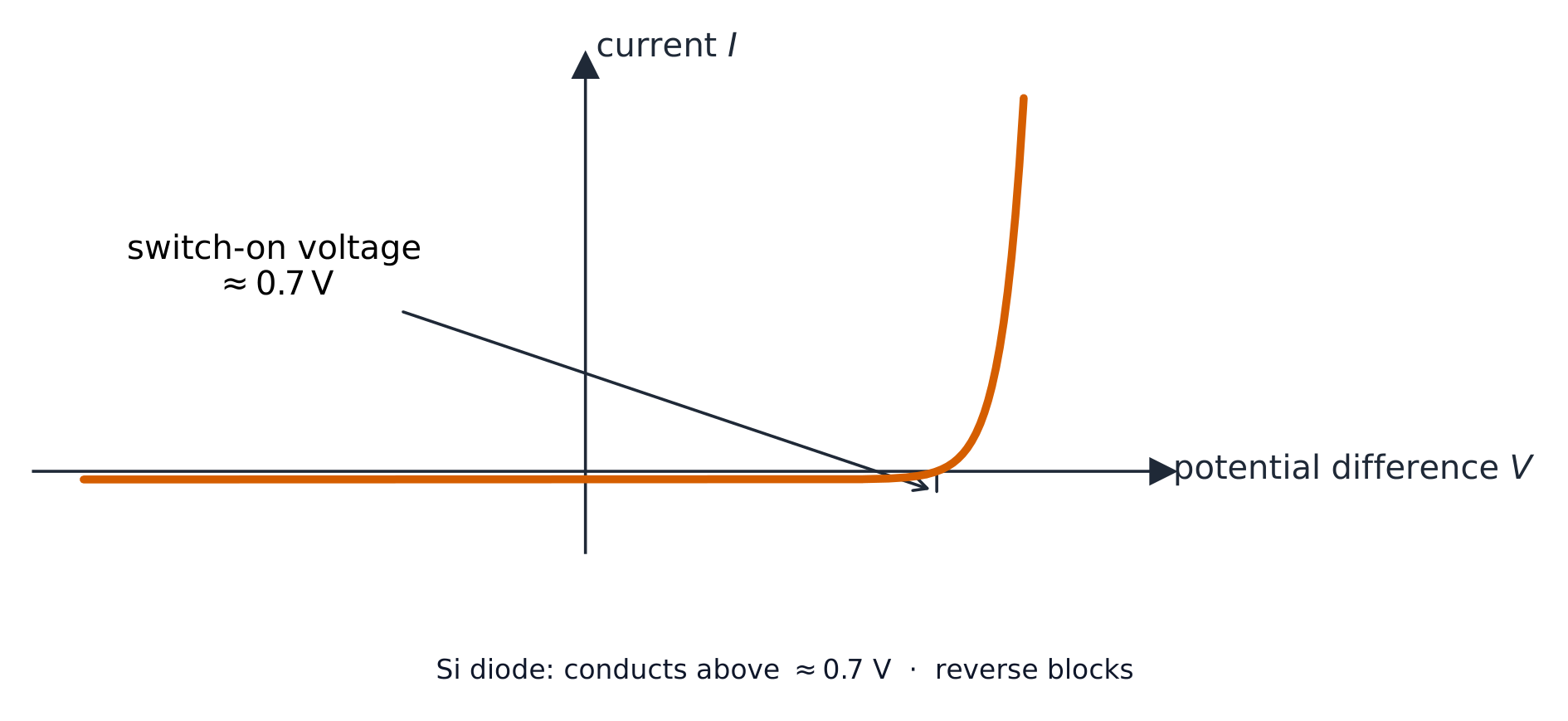
半导体二极管的 I-V 特性曲线
Match each component to its $I$–$V$ characteristic. · 把每个元件与它的 $I$–$V$ 特性配对。
Constant $R$ → straight line; heating raises $R$ → flattening curve; a diode blocks reverse current. · $R$ 恒定 → 直线;加热使 $R$ 增大 → 变平的曲线;二极管阻断反向电流。
A filament lamp's resistance rises at higher voltage because: · 白炽灯的电阻在更高电压下增大,因为:
More current heats the filament; in a metal, more lattice vibration scatters electrons, so $R$ increases. · 更大的电流使灯丝变热;在金属中,更多的晶格振动散射电子,所以 $R$ 增大。
Why the lamp's resistance rises
- The exam chain: a larger current → more heating → higher temperature → the metal ions in the lattice 晶格 vibrate more → the free electrons collide more often → resistance increases.
- Read $R$ off an $I$–$V$ graph as $\dfrac{V}{I}$ at that point — not as the gradient. Only for a straight line through the origin are the two the same.
为什么灯泡的电阻会升高
- 考试的推理链:电流增大 → 更多 发热 → 温度升高 → 晶格中的金属离子 振动更剧烈 → 自由电子 碰撞更频繁 → 电阻 增大。
- 从 $I$–$V$ 图上读 $R$,用 该点处 的 $\dfrac{V}{I}$——而不是斜率。只有过原点的直线,两者才相同。
Put the steps of the explanation for why a filament lamp's resistance rises with current in order. · 把"为什么灯丝灯泡的电阻随电流增大"的解释步骤按顺序排列。
Heating → more lattice vibration → more frequent collisions → higher resistance. Each link is a mark in the exam explanation. · 发热 → 晶格振动更剧烈 → 碰撞更频繁 → 电阻更大。每一环都是考试解释中的一分。
Resistivity 电阻率
- $R = \dfrac{\rho L}{A}$ — $\rho$ is the resistivity, a property of the material ($\Omega\cdot\text{m}$).
- Longer wire → more $R$; thicker wire → less $R$.
- To measure it: ammeter in series with the wire, voltmeter across it, a variable supply (or variable resistor) to take several readings; $R$ is the gradient of $V$ against $I$; measure $L$ with a rule and the diameter with a micrometer at several places.
A longer conductor has more resistance
电阻率
- $R = \dfrac{\rho L}{A}$——$\rho$ 是 电阻率(resistivity),是材料的属性($\Omega\cdot\text{m}$)。
- 导线越长 → $R$ 越大;导线越粗 → $R$ 越小。
- 测量方法: 电流表与导线串联,电压表并联在导线两端,用可调电源(或可变电阻)取多组读数;$R$ 是 $V$–$I$ 图的斜率;用尺测 $L$,用螺旋测微器在多处测直径。

更长的导体有更大的电阻
What resistance depends on: R = ρL/A · 电阻取决于什么:R = ρL/A
A longer wire has more resistance; a thicker one (bigger area) has less. Change the length, area and metal. · 更长的导线电阻更大;更粗的(面积更大)电阻更小。改变长度、面积和金属。
A wire has resistivity $2.0 \times 10^{-8}\ \Omega\cdot\text{m}$, length $10\ \text{m}$ and area $2.0 \times 10^{-6}\ \text{m}^2$. Find its resistance. · 一根导线的电阻率为 $2.0 \times 10^{-8}\ \Omega\cdot\text{m}$,长度 $10\ \text{m}$,面积 $2.0 \times 10^{-6}\ \text{m}^2$。求它的电阻。
$R = \dfrac{\rho L}{A} = \dfrac{2.0 \times 10^{-8} \times 10}{2.0 \times 10^{-6}} = 0.10\ \Omega$. · $R = \dfrac{\rho L}{A} = \dfrac{2.0 \times 10^{-8} \times 10}{2.0 \times 10^{-6}} = 0.10\ \Omega$。
Doubling a wire's length doubles its resistance (same material and area). · 把导线的长度加倍会使它的电阻加倍(材料和面积相同)。
$R = \dfrac{\rho L}{A}$, so $R \propto L$ — twice the length, twice the resistance. · $R = \dfrac{\rho L}{A}$,所以 $R \propto L$——长度两倍,电阻两倍。
Worked example: resistivity with its uncertainty
A nichrome wire of length $1.20\ \text{m}$ ($\pm 0.5\%$) and diameter $0.40\ \text{mm}$ ($\pm 2.5\%$) has $3.00\ \text{V}$ ($\pm 1\%$) across it when the current is $0.600\ \text{A}$ ($\pm 1\%$). Find the resistivity and its uncertainty.
- Resistance: $R = \dfrac{V}{I} = \dfrac{3.00}{0.600} = 5.00\ \Omega$.
- Area: $A = \dfrac{\pi d^{2}}{4} = \dfrac{\pi (0.40 \times 10^{-3})^{2}}{4} = 1.26 \times 10^{-7}\ \text{m}^{2}$.
- Resistivity: $\rho = \dfrac{RA}{L} = \dfrac{5.00 \times 1.26 \times 10^{-7}}{1.20} = 5.24 \times 10^{-7}\ \Omega\,\text{m}$.
- Percentage uncertainty: add them, counting the diameter twice because it is squared: $1 + 1 + 2(2.5) + 0.5 = 7.5\%$.
- Absolute uncertainty: $0.075 \times 5.24 \times 10^{-7} = 0.4 \times 10^{-7}$, so $\rho = (5.2 \pm 0.4) \times 10^{-7}\ \Omega\,\text{m}$.
- Check: the diameter dominates the uncertainty — which is why it is measured with a micrometer, several times, and averaged.
例题:电阻率及其不确定度
一根镍铬合金丝长 $1.20\ \text{m}$($\pm 0.5\%$),直径 $0.40\ \text{mm}$($\pm 2.5\%$),电流为 $0.600\ \text{A}$($\pm 1\%$)时两端电压为 $3.00\ \text{V}$($\pm 1\%$)。求电阻率及其不确定度。
- 电阻: $R = \dfrac{V}{I} = \dfrac{3.00}{0.600} = 5.00\ \Omega$。
- 面积: $A = \dfrac{\pi d^{2}}{4} = \dfrac{\pi (0.40 \times 10^{-3})^{2}}{4} = 1.26 \times 10^{-7}\ \text{m}^{2}$。
- 电阻率: $\rho = \dfrac{RA}{L} = \dfrac{5.00 \times 1.26 \times 10^{-7}}{1.20} = 5.24 \times 10^{-7}\ \Omega\,\text{m}$。
- 百分比不确定度: 相加,直径因为被平方要算 两次:$1 + 1 + 2(2.5) + 0.5 = 7.5\%$。
- 绝对不确定度: $0.075 \times 5.24 \times 10^{-7} = 0.4 \times 10^{-7}$,所以 $\rho = (5.2 \pm 0.4) \times 10^{-7}\ \Omega\,\text{m}$。
- 检查: 直径主导了不确定度——这就是为什么要用螺旋测微器多次测量并取平均。
In a resistivity measurement the percentage uncertainties are: $V$ 2%, $I$ 1%, diameter 3%, length 1%. What is the percentage uncertainty in $\rho = \dfrac{RA}{L}$? · 在一次电阻率测量中,百分比不确定度为:$V$ 2%,$I$ 1%,直径 3%,长度 1%。$\rho = \dfrac{RA}{L}$ 的百分比不确定度是多少?
$\rho \propto \dfrac{V d^{2}}{I L}$, so add $2 + 1 + 2(3) + 1 = 10\%$. The diameter counts twice because it is squared. · $\rho \propto \dfrac{V d^{2}}{I L}$,所以相加 $2 + 1 + 2(3) + 1 = 10\%$。直径因被平方而算两次。
$R = \dfrac{V}{I}$ is the definition and works for everything; Ohm's law is the special case where it stays constant. Resistance is not the gradient of an $I$–$V$ curve. The diameter is squared in $A = \dfrac{\pi d^{2}}{4}$, so its percentage uncertainty counts twice — and use the diameter in metres.
$R = \dfrac{V}{I}$ 是 定义,对一切都成立;欧姆定律是它保持恒定的特殊情况。电阻 不是 $I$–$V$ 曲线的斜率。在 $A = \dfrac{\pi d^{2}}{4}$ 中直径被 平方,所以它的百分比不确定度要算两次——而且直径要用 米 作单位。
Light and heat sensors
- An LDR's resistance falls as light gets brighter (megaohms in the dark, hundreds of ohms in light).
- A thermistor 热敏电阻 (NTC)'s resistance falls as it gets hotter — both are semiconductors.
A thermistor's resistance drops sharply as it gets hotter — the basis of a temperature sensor
光与热传感器
- LDR 的电阻随光变亮而 减小(黑暗中是兆欧,光亮时是几百欧)。
- 热敏电阻(thermistor)(NTC)的电阻随温度升高而 减小——两者都是半导体。
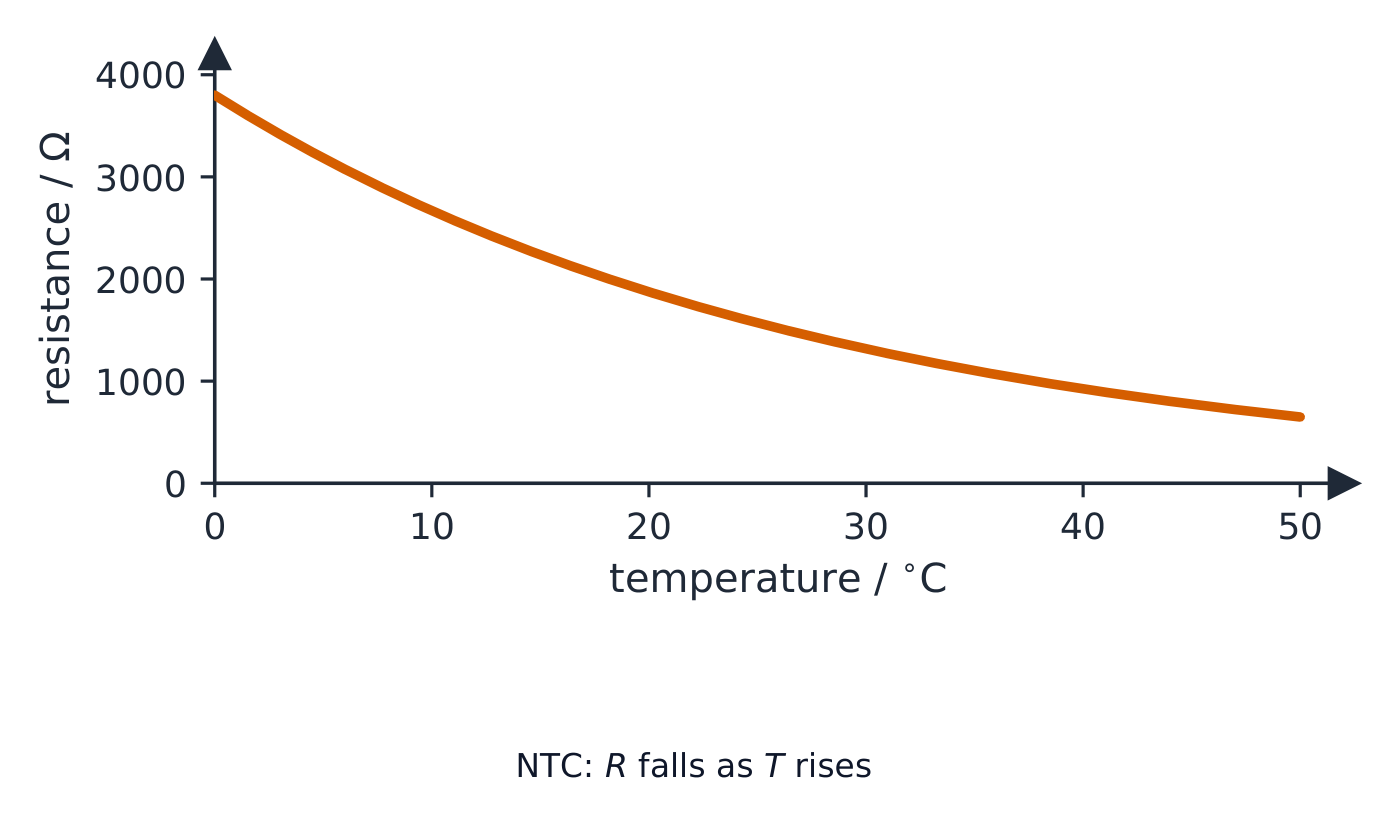
热敏电阻的电阻随温度升高而急剧下降——温度传感器的基础
Select all · 所有 the true statements. · 选出所有正确的说法。
LDRs and NTC thermistors (semiconductors) drop in resistance with more light/heat. A metal does the opposite — its resistance rises with temperature. · 光敏电阻和 NTC 热敏电阻(半导体)的电阻随光/热增加而下降。金属则相反——它的电阻随温度升高而增大。
You've got it
- resistance $R = \dfrac{V}{I}$ (the definition, at a point — never a gradient); Ohm's law: $I \propto V$ at constant temperature
- filament lamp curves because heating makes the lattice vibrate more and electrons collide more; a diode is one-way
- resistivity $R = \dfrac{\rho L}{A}$, with the diameter's uncertainty counted twice; LDR ↓ with light, thermistor ↓ with heat
你掌握了
- 电阻 $R = \dfrac{V}{I}$(定义,在某一点处——绝不是斜率);欧姆定律:温度恒定时 $I \propto V$
- 灯丝灯泡曲线弯折,因为发热使晶格振动更剧烈、电子碰撞更多;二极管是单向的
- 电阻率 $R = \dfrac{\rho L}{A}$,直径的不确定度算两次;LDR 随光 ↓,热敏电阻随热 ↓