Potential difference and power · 电势差与功率
| English | 中文 | Pinyin · 拼音 |
|---|---|---|
| potential difference/pəˈtenʃl ˈdɪfrəns/ | 电势差 | diàn shì chà |
| volt/vəʊlt/ | 伏特 | fú tè |
| electromotive force/ɪˌlektrəʊˈməʊtɪv fɔːs/ | 电动势 | diàn dòng shì |
| electrical power/ɪˈlektrɪkl ˈpaʊə/ | 电功率 | diàn gōng lǜ |
| Ohm's law/əʊmz lɔː/ | 欧姆定律 | ōu mǔ dìng lǜ |
What "voltage" really means
- A 240 V supply is dangerous; a 1.5 V cell is harmless.
- The difference is the energy each coulomb of charge carries.
- That energy-per-charge is the potential difference 电势差.
"电压"到底是什么意思
- 240 V 的电源很危险;1.5 V 的电池却无害。
- 区别在于 每库仑电荷携带的能量。
- 这个每单位电荷的能量就是 电势差(potential difference)。
Potential difference
- p.d. is the energy transferred per unit charge: $V = \dfrac{W}{Q}$.
- Unit: the volt 伏特, $1\ \text{V} = 1\ \dfrac{\text{J}}{\text{C}}$.
- The exam definition needs both halves: "the energy transferred from electrical to other forms per unit charge passing through the component".
电势差
- 电势差(p.d.) 是每单位电荷转移的能量:$V = \dfrac{W}{Q}$。
- 单位:伏特,$1\ \text{V} = 1\ \dfrac{\text{J}}{\text{C}}$。
- 考试定义需要两个部分:"通过元件的 每单位电荷 从电能 转移 为其他形式的能量"。
Potential difference is the energy transferred per unit: · 电势差是每单位什么所转移的能量:
$V = \dfrac{W}{Q}$ — energy per unit charge, in joules per coulomb (volts). · $V = \dfrac{W}{Q}$——每单位电荷的能量,单位是每库仑焦耳(伏特)。
One volt equals one joule per ____. · 一伏特等于每 ____ 一焦耳。
$1\ \text{V} = 1\ \dfrac{\text{J}}{\text{C}}$ — one joule of energy moved per coulomb of charge. · $1\ \text{V} = 1\ \dfrac{\text{J}}{\text{C}}$——每库仑电荷移动一焦耳的能量。
e.m.f. vs p.d.
- e.m.f. (electromotive force 电动势) = energy a source gives to each coulomb (from chemical or other forms into electrical).
- p.d. = energy a coulomb gives up to a component (from electrical into other forms). Same unit, opposite roles.
Voltage is energy per charge. A 240 V supply gives each coulomb 160 times more energy than a 1.5 V cell — that's why it's dangerous.
电动势(e.m.f.)与电势差
- 电动势(electromotive force) = 电源 给予 每库仑电荷的能量(从化学能或其他形式变成电能)。
- 电势差 = 每库仑电荷 交给 元件的能量(从电能变成其他形式)。单位相同,角色相反。
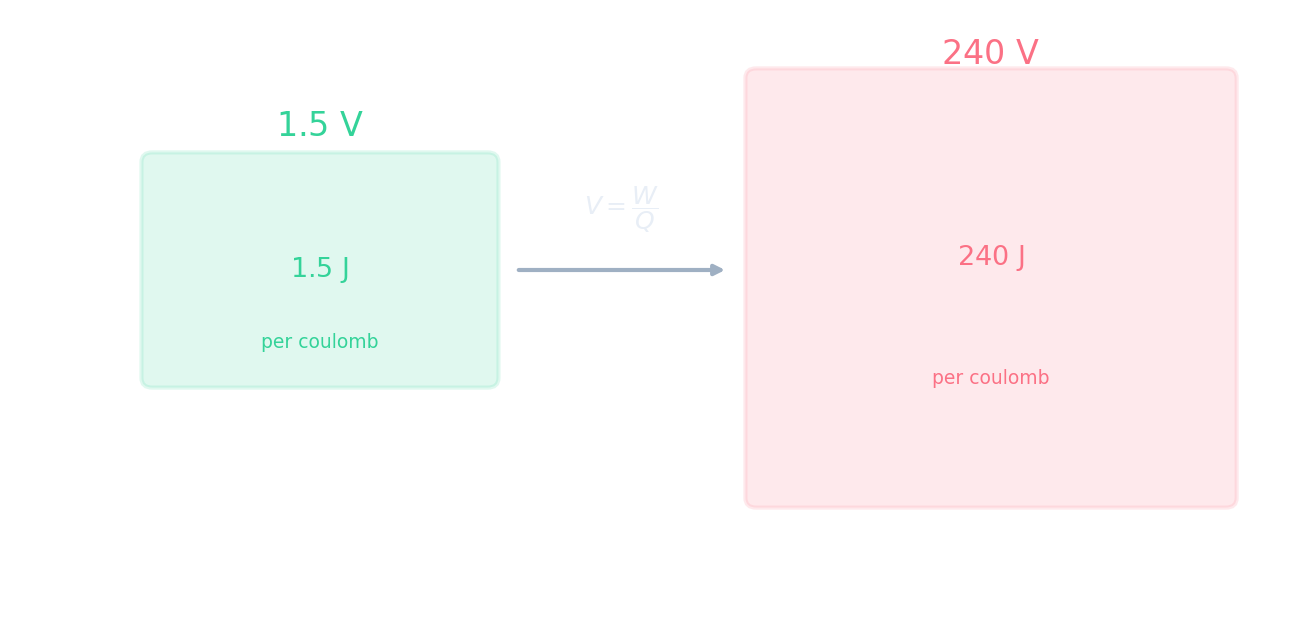
电压是每单位电荷的能量。240 V 电源给每库仑的能量是 1.5 V 电池的 160 倍——这就是它危险的原因。
Both e.m.f. and potential difference are measured in volts. · 电动势和电势差都以伏特为单位。
Yes — both are energy per unit charge (J/C). The difference is whether energy is given to, or taken from, the charge. · 是的——两者都是每单位电荷的能量(J/C)。区别在于能量是给电荷,还是从电荷取走。
Worked example: charge, energy, power
A battery drives $0.50\ \text{A}$ through a lamp for $4.0$ minutes. The p.d. across the lamp is $6.0\ \text{V}$.
- Charge: $Q = It = 0.50 \times 240 = 120\ \text{C}$ (minutes → seconds).
- Energy transferred in the lamp: $W = VQ = 6.0 \times 120 = 720\ \text{J}$.
- Power: $P = \dfrac{W}{t} = \dfrac{720}{240} = 3.0\ \text{W}$ — the same as $VI = 6.0 \times 0.50$.
- Check: each coulomb delivers $6\ \text{J}$, and $120$ coulombs pass, so $720\ \text{J}$; the two routes to the power must agree.
例题:电荷、能量、功率
一个电池驱动 $0.50\ \text{A}$ 的电流通过一盏灯 $4.0$ 分钟。灯两端的电势差为 $6.0\ \text{V}$。
- 电荷: $Q = It = 0.50 \times 240 = 120\ \text{C}$(分钟 → 秒)。
- 灯中转移的能量: $W = VQ = 6.0 \times 120 = 720\ \text{J}$。
- 功率: $P = \dfrac{W}{t} = \dfrac{720}{240} = 3.0\ \text{W}$——与 $VI = 6.0 \times 0.50$ 相同。
- 检查: 每库仑交出 $6\ \text{J}$,通过了 $120$ 库仑,所以是 $720\ \text{J}$;求功率的两条路必须一致。
A p.d. of $9.0\ \text{V}$ drives $40\ \text{C}$ of charge through a resistor. How much energy is transferred in the resistor, in J? · $9.0\ \text{V}$ 的电势差驱动 $40\ \text{C}$ 的电荷通过一个电阻。电阻中转移了多少能量(单位 J)?
$W = VQ = 9.0 \times 40 = 360\ \text{J}$ — nine joules for every coulomb. · $W = VQ = 9.0 \times 40 = 360\ \text{J}$——每库仑九焦耳。
Electrical power 电功率
- Combining $V = \dfrac{W}{Q}$ and $I = \dfrac{Q}{t}$ gives $P = VI$.
- Energy transferred in a time is $E = Pt$.
电功率
- 把 $V = \dfrac{W}{Q}$ 和 $I = \dfrac{Q}{t}$ 结合,得到 $P = VI$。
- 一段时间内转移的能量是 $E = Pt$。
Electrical power · 电功率
P = VI
At a fixed voltage, power is proportional to the current it drives. · 在固定电压下,功率与驱动电流成正比。
A device runs at $12\ \text{V}$ and draws $2.0\ \text{A}$. What is its power? · 一个器件在 $12\ \text{V}$ 下工作,抽取 $2.0\ \text{A}$。它的功率是多少?
$P = VI = 12 \times 2.0 = 24\ \text{W}$. · $P = VI = 12 \times 2.0 = 24\ \text{W}$。
Three forms of power
- With Ohm's law 欧姆定律 ($V = IR$): $P = VI = I^{2}R = \dfrac{V^{2}}{R}$.
- Choose the form that uses the quantities you already know.
功率的三种形式
- 结合欧姆定律($V = IR$):$P = VI = I^{2}R = \dfrac{V^{2}}{R}$。
- 选择使用你已知量的那种形式。
Which form of electrical power uses only the voltage and the resistance? · 哪种电功率形式只用到电压和电阻?
$P = \dfrac{V^{2}}{R}$ needs only $V$ and $R$ — handy when you do not know the current. · $P = \dfrac{V^{2}}{R}$ 只需要 $V$ 和 $R$——当你不知道电流时很方便。
A $100\ \text{W}$ lamp is on for $60\ \text{s}$. How much energy does it transfer? · 一盏 $100\ \text{W}$ 的灯亮了 $60\ \text{s}$。它转移多少能量?
$E = Pt = 100 \times 60 = 6000\ \text{J}$. · $E = Pt = 100 \times 60 = 6000\ \text{J}$。
Worked example: which form to use
A $12\ \text{V}$ heater draws $5.0\ \text{A}$. Find its power and resistance, the power if it were run from $6.0\ \text{V}$ instead, and the energy it transfers in $10$ minutes at full power.
- Power: $P = VI = 12 \times 5.0 = 60\ \text{W}$.
- Resistance: $R = \dfrac{V}{I} = \dfrac{12}{5.0} = 2.4\ \Omega$.
- On $6.0\ \text{V}$: with $R$ unchanged, $P = \dfrac{V^{2}}{R} = \dfrac{6.0^{2}}{2.4} = 15\ \text{W}$ — halving the voltage quarters the power.
- Energy: $E = Pt = 60 \times 600 = 3.6 \times 10^{4}\ \text{J} = 36\ \text{kJ}$.
- Check: $I^{2}R$ gives the same $60\ \text{W}$: $5.0^{2} \times 2.4 = 60$. All three forms agree because $R$ is fixed.
例题:用哪种形式
一个 $12\ \text{V}$ 的加热器通有 $5.0\ \text{A}$ 电流。求它的功率和电阻、改用 $6.0\ \text{V}$ 时的功率,以及它在满功率下 $10$ 分钟内转移的能量。
- 功率: $P = VI = 12 \times 5.0 = 60\ \text{W}$。
- 电阻: $R = \dfrac{V}{I} = \dfrac{12}{5.0} = 2.4\ \Omega$。
- 用 $6.0\ \text{V}$: $R$ 不变,$P = \dfrac{V^{2}}{R} = \dfrac{6.0^{2}}{2.4} = 15\ \text{W}$——电压减半,功率变为 四分之一。
- 能量: $E = Pt = 60 \times 600 = 3.6 \times 10^{4}\ \text{J} = 36\ \text{kJ}$。
- 检查: $I^{2}R$ 给出同样的 $60\ \text{W}$:$5.0^{2} \times 2.4 = 60$。三种形式一致,因为 $R$ 是固定的。
A fixed resistor is moved from a $12\ \text{V}$ supply to a $6.0\ \text{V}$ supply. Which statements are true? Select all that apply. · 一个定值电阻从 $12\ \text{V}$ 电源换到 $6.0\ \text{V}$ 电源。下列哪些说法正确?选出所有正确的。
With $R$ fixed, $I = \dfrac{V}{R}$ halves and $P = \dfrac{V^{2}}{R}$ falls to a quarter. The resistance itself does not change. · $R$ 固定时,$I = \dfrac{V}{R}$ 减半,$P = \dfrac{V^{2}}{R}$ 降到四分之一。电阻本身不变。
$I^{2}R$ and $\dfrac{V^{2}}{R}$ only agree when $R$ is constant. For a filament lamp $R$ rises as it heats, so doubling the voltage gives less than four times the power. Convert minutes to seconds before $E = Pt$. And a volt is a joule per coulomb — not a joule per second, which is a watt.
只有当 $R$ 恒定 时,$I^{2}R$ 和 $\dfrac{V^{2}}{R}$ 才一致。对于灯丝灯泡,$R$ 随温度升高而增大,所以电压加倍得到的功率 少于 四倍。在用 $E = Pt$ 之前把分钟换成秒。另外,伏特是每 库仑 的焦耳——不是每秒的焦耳,那是瓦特。
One volt is one joule per second. · 一伏特等于一焦耳每秒。
One volt is one joule per coulomb — energy per charge. One joule per second is one watt, a power. · 一伏特是一焦耳每 库仑——每单位电荷的能量。一焦耳每秒是一瓦特,是功率。
You've got it
- p.d. is energy transferred per unit charge: $V = \dfrac{W}{Q}$ (volt = joule per coulomb)
- e.m.f. is energy given to charge by the source; p.d. is energy given up by charge
- power $P = VI = I^{2}R = \dfrac{V^{2}}{R}$ (the last two need constant $R$); energy $E = Pt$
你掌握了
- 电势差是每单位电荷转移的能量:$V = \dfrac{W}{Q}$(伏特 = 焦耳每库仑)
- 电动势 是电源 给予 电荷的能量;电势差 是电荷 交出 的能量
- 功率 $P = VI = I^{2}R = \dfrac{V^{2}}{R}$(后两个需要 $R$ 恒定);能量 $E = Pt$