Electric current · 电流
| English | 中文 | Pinyin · 拼音 |
|---|---|---|
| current/ˈkʌrənt/ | 电流 | diànliú |
| charge carriers/tʃɑːdʒ ˈkærɪəz/ | 载流子 | zài liú zi |
| conventional current/kənˈvenʃənl ˈkʌrənt/ | 常规电流 | cháng guī diàn liú |
| quantised/ˈkwɒntaɪzd/ | 量子化 | liàng zǐ huà |
| elementary charge/ˌelɪˈmentəri tʃɑːdʒ/ | 基本电荷 | jī běn diàn hè |
| coulomb/ˈkuːlɒm/ | 库仑 | kù lún |
| drift velocity/drɪft vəˈlɒsɪti/ | 漂移速度 | piāo yí sù dù |
| number density/ˈnʌmbə ˈdensɪti/ | 数密度 | shù mì dù |
| semiconductor/ˌsemɪkənˈdʌktə/ | 半导体 | bàn dǎo tǐ |
Slower than a snail
- Flip a switch and the light comes on instantly.
- Yet the electrons themselves drift through the wire slower than a snail.
- The push (the electric field) travels fast; the charges crawl.
比蜗牛还慢
- 按下开关,灯立刻亮起。
- 然而电子本身在导线中 漂移 的速度比蜗牛还慢。
- 推力(电场)传播得很快;电荷却在爬行。
What current 电流 is
- An electric current is a flow of charge carriers 载流子 (electrons in a metal, ions in a liquid).
- Conventional current 常规电流 points the way positive charge would flow — opposite to the electrons.
Charge carriers drifting inside a conductor
什么是电流
- 电流(current) 是 载流子(charge carriers) 的流动(金属中是电子,液体中是离子)。
- 常规电流(conventional current) 指向 正 电荷流动的方向——与电子相反。

导体内漂移的载流子
Current, voltage and resistance · 电流、电压与电阻
Current is the rate of flow of charge. Raise the voltage and current rises; raise the resistance and it falls — I = V / R. · 电流是电荷流动的速率。升高电压,电流增大;增大电阻,电流减小——I = V / R。
Conventional current points in the direction that: · 传统电流指向以下哪种方向:
Conventional current is the flow of positive charge — opposite to the electron drift in a metal wire. · 传统电流是正电荷的流动——与金属丝中电子的漂移方向相反。
Charge comes in lumps
- Charge is quantised 量子化: the smallest free unit is the elementary charge 基本电荷 $e = 1.60 \times 10^{-19}\ \text{C}$.
- Every free charge is a whole-number multiple of $e$. Unit of charge: the coulomb 库仑 (C).
电荷是一份一份的
- 电荷是 量子化(quantised) 的:最小的自由单位是 基本电荷(elementary charge) $e = 1.60 \times 10^{-19}\ \text{C}$。
- 每个自由电荷都是 $e$ 的整数倍。电荷的单位:库仑(C)。
The smallest free unit of charge is the ____ charge, $e = 1.6 \times 10^{-19}\ \text{C}$. · 电荷最小的自由单位是 ____ 电荷,$e = 1.6 \times 10^{-19}\ \text{C}$。
All free charges are whole-number multiples of the elementary charge $e$. · 所有自由电荷都是基本电荷 $e$ 的整数倍。
Current = charge per second
- $I = \dfrac{Q}{t}$, so $Q = It$. Unit: the ampere ($1\ \text{A} = 1\ \dfrac{\text{C}}{\text{s}}$).
- For a changing current, the charge is the area under an $I$–$t$ graph.
- Time must be in seconds — a question that says "minutes" is testing exactly that.
电流 = 每秒的电荷
- $I = \dfrac{Q}{t}$,所以 $Q = It$。单位:安培($1\ \text{A} = 1\ \dfrac{\text{C}}{\text{s}}$)。
- 对于变化的电流,电荷是 $I$–$t$ 图线下的 面积。
- 时间必须用 秒——题目里说"分钟"正是在考这一点。
A current of $2.0\ \text{A}$ flows for $5.0\ \text{s}$. How much charge passes? · $2.0\ \text{A}$ 的电流流过 $5.0\ \text{s}$。通过多少电荷?
$Q = It = 2.0 \times 5.0 = 10\ \text{C}$. · $Q = It = 2.0 \times 5.0 = 10\ \text{C}$。
The charge that has flowed equals the area under an $I$–$t$ graph. · 已流过的电荷等于 $I$–$t$ 图线下的面积。
Yes — current is the rate of flow of charge, so the area (current × time) gives the total charge. · 是的——电流是电荷流动的速率,所以面积(电流 × 时间)给出总电荷。
Worked example: how many electrons?
A current of $0.25\ \text{A}$ flows in a wire for $4.0$ minutes. How much charge passes, and how many electrons is that?
- Seconds first: $t = 4.0 \times 60 = 240\ \text{s}$.
- Charge: $Q = It = 0.25 \times 240 = 60\ \text{C}$.
- Electrons: $N = \dfrac{Q}{e} = \dfrac{60}{1.60 \times 10^{-19}} = 3.8 \times 10^{20}$.
- Check: a huge number from a small current — that is normal, because each electron carries so little charge.
例题:多少个电子?
$0.25\ \text{A}$ 的电流在导线中流了 $4.0$ 分钟。通过了多少电荷,相当于多少个电子?
- 先换成秒: $t = 4.0 \times 60 = 240\ \text{s}$。
- 电荷: $Q = It = 0.25 \times 240 = 60\ \text{C}$。
- 电子数: $N = \dfrac{Q}{e} = \dfrac{60}{1.60 \times 10^{-19}} = 3.8 \times 10^{20}$。
- 检查: 小电流对应巨大的数目——这很正常,因为每个电子携带的电荷太少了。
A current of $0.50\ \text{A}$ flows for $2.0$ minutes. How many electrons pass a point in the wire? Give your answer as a multiple of $10^{20}$. · $0.50\ \text{A}$ 的电流流了 $2.0$ 分钟。有多少个电子通过导线上的一点?答案用 $10^{20}$ 的倍数表示。
$Q = It = 0.50 \times 120 = 60\ \text{C}$, so $N = \dfrac{60}{1.60 \times 10^{-19}} = 3.75 \times 10^{20}$. Minutes must become seconds first. · $Q = It = 0.50 \times 120 = 60\ \text{C}$,所以 $N = \dfrac{60}{1.60 \times 10^{-19}} = 3.75 \times 10^{20}$。分钟必须先换成秒。
Drift velocity 漂移速度
- $I = Anvq$ — area $A$, carrier number density 数密度 $n$, drift speed $v$, charge $q$ each.
- Same current in a thinner wire → faster drift; a semiconductor 半导体 (small $n$) → much faster drift.
漂移速度
- $I = Anvq$——面积 $A$、载流子 数密度(number density) $n$、漂移速率 $v$、每个载流子的电荷 $q$。
- 同样的电流通过 更细 的导线 → 漂移更快;半导体($n$ 很小)→ 漂移快得多。
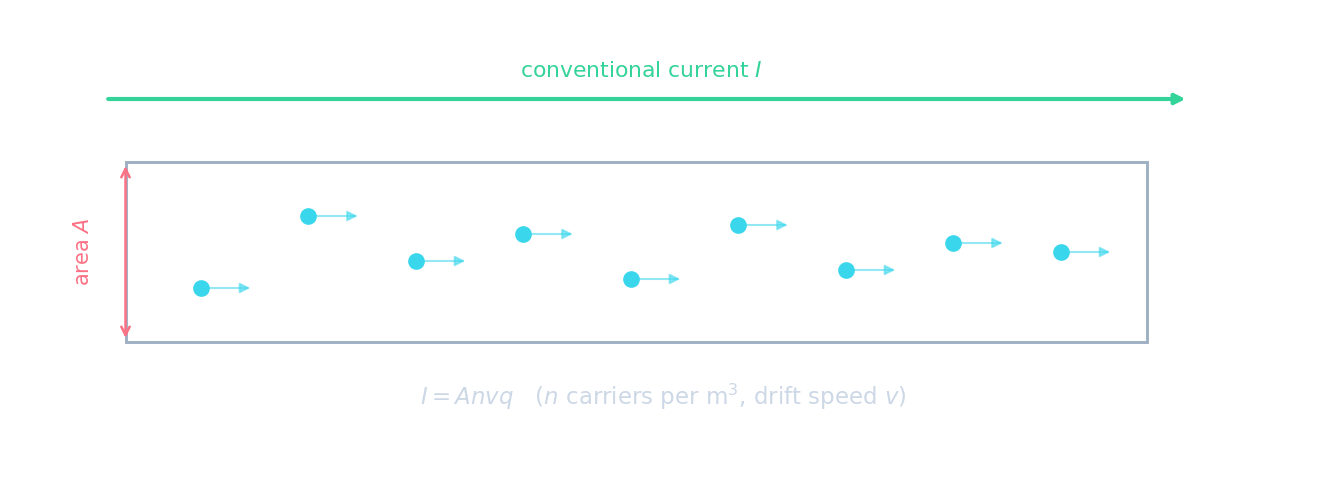
Which equation gives the current in terms of the drift velocity? · 哪个方程用漂移速度表示电流?
Current = (area)(number density)(drift speed)(charge per carrier) $= Anvq$. · 电流 =(面积)(数密度)(漂移速率)(每个载流子的电荷)$= Anvq$。
In a thinner wire carrying the same current, the electrons drift faster. · 在通过相同电流的更细导线中,电子漂移得更快。
From $I = Anvq$, a smaller area $A$ at the same $I$ needs a larger drift speed $v$. · 由 $I = Anvq$,相同 $I$ 下更小的面积 $A$ 需要更大的漂移速率 $v$。
Match each quantity in $I = Anvq$ to its SI unit. · 把 $I = Anvq$ 中的每个量与它的 SI 单位配对。
Multiply the units out: $\text{m}^{2} \times \text{m}^{-3} \times \dfrac{\text{m}}{\text{s}} \times \text{C} = \dfrac{\text{C}}{\text{s}} = \text{A}$, which is the check that the equation makes sense. · 把单位乘起来:$\text{m}^{2} \times \text{m}^{-3} \times \dfrac{\text{m}}{\text{s}} \times \text{C} = \dfrac{\text{C}}{\text{s}} = \text{A}$,这正是检验方程合理的方法。
Where $n$ comes from
- In a metal, each atom gives up about one free electron, so $n$ is simply the number of atoms per cubic metre.
- Atoms per $\text{m}^{3}$ = $\dfrac{\text{density} \times N_{\text{A}}}{\text{molar mass}}$. For copper: $n = \dfrac{(8.9 \times 10^{3})(6.02 \times 10^{23})}{0.0635} = 8.4 \times 10^{28}\ \text{m}^{-3}$.
- Metals sit around $10^{28}$–$10^{29}\ \text{m}^{-3}$; semiconductors are many powers of ten lower.
$n$ 从哪里来
- 在金属中,每个原子大约贡献 一个 自由电子,所以 $n$ 就是每立方米的原子数。
- 每 $\text{m}^{3}$ 的原子数 = 密度 × $N_{\text{A}}$ ÷ 摩尔质量。对铜:$n = \dfrac{(8.9 \times 10^{3})(6.02 \times 10^{23})}{0.0635} = 8.4 \times 10^{28}\ \text{m}^{-3}$。
- 金属大约在 $10^{28}$–$10^{29}\ \text{m}^{-3}$;半导体低很多个数量级。
Worked example: drift speed in a copper wire
A copper wire of diameter $1.3\ \text{mm}$ carries $2.0\ \text{A}$. Using $n = 8.4 \times 10^{28}\ \text{m}^{-3}$, find the drift speed. The wire then narrows to half the diameter.
- Area: $A = \pi r^{2} = \pi (0.65 \times 10^{-3})^{2} = 1.3 \times 10^{-6}\ \text{m}^{2}$.
- Drift speed: $v = \dfrac{I}{nAe} = \dfrac{2.0}{(8.4 \times 10^{28})(1.3 \times 10^{-6})(1.60 \times 10^{-19})} = 1.1 \times 10^{-4}\ \dfrac{\text{m}}{\text{s}}$ — about a tenth of a millimetre per second.
- Narrow section: the current is the same everywhere along the wire, so $v \propto \dfrac{1}{A} \propto \dfrac{1}{r^{2}}$. Half the diameter → a quarter of the area → four times the drift speed.
- Check: the electrons speed up in the narrow part for the same reason water speeds up in a narrow pipe — the same flow has to get through a smaller opening.
例题:铜导线中的漂移速率
直径 $1.3\ \text{mm}$ 的铜导线通有 $2.0\ \text{A}$ 电流。取 $n = 8.4 \times 10^{28}\ \text{m}^{-3}$,求漂移速率。然后导线变细到直径的 一半。
- 面积: $A = \pi r^{2} = \pi (0.65 \times 10^{-3})^{2} = 1.3 \times 10^{-6}\ \text{m}^{2}$。
- 漂移速率: $v = \dfrac{I}{nAe} = \dfrac{2.0}{(8.4 \times 10^{28})(1.3 \times 10^{-6})(1.60 \times 10^{-19})} = 1.1 \times 10^{-4}\ \dfrac{\text{m}}{\text{s}}$——每秒约十分之一毫米。
- 变细的部分: 沿导线各处电流 相同,所以 $v \propto \dfrac{1}{A} \propto \dfrac{1}{r^{2}}$。直径减半 → 面积变为四分之一 → 漂移速率变为 四倍。
- 检查: 电子在细的部分加速,与水在细管中加速的原因相同——同样的流量要挤过更小的开口。
A wire of cross-sectional area $2.0 \times 10^{-6}\ \text{m}^{2}$ carries $3.2\ \text{A}$. The number density of free electrons is $1.0 \times 10^{29}\ \text{m}^{-3}$. What is the drift speed, in mm/s? · 横截面积 $2.0 \times 10^{-6}\ \text{m}^{2}$ 的导线通有 $3.2\ \text{A}$ 电流。自由电子的数密度为 $1.0 \times 10^{29}\ \text{m}^{-3}$。漂移速率是多少(单位 mm/s)?
$v = \dfrac{I}{nAe} = \dfrac{3.2}{(1.0 \times 10^{29})(2.0 \times 10^{-6})(1.60 \times 10^{-19})} = 1.0 \times 10^{-4}\ \dfrac{\text{m}}{\text{s}} = 0.10\ \dfrac{\text{mm}}{\text{s}}$. · $v = \dfrac{I}{nAe} = \dfrac{3.2}{(1.0 \times 10^{29})(2.0 \times 10^{-6})(1.60 \times 10^{-19})} = 1.0 \times 10^{-4}\ \dfrac{\text{m}}{\text{s}} = 0.10\ \dfrac{\text{mm}}{\text{s}}$。
Three slips cost marks here. $A$ must be in $\text{m}^{2}$: a diameter in mm gives an area in $\text{mm}^{2}$, and $1\ \text{mm}^{2} = 10^{-6}\ \text{m}^{2}$. Use the radius in $\pi r^{2}$, not the diameter. And a narrower part of a wire does not carry less current — the current is the same all along a series path; the drift speed is what changes.
这里有三个失分点。$A$ 必须用 $\text{m}^{2}$:直径以 mm 给出时算出的面积是 $\text{mm}^{2}$,而 $1\ \text{mm}^{2} = 10^{-6}\ \text{m}^{2}$。在 $\pi r^{2}$ 中用 半径,不是直径。另外,导线较细的部分 不会 通过更少的电流——串联路径上各处电流相同;变化的是漂移速率。
You've got it
- current is a flow of charge; conventional current = direction of positive flow
- $I = \dfrac{Q}{t}$ (seconds!), and charge is the area under an $I$–$t$ graph; electrons $= \dfrac{Q}{e}$
- drift: $I = Anvq$; $n \approx 10^{29}\ \text{m}^{-3}$ for a metal; same current, smaller area → faster drift
你掌握了
- 电流是电荷的流动;常规电流 = 正电荷流动的方向
- $I = \dfrac{Q}{t}$(用秒!),电荷是 $I$–$t$ 图线下的 面积;电子数 $= \dfrac{Q}{e}$
- 漂移:$I = Anvq$;金属的 $n \approx 10^{29}\ \text{m}^{-3}$;同样的电流、更小的面积 → 更快的漂移