The electromagnetic spectrum · 电磁波谱
| English | 中文 | Pinyin · 拼音 |
|---|---|---|
| electromagnetic waves/ɪˌlektrəʊməɡˈnetɪk weɪvz/ | 电磁波 | diàn cí bō |
| spectrum/ˈspektrəm/ | 光谱 | guāng pǔ |
| vacuum/ˈvækjuːm/ | 真空 | zhēn kōng |
| microwave/ˈmaɪkrəʊweɪv/ | 微波 | wēi bō |
| infrared/ˌɪnfrəˈred/ | 红外线 | hóng wài xiàn |
| ultraviolet/ˌʊltrəˈvaɪəlɪt/ | 紫外线 | zǐ wài xiàn |
| gamma/ˈɡæmə/ | 伽马 | gā mǎ |
All the same family
- Radio, the heat from a fire, sunburn, a hospital X-ray — all are electromagnetic waves 电磁波.
- They differ only in wavelength (and so frequency).
- One family, one spectrum 光谱.
同一个家族
- 无线电、篝火的热、晒伤、医院的 X 射线——全都是 电磁波(electromagnetic waves)。
- 它们只在 波长(从而频率)上不同。
- 一个家族,一个光谱。
What they share
- All EM waves are transverse.
- In a vacuum 真空 they all travel at the same speed, $c = 3.00 \times 10^{8}\ \dfrac{\text{m}}{\text{s}}$.
The electromagnetic spectrum
它们的共同点
- 所有电磁波都是 横波。
- 在真空中它们都以相同的速率传播,$c = 3.00 \times 10^{8}\ \dfrac{\text{m}}{\text{s}}$。
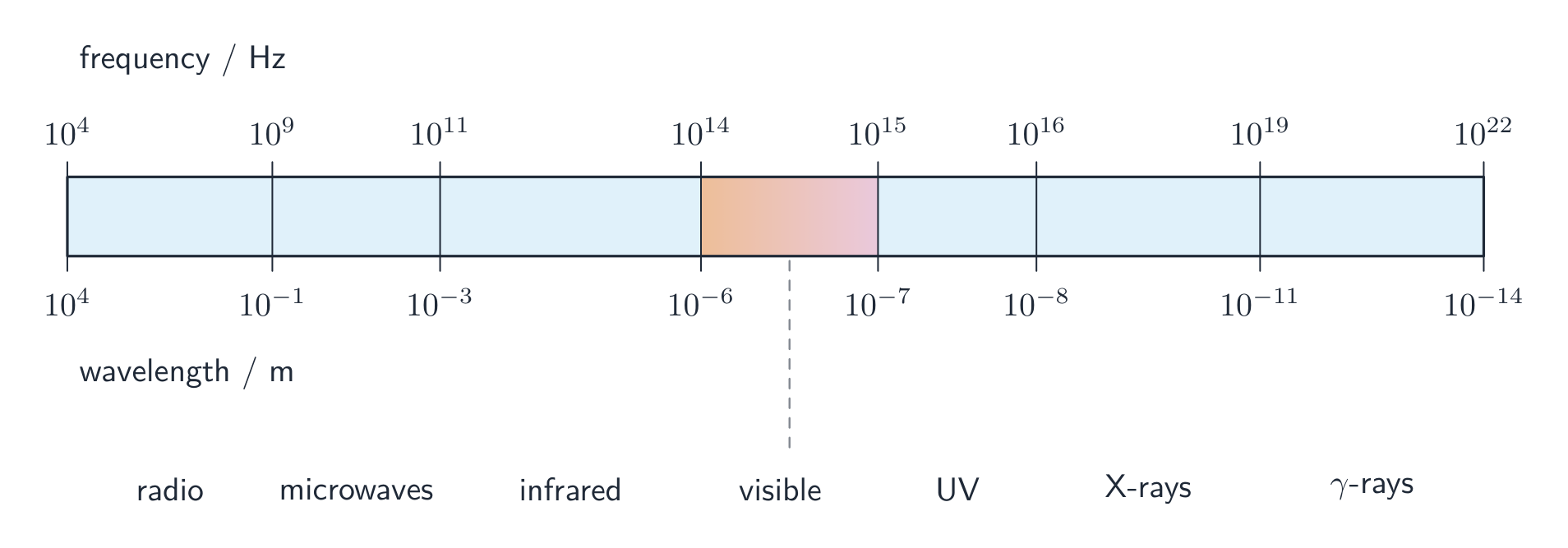
电磁波谱
Slide across the spectrum · 滑过电磁波谱
Radio waves, visible light and gamma rays are all the same wave — only the wavelength changes, and with it the frequency, photon energy and everyday use. · 无线电波、可见光和伽马射线都是同一种波——只是波长改变,频率、光子能量和日常用途也随之改变。
All electromagnetic waves are transverse. · 所有电磁波都是横波。
Yes — every EM wave is transverse, and all travel at $c$ in a vacuum. · 是的——每一种电磁波都是横波,且在真空中都以 $c$ 传播。
In a vacuum, which EM wave travels the fastest? · 在真空中,哪种电磁波传播得最快?
In a vacuum every EM wave travels at $c = 3.0 \times 10^{8}\ \dfrac{\text{m}}{\text{s}}$. · 在真空中,每一种电磁波都以 $c = 3.0 \times 10^{8}\ \dfrac{\text{m}}{\text{s}}$ 传播。
What do all electromagnetic waves share? Select all · 所有 that apply. · 所有电磁波共有的是什么?选出所有适用的。
Needing no medium is exactly what lets sunlight cross space. Being transverse is what makes every one of them polarisable, unlike sound. · 不需要介质正是阳光能穿越太空的原因。是横波使它们每一种都能被偏振,这与声波不同。
The spectrum in order
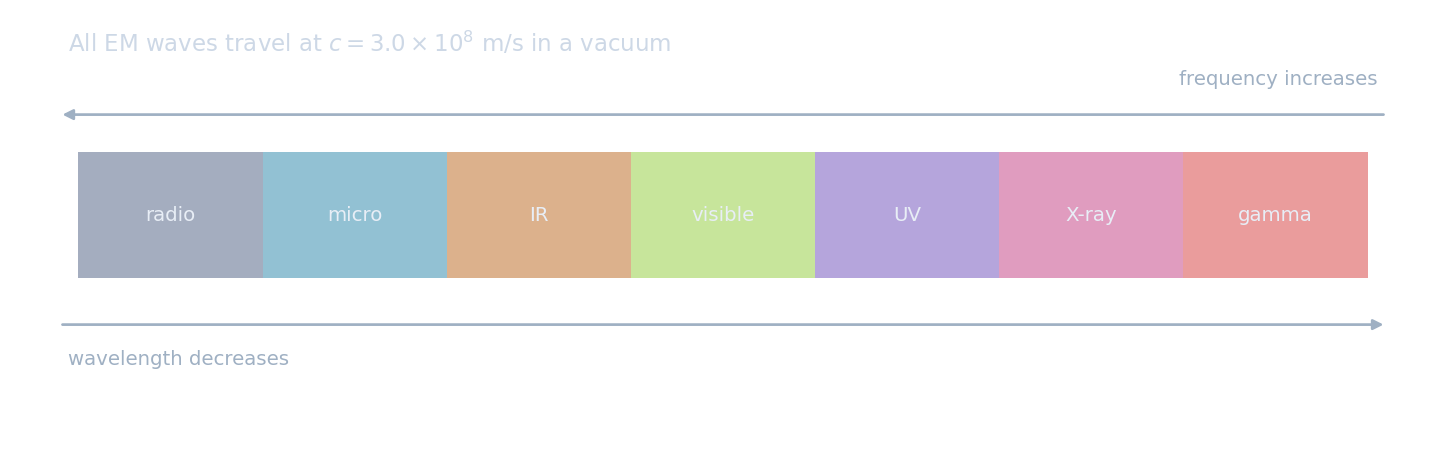
- From long to short wavelength: radio · microwave 微波 · infrared 红外线 · visible · ultraviolet 紫外线 · X-ray · gamma 伽马.
- As wavelength decreases, frequency increases.
按顺序排列的波谱
- 从长波长到短波长:无线电 · 微波 · 红外线 · 可见光 · 紫外线 · X 射线 · 伽马射线。
- 波长减小时,频率增大。
Put these in order of increasing frequency (lowest first). · 把这些按 频率递增 排序(最低的在前)。
Frequency rises as wavelength falls: radio (longest) → microwave → visible → X-ray (much shorter). · 频率随波长减小而升高:无线电(最长)→ 微波 → 可见光 → X 射线(短得多)。
Put the electromagnetic spectrum in order of increasing wavelength. · 把电磁波谱按波长递增排列。
Increasing wavelength is decreasing frequency and decreasing photon energy, so the same list read backwards answers all three questions. · 波长递增就是频率递减、光子能量递减,所以同一份表反着读就同时回答了三个问题。
Wavelengths and the link
- Learn the orders of magnitude: radio $> 10^{-1}\ \text{m}$; microwave $10^{-1}$ to $10^{-3}\ \text{m}$; infrared $10^{-3}$ to $7 \times 10^{-7}\ \text{m}$; visible $400$–$700\ \text{nm}$; ultraviolet $4 \times 10^{-7}$ to $10^{-8}\ \text{m}$; X-rays $10^{-8}$ to $10^{-13}\ \text{m}$; gamma below about $10^{-10}\ \text{m}$.
- Visible light is the narrow band $400$–$700\ \text{nm}$ — violet at the short end, red at the long end.
- Switch between $\lambda$ and $f$ with $c = f\lambda$.
波长与联系
- 记住数量级:无线电 $> 10^{-1}\ \text{m}$;微波 $10^{-1}$ 到 $10^{-3}\ \text{m}$;红外线 $10^{-3}$ 到 $7 \times 10^{-7}\ \text{m}$;可见光 $400$–$700\ \text{nm}$;紫外线 $4 \times 10^{-7}$ 到 $10^{-8}\ \text{m}$;X 射线 $10^{-8}$ 到 $10^{-13}\ \text{m}$;伽马射线低于约 $10^{-10}\ \text{m}$。
- 可见光 只是 $400$–$700\ \text{nm}$ 的窄带——短波长端是紫色,长波长端是红色。
- 用 $c = f\lambda$ 在 $\lambda$ 和 $f$ 之间转换。
Visible light has wavelengths of roughly: · 可见光的波长大约是:
About $400\ \text{nm}$ (violet) to $700\ \text{nm}$ (red) — a tiny slice of the whole spectrum. · 大约从 $400\ \text{nm}$(紫)到 $700\ \text{nm}$(红)——整个波谱中很小的一段。
A radio wave has wavelength $3.0\ \text{m}$. What is its frequency, in MHz? (Use $c = 3.0 \times 10^{8}\ \dfrac{\text{m}}{\text{s}}$.) · 一个无线电波的波长是 $3.0\ \text{m}$。它的频率是多少(用 MHz)?(取 $c = 3.0 \times 10^{8}\ \dfrac{\text{m}}{\text{s}}$。)
$f = \dfrac{c}{\lambda} = \dfrac{3.0 \times 10^{8}}{3.0} = 1.0 \times 10^{8}\ \text{Hz} = 100\ \text{MHz}$. · $f = \dfrac{c}{\lambda} = \dfrac{3.0 \times 10^{8}}{3.0} = 1.0 \times 10^{8}\ \text{Hz} = 100\ \text{MHz}$。
Naming the region
- Exam questions give a wavelength or a frequency and ask which region. Convert to wavelength if needed, then place it on the ladder.
- Just below $400\ \text{nm}$ is ultraviolet; just above $700\ \text{nm}$ is infrared.
- X-rays and gamma rays overlap in wavelength — they are told apart by where they come from (X-rays from electrons, gamma from nuclei), so either name can be right in the overlap.
说出波段的名称
- 考题给出一个波长或频率,问 属于哪个波段。必要时先换算成波长,再把它放到阶梯上。
- 略低于 $400\ \text{nm}$ 是紫外线;略高于 $700\ \text{nm}$ 是红外线。
- X 射线和伽马射线在波长上 重叠——它们靠来源区分(X 射线来自电子,伽马射线来自原子核),所以在重叠区两个名称都可以是对的。
An electromagnetic wave has a wavelength of 500 nm. What is its frequency, in units of 1e14 Hz? · 一列电磁波的波长是 500 nm。它的频率是多少(以 1e14 Hz 为单位)?
f = c/lambda = 3.00e8/5.00e-7 = 6.0e14 Hz, in the green of the visible band. Convert nm to m before dividing. · f = c/lambda = 3.00e8/5.00e-7 = 6.0e14 Hz,落在可见光的绿色区。相除之前先把 nm 换成 m。
Worked example: which region, and what period?
(a) A laser emits waves of wavelength $8.1 \times 10^{-8}\ \text{m}$. (b) A satellite link uses $12\ \text{GHz}$. Name each region and find the period of the satellite waves in picoseconds.
- (a) $8.1 \times 10^{-8}\ \text{m} = 81\ \text{nm}$, which is below $400\ \text{nm}$ but above $10^{-8}\ \text{m}$: ultraviolet. Its frequency is $f = \dfrac{c}{\lambda} = \dfrac{3.00 \times 10^{8}}{8.1 \times 10^{-8}} = 3.7 \times 10^{15}\ \text{Hz}$.
- (b) $\lambda = \dfrac{c}{f} = \dfrac{3.00 \times 10^{8}}{12 \times 10^{9}} = 0.025\ \text{m}$: a few centimetres, so microwave.
- Period: $T = \dfrac{1}{f} = \dfrac{1}{12 \times 10^{9}} = 8.3 \times 10^{-11}\ \text{s} = 83\ \text{ps}$.
- Check: $1\ \text{ps} = 10^{-12}\ \text{s}$, so divide by $10^{-12}$ to convert — an answer of $0.083\ \text{ps}$ means the prefix was applied the wrong way.
例题:哪个波段,周期多长?
(a) 一台激光器发出波长 $8.1 \times 10^{-8}\ \text{m}$ 的波。(b) 一条卫星链路使用 $12\ \text{GHz}$。说出各自的波段,并求卫星波的周期(单位皮秒)。
- (a) $8.1 \times 10^{-8}\ \text{m} = 81\ \text{nm}$,低于 $400\ \text{nm}$ 但高于 $10^{-8}\ \text{m}$:紫外线。它的频率是 $f = \dfrac{c}{\lambda} = \dfrac{3.00 \times 10^{8}}{8.1 \times 10^{-8}} = 3.7 \times 10^{15}\ \text{Hz}$。
- (b) $\lambda = \dfrac{c}{f} = \dfrac{3.00 \times 10^{8}}{12 \times 10^{9}} = 0.025\ \text{m}$:几厘米,所以是 微波。
- 周期: $T = \dfrac{1}{f} = \dfrac{1}{12 \times 10^{9}} = 8.3 \times 10^{-11}\ \text{s} = 83\ \text{ps}$。
- 检查: $1\ \text{ps} = 10^{-12}\ \text{s}$,所以除以 $10^{-12}$ 来换算——答案若是 $0.083\ \text{ps}$,说明词头用反了。
An electromagnetic wave has a wavelength of $5.0 \times 10^{-9}\ \text{m}$. Which region of the spectrum is it in? · 一列电磁波的波长为 $5.0 \times 10^{-9}\ \text{m}$。它属于波谱的哪个波段?
$5.0 \times 10^{-9}\ \text{m} = 5\ \text{nm}$ — shorter than $10^{-8}\ \text{m}$ (the bottom of the ultraviolet range), so X-rays. · $5.0 \times 10^{-9}\ \text{m} = 5\ \text{nm}$——比 $10^{-8}\ \text{m}$(紫外线范围的下限)还短,所以是 X 射线。
Microwaves in a satellite link have a frequency of $12\ \text{GHz}$. What is their period, in ps? · 卫星链路中的微波频率为 $12\ \text{GHz}$。它们的周期是多少(单位 ps)?
$T = \dfrac{1}{f} = \dfrac{1}{12 \times 10^{9}} = 8.3 \times 10^{-11}\ \text{s}$, and $1\ \text{ps} = 10^{-12}\ \text{s}$, so $T = 83\ \text{ps}$. · $T = \dfrac{1}{f} = \dfrac{1}{12 \times 10^{9}} = 8.3 \times 10^{-11}\ \text{s}$,而 $1\ \text{ps} = 10^{-12}\ \text{s}$,所以 $T = 83\ \text{ps}$。
$c = 3.00 \times 10^{8}\ \dfrac{\text{m}}{\text{s}}$ is the speed in a vacuum (air is close enough). In glass or water the wave slows down and its wavelength shortens, but its frequency stays the same — frequency is fixed by the source. And the order of the spectrum by frequency is the reverse of the order by wavelength.
$c = 3.00 \times 10^{8}\ \dfrac{\text{m}}{\text{s}}$ 是 真空中 的速率(空气足够接近)。在玻璃或水中,波会变慢、波长变短,但 频率保持不变——频率由波源决定。另外,按 频率 排列的波谱顺序与按波长排列的顺序相反。
When light passes from air into glass, its speed and wavelength both decrease but its ____ does not change. · 当光从空气进入玻璃时,它的速率和波长都减小,但它的 ____ 不变。
Frequency is set by the source. Since $v = f\lambda$, a smaller $v$ with the same $f$ means a smaller $\lambda$. · 频率由波源决定。由于 $v = f\lambda$,$v$ 变小而 $f$ 不变,意味着 $\lambda$ 变小。
Recognise them by their uses
- Radio: broadcasting. Microwave: phones, satellite links, ovens. Infrared: remote controls, thermal imaging, heating.
- Visible: seeing, fibre-optic signals. Ultraviolet: fluorescence, sterilising, sunburn.
- X-rays: medical imaging. Gamma: sterilising equipment, treating cancer.
靠用途认出它们
- 无线电: 广播。微波: 手机、卫星链路、微波炉。红外线: 遥控器、热成像、加热。
- 可见光: 视觉、光纤信号。紫外线: 荧光、消毒、晒伤。
- X 射线: 医学成像。伽马射线: 器械消毒、治疗癌症。
You've got it
- all EM waves are transverse and travel at $c = 3.0 \times 10^{8}\ \dfrac{\text{m}}{\text{s}}$ in a vacuum
- order by wavelength: radio → microwave → IR → visible → UV → X-ray → gamma (frequency runs the other way)
- visible light is $400$–$700\ \text{nm}$; use $c = f\lambda$ and $T = \dfrac{1}{f}$ to name a region
你掌握了
- 所有电磁波都是 横波,在真空中以 $c = 3.0 \times 10^{8}\ \dfrac{\text{m}}{\text{s}}$ 传播
- 按波长排序:无线电 → 微波 → 红外 → 可见光 → 紫外 → X 射线 → 伽马(频率顺序相反)
- 可见光是 $400$–$700\ \text{nm}$;用 $c = f\lambda$ 和 $T = \dfrac{1}{f}$ 来判断波段