Density and pressure · 密度与压强
| English | 中文 | Pinyin · 拼音 |
|---|---|---|
| density/ˈdensɪti/ | 密度 | mìdù |
| pressure/ˈpreʃə/ | 压强 | yāqiáng |
| upthrust/ˈʌpθrʌst/ | 浮力 | fú lì |
| atmospheric pressure/ˌætməsˈferɪk ˈpreʃə/ | 大气压强 | dà qì yā qiáng |
| submerged/səbˈmɜːdʒd/ | 浸没 | jìn mò |
| Archimedes' principle/ˌɑːkɪˈmiːdiːz ˈprɪnsɪpl/ | 阿基米德原理 | ā jī mǐ dé yuán lǐ |
| displaced/dɪˈspleɪst/ | 排开 | pái kāi |
Why a steel ship floats
- A solid steel nail sinks, yet a huge steel ship floats.
- The ship's shape pushes aside a lot of water — and the water pushes back.
- To explain it we need density 密度, pressure 压强 and upthrust 浮力.
为什么钢铁造的船会浮
- 一颗实心钢钉会沉,但一艘巨大的钢船却能浮。
- 船的形状推开了大量的水——水又把船推回去。
- 要解释它,我们需要 密度、压强 和 浮力。
Density
- Density is mass per unit volume: $\rho = \dfrac{m}{V}$, unit $\dfrac{\text{kg}}{\text{m}^3}$.
- Worth knowing: water $1000$, air $\approx 1.2$, steel $\approx 7800\ \dfrac{\text{kg}}{\text{m}^3}$.
A precision aneroid barometer measures atmospheric pressure 大气压强
密度
- 密度(density) 是单位体积的质量:$\rho = \dfrac{m}{V}$,单位 $\dfrac{\text{kg}}{\text{m}^3}$。
- 值得记住:水 $1000$,空气 $\approx 1.2$,钢 $\approx 7800\ \dfrac{\text{kg}}{\text{m}^3}$。
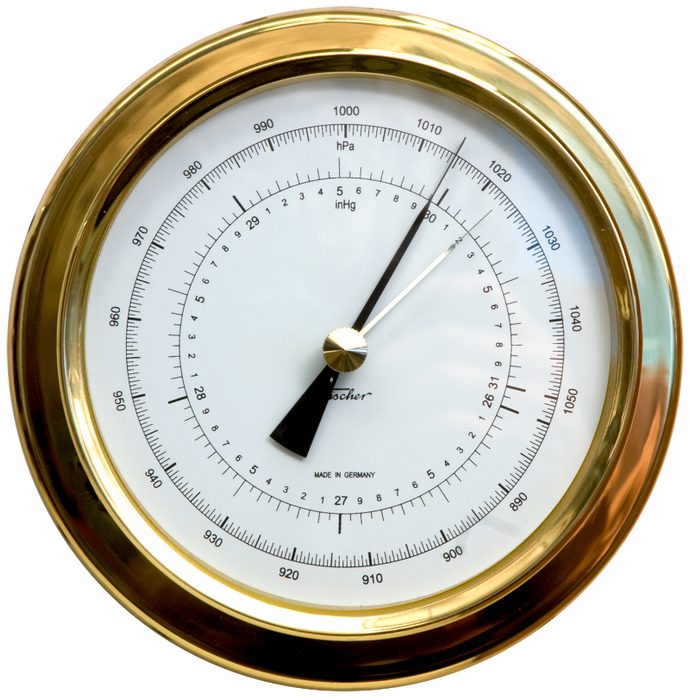
一台精密的无液气压计测量大气压强
Pressure with depth · 压强随深度变化
p = ρg·h
Pressure is · 压强是 proportional to depth — the gradient is ρg. · 压强与深度 成正比——斜率是 ρg。
A block has mass $5.0\ \text{kg}$ and volume $0.0020\ \text{m}^3$. What is its density? · 一个方块质量为 $5.0\ \text{kg}$,体积为 $0.0020\ \text{m}^3$。它的密度是多少?
$\rho = \dfrac{m}{V} = \dfrac{5.0}{0.0020} = 2500\ \dfrac{\text{kg}}{\text{m}^3}$. · $\rho = \dfrac{m}{V} = \dfrac{5.0}{0.0020} = 2500\ \dfrac{\text{kg}}{\text{m}^3}$。
Pressure
- Pressure is force per unit area, at right angles to the surface: $p = \dfrac{F}{A}$.
- Unit: $\text{Pa} = \dfrac{\text{N}}{\text{m}^2}$.
An iceberg floats with most of its volume hidden: ice is slightly less dense than water
压强
- 压强(pressure) 是垂直于表面的、单位面积上的力:$p = \dfrac{F}{A}$。
- 单位:$\text{Pa} = \dfrac{\text{N}}{\text{m}^2}$。

一座冰山漂浮着,大部分体积藏在水下:冰的密度略小于水
Pressure is the force per unit ____ (acting at right angles to the surface). · 压强是垂直于表面、单位 ____ 上的力。
$p = \dfrac{F}{A}$, measured in $\text{Pa} = \dfrac{\text{N}}{\text{m}^2}$. · $p = \dfrac{F}{A}$,单位是 $\text{Pa} = \dfrac{\text{N}}{\text{m}^2}$。
Pressure in a liquid
- The extra pressure at a depth is $\Delta p = \rho g \Delta h$.
- It depends only on the density and depth — not the container's shape.
- For the total pressure, add the atmospheric pressure ($\approx 1.0 \times 10^{5}\ \text{Pa}$).
A column of liquid of area $A$: its weight sets the extra pressure at the depth below
液体中的压强
- 深度处增加的压强是 $\Delta p = \rho g \Delta h$。
- 它只取决于 密度和深度——与容器的形状无关。
- 求总压强时,再加上大气压强($\approx 1.0 \times 10^{5}\ \text{Pa}$)。

一柱面积为 $A$ 的液体:它的重力决定了下方深度处增加的压强
The extra pressure at a depth in a liquid depends on: · 液体中某深度处增加的压强取决于:
$\Delta p = \rho g \Delta h$ — only density and depth matter; the container shape does not. · $\Delta p = \rho g \Delta h$——只有密度和深度有关;容器形状无关。
Match each term to the definition the examiner marks. · 把每个术语与评分认可的定义配对。
Pressure's definition carries the phrase at right angles. Leaving it out is a lost mark even though the formula is the same. · 压强的定义带着「垂直于」这个说法。漏掉它就丢分,尽管公式是一样的。
Where upthrust comes from
- Pressure is greater at the bottom of a submerged 浸没 object than at the top.
- That difference is a net upward force — the upthrust.
浮力从哪里来
- 浸入物体 底部的压强大于 顶部。
- 这个差值就是一个净向上的力——浮力(upthrust)。
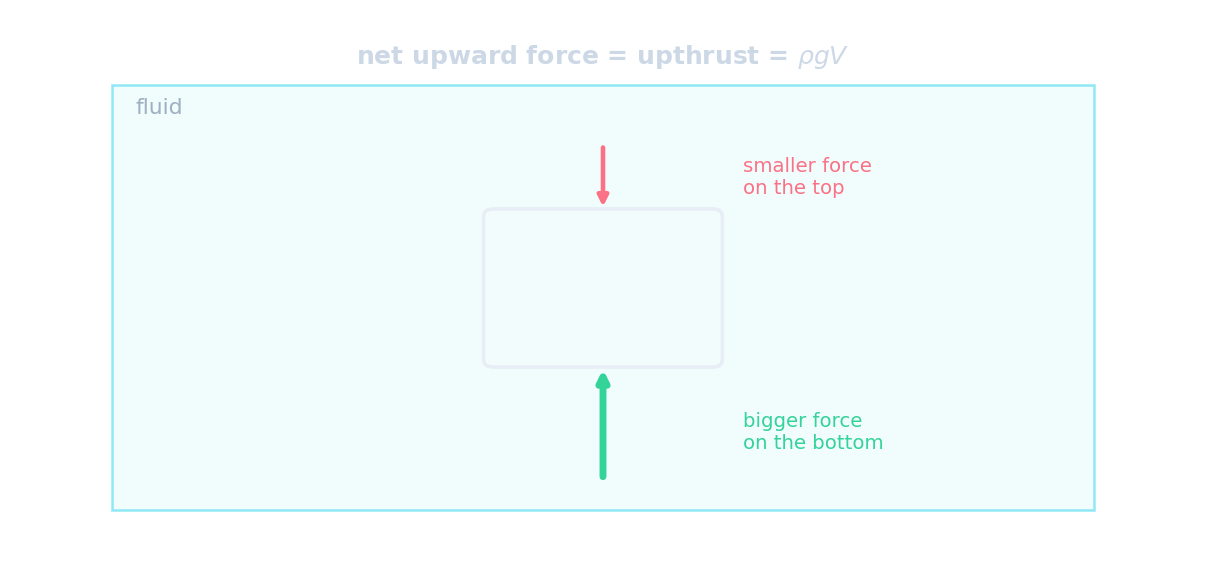
Archimedes' principle 阿基米德原理
- Upthrust $= \rho_{\text{fluid}}\, g\, V$, where $V$ is the volume of fluid displaced 排开.
- In words: the upthrust equals the weight of the fluid pushed aside.
- An object floats when this upthrust equals its weight.
阿基米德原理
- 浮力 $= \rho_{\text{fluid}}\, g\, V$,其中 $V$ 是被 排开 的流体体积。
- 用语言说:浮力等于 被推开的流体的重力。
- 当这个浮力等于物体的重力时,物体就漂浮。
Archimedes' principle: the upthrust equals the weight of the fluid that is ____. · 阿基米德原理:浮力等于被 ____ 的流体的重力。
The upthrust $= \rho g V$, where $V$ is the displaced volume — the weight of fluid pushed out of the way. · 浮力 $= \rho g V$,其中 $V$ 是被排开的体积——即被推开的流体的重力。
A block of volume $0.0020\ \text{m}^3$ is fully under water ($\rho = 1000\ \dfrac{\text{kg}}{\text{m}^3}$, $g = 9.81\ \dfrac{\text{m}}{\text{s}^2}$). What is the upthrust? · 一个体积为 $0.0020\ \text{m}^3$ 的方块完全浸没在水中($\rho = 1000\ \dfrac{\text{kg}}{\text{m}^3}$,$g = 9.81\ \dfrac{\text{m}}{\text{s}^2}$)。浮力是多少?
Upthrust $= \rho g V = 1000 \times 9.81 \times 0.0020 \approx 19.6\ \text{N}$. · 浮力 $= \rho g V = 1000 \times 9.81 \times 0.0020 \approx 19.6\ \text{N}$。
Weighing in a fluid
- A submerged block on a newton-meter reads less than its real weight: reading $= W - \text{upthrust}$.
- That is why heavy things feel lighter under water.
在流体中称重
- 浸入的方块挂在牛顿计上,读数小于它的真实重力(读数 = 重力 − 浮力)。
- 这就是为什么重物在水下感觉更轻。
A floating object displaces its own weight of fluid. · 一个漂浮的物体排开与自身重力相等的流体。
Yes — it sinks until the upthrust (weight of fluid displaced) equals its own weight, then floats. · 是的——它会下沉到浮力(排开流体的重力)等于自身重力为止,然后漂浮。
Worked example: floating and sinking
- A block of volume $2.0\times10^{-3}\ \text{m}^3$ and mass $1.6\ \text{kg}$ is fully submerged in water ($\rho = 1000\ \text{kg/m}^3$). Find the upthrust and the resultant force on it.
- Upthrust is the weight of the fluid displaced: $U = \rho_{\text{fluid}} V g = 1000 \times 2.0\times10^{-3} \times 9.81 = 19.6\ \text{N}$.
- The block's own weight is $mg = 1.6 \times 9.81 = 15.7\ \text{N}$.
- Resultant: $19.6 - 15.7 = 3.9\ \text{N}$ upwards, so the block rises and will float.
- Note whose density each term uses. The upthrust uses the fluid's density and the displaced volume; the weight uses the block's mass. Substituting the block's weight into the upthrust is the standard error.
例题:浮起来还是沉下去
- 一块体积 $2.0\times10^{-3}\ \text{m}^3$、质量 $1.6\ \text{kg}$ 的物块完全浸没在水中($\rho = 1000\ \text{kg/m}^3$)。求浮力和它所受的合力。
- 浮力等于排开流体的重量:$U = \rho_{\text{fluid}} V g = 1000 \times 2.0\times10^{-3} \times 9.81 = 19.6\ \text{N}$。
- 物块自身的重力是 $mg = 1.6 \times 9.81 = 15.7\ \text{N}$。
- 合力:$19.6 - 15.7 = 3.9\ \text{N}$,方向向上,所以物块会上浮并最终漂浮。
- 注意每一项用的是谁的密度。浮力用流体的密度和排开的体积;重力用物块的质量。把物块的重量代入浮力是标准错误。
Marks that slip away
- Upthrust is the weight of the fluid displaced, $\rho_{\text{fluid}} V g$. It is not the weight of the object.
- A floating body displaces its own weight of fluid; a fully submerged one displaces its own volume. Read which case the question describes.
- Pressure is force per unit area with the force at right angles to the surface. The perpendicular part is marked.
- Hydrostatic pressure $p = \rho g h$ depends on depth, not on the shape or width of the container, and $h$ is measured from the surface downwards.
- Density is mass per unit volume. Check the units: a volume in $\text{cm}^3$ with a mass in kg gives an answer wrong by $10^6$.
容易丢掉的分
- 浮力是排开流体的重量,$\rho_{\text{fluid}} V g$。它不是物体的重量。
- 漂浮的物体排开与自身重量相等的流体;完全浸没的物体排开与自身体积相等的流体。看清题目说的是哪一种。
- 压强是单位面积上的力,而且力要垂直于表面。那个"垂直"是得分点。
- 静液压强 $p = \rho g h$ 取决于深度,与容器的形状或宽窄无关,而 $h$ 是自液面向下量的。
- 密度是单位体积的质量。检查单位:体积用 $\text{cm}^3$ 而质量用 kg,答案会差 $10^6$ 倍。
A block of volume 2.0e-3 m^3 is fully submerged in water of density 1000 kg/m^3. What is the upthrust on it, in N? (g = 9.81 m/s^2) · 一块体积 2.0e-3 m^3 的物块完全浸没在密度 1000 kg/m^3 的水中。它受到的浮力是多少 N?(g = 9.81 m/s^2)
U = rho_fluid V g = 1000 x 2.0e-3 x 9.81 = 19.6 N. The block's own mass never enters the upthrust; it only decides whether the block rises or sinks. · U = rho_fluid V g = 1000 x 2.0e-3 x 9.81 = 19.6 N。物块自身的质量从不进入浮力;它只决定物块上浮还是下沉。
Hydrostatic pressure at a point in a liquid depends on which of these? Select all · 所有 that apply. · 液体中某点的静液压强取决于下列哪些?选出所有适用的。
p = rho g h has no area or shape in it. A narrow tube and a wide tank give the same pressure at the same depth, which surprises people every year. · p = rho g h 里既没有面积也没有形状。同样的深度上,细管和宽槽给出同样的压强,这一点年年都让人意外。
Put the method for deciding whether a submerged object rises in order. · 把判断浸没物体是否上浮的方法按顺序排列。
Each term uses a different body's property: the fluid's density for the upthrust, the object's mass for the weight. · 每一项用的是不同物体的属性:浮力用流体的密度,重力用物体的质量。
You've got it
- density $\rho = \dfrac{m}{V}$; pressure $p = \dfrac{F}{A}$
- pressure in a liquid: $\Delta p = \rho g \Delta h$ — set by density and depth only
- upthrust $= \rho g V$ = the weight of fluid displaced (Archimedes)
你掌握了
- 密度 $\rho = \dfrac{m}{V}$;压强 $p = \dfrac{F}{A}$
- 液体中的压强:$\Delta p = \rho g \Delta h$——只由 密度和深度 决定
- 浮力 $= \rho g V$ = 被排开流体的重力(阿基米德)