Physical quantities · 物理量
| English | 中文 | Pinyin · 拼音 |
|---|---|---|
| physical quantity/ˈfɪzɪkl ˈkwɒntɪti/ | 物理量 | wùlǐliàng |
| magnitude/ˈmæɡnɪtjuːd/ | 大小 | dàxiǎo |
| estimate/ˈestɪmət/ | 估算 | gūsuàn |
| free fall/friː fɔːl/ | 自由落体 | zì yóu luò tǐ |
| order of magnitude/ˈɔːdə ɒv ˈmæɡnɪtjuːd/ | 数量级 | shùliàngjí |
A 125-million-dollar mistake
- In 1999, NASA lost the Mars Climate Orbiter at Mars.
- One team used pounds, the other used newtons — and nobody converted.
- The spacecraft flew too low and burned up.
- It was a unit mistake, not a maths mistake.
一个一亿两千五百万美元的错误
- 1999 年,NASA 在火星丢失了 火星气候探测者号(Mars Climate Orbiter)。
- 一个团队用磅,另一个团队用 牛顿(newton)——却没有人做换算。
- 探测器飞得太低,被烧毁了。
- 这是一个单位错误,不是数学错误。
Physical quantity lab · 物理量实验
Classify measurement examples by the kind of quantity they represent. · 根据测量示例代表的物理量类型进行分类。
What is a physical quantity 物理量?
- In physics we measure things.
- Every measurement is a physical quantity.
什么是物理量?
- 在物理里,我们 测量 各种东西。
- 每一次测量都是一个 物理量(physical quantity)。
It always has two parts
- A quantity = a magnitude 大小 (the number) + a unit.
- The magnitude says how much; the unit says of what.
它总是有两部分
- 一个物理量 = 大小(magnitude)(那个数字)+ 一个 单位(unit)。
- 大小说明有多少;单位说明是什么。
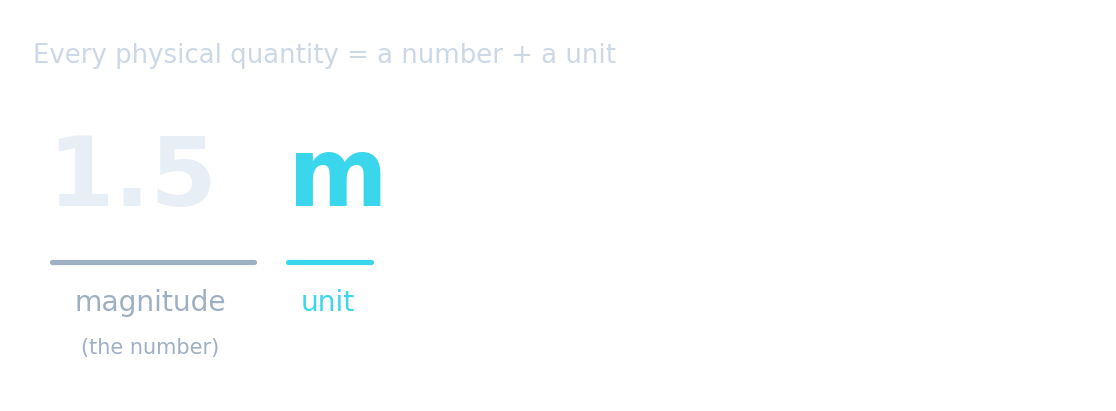
Every physical quantity has two parts: a number (its ____) and a unit. · 每个物理量都有两部分:一个数字(它的 ____)和一个单位。
The two parts are the magnitude (the number) and the unit. · 这两部分是 量值(数字)和 单位。
Match each term to the definition the examiner marks. · 将每个术语与考官标记的定义匹配。
Both halves of the first one score. A number with no unit is not a physical quantity, which is exactly how the Mars orbiter was lost. · 第一题的两个选项都得分。没有单位的数字不是物理量,这正是火星探测器丢失的原因。
A number alone means nothing
- "The speed is 90" — 90 what?
- $90\ \dfrac{\text{km}}{\text{h}}$, $90\ \dfrac{\text{m}}{\text{s}}$ and 90 mph are all different.
- Always write the unit too.
只有数字没有意义
- “速度是 90”——90 什么?
- $90\ \dfrac{\text{km}}{\text{h}}$、$90\ \dfrac{\text{m}}{\text{s}}$ 和 90 mph 都是不一样的。
- 一定要把单位也写上。
Saying "the speed is 90" — with no unit — gives a complete physical quantity. · 说“速度是 90”——没有单位——不构成完整的物理量。
Without a unit the number is ambiguous. "$90\ \dfrac{\text{km}}{\text{h}}$" is complete; "90" is not. · 没有单位时数字是模棱两可的。“$90\ \dfrac{\text{km}}{\text{h}}$”是完整的;“90”不是。
An answer of "5" to a question asking for a length is complete as long as the working is shown. · 问长度时回答“5”,只要展示了计算过程就是完整的。
A physical quantity is a magnitude AND a unit. 5 metres, 5 centimetres and 5 kilometres are three different lengths, and the mark scheme asks for the unit. · 物理量是量值 AND 单位。5 米、5 厘米和 5 千米是三种不同的长度,评分标准要求写出单位。
"$90\ \dfrac{\text{km}}{\text{h}}$" is a complete quantity. "90" on its own is not.
“$90\ \dfrac{\text{km}}{\text{h}}$” 是一个完整的物理量。单独的 “90” 不是。
Which statement gives a complete · 完整的 physical quantity? · 哪个陈述给出了 完整 的物理量?
A physical quantity needs both · 两者 a magnitude (the number, 70) and a unit (kg). A number alone, or a unit alone, is not enough. · 物理量需要 同时具备 量值(数字,70)和 单位(kg)。单独的数字或单独的单位都不够。
Estimate 估算 everyday sizes
- You should know roughly how big common things are.
- Learn these standard values by heart.
估计日常事物的大小
- 你应该大致知道常见事物有多大。
- 把这些标准数值记在心里。
Select all · 所有 the estimates that are about right. · 选择 所有 大致正确的估计值。
All are right except the speed of sound: in air it is about $340\ \dfrac{\text{m}}{\text{s}}$. $3 \times 10^{8}\ \dfrac{\text{m}}{\text{s}}$ is the speed of light · 光. · 除了声速外都是对的:在空气中约为 $340\ \dfrac{\text{m}}{\text{s}}$。$3 \times 10^{8}\ \dfrac{\text{m}}{\text{s}}$ 是 光 的速度。
Put the method for an order-of-magnitude estimate in order. · 将数量级估算的方法按顺序排列。
An order-of-magnitude answer is only claiming the right power of ten, so carrying three significant figures through it is wasted work. · 数量级答案仅声称正确的十进制幂次,因此在其中保留三位有效数字是徒劳的工作。
How to estimate
- Compare with something you know (a person $\approx 70\ \text{kg}$).
- Round to one figure — a car is about $1000\ \text{kg}$, not $1043$.
- Getting the power of ten right matters most.
怎么估计
- 和你熟悉的事物作比较(一个人 $\approx 70\ \text{kg}$)。
- 取一位有效数字——一辆汽车大约 $1000\ \text{kg}$,而不是 $1043$。
- 把十的幂(数量级)取对最重要。
Estimate the acceleration of free fall $g$ near the Earth's surface. · 估算地球表面附近的自由落体加速度 $g$。
Near the Earth's surface $g \approx 9.81\ \dfrac{\text{m}}{\text{s}^2}$ — roughly $10\ \dfrac{\text{m}}{\text{s}^2}$. · 靠近地球表面 $g \approx 9.81\ \dfrac{\text{m}}{\text{s}^2}$ —— 大约 $10\ \dfrac{\text{m}}{\text{s}^2}$。
A human hair is about 0.1 mm across. What is the order of magnitude of that width in metres, as a power of ten? (Give the exponent, e.g. -3) · 人类头发的直径约为0.1毫米。以米为单位的宽度数量级是多少(以10的幂表示)?(给出指数,例如 -3)
0.1 mm = 1e-4 m. Convert the prefix before taking the power of ten; treating 0.1 mm as 0.1 is the standard slip. · 0.1 mm = 1e-4 m。在取10的幂之前先转换前缀;将0.1 mm视为0.1是常见的错误。
Order of magnitude 数量级
- A good estimate has the right power of ten.
- $70\ \text{kg}$ ✓ · $7\ \text{kg}$ ✗
数量级
- 一个好的估计要有正确的十的幂。
- $70\ \text{kg}$ ✓ · $7\ \text{kg}$ ✗
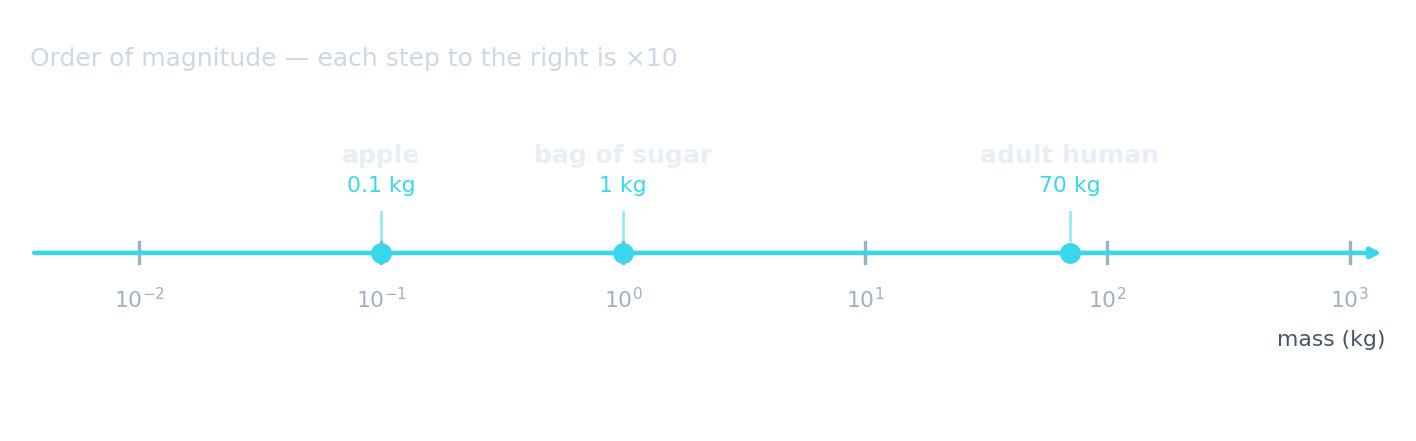
Put these masses in order, smallest first. · 将这些质量按顺序排列,从小到大。
Ordering by size checks your sense of order of magnitude: $0.1\ \text{kg}$, then $1\ \text{kg}$, then $70\ \text{kg}$. · 按大小排序检查你对 数量级 的感觉:$0.1\ \text{kg}$,然后是 $1\ \text{kg}$,最后是 $70\ \text{kg}$。
The scale of the universe
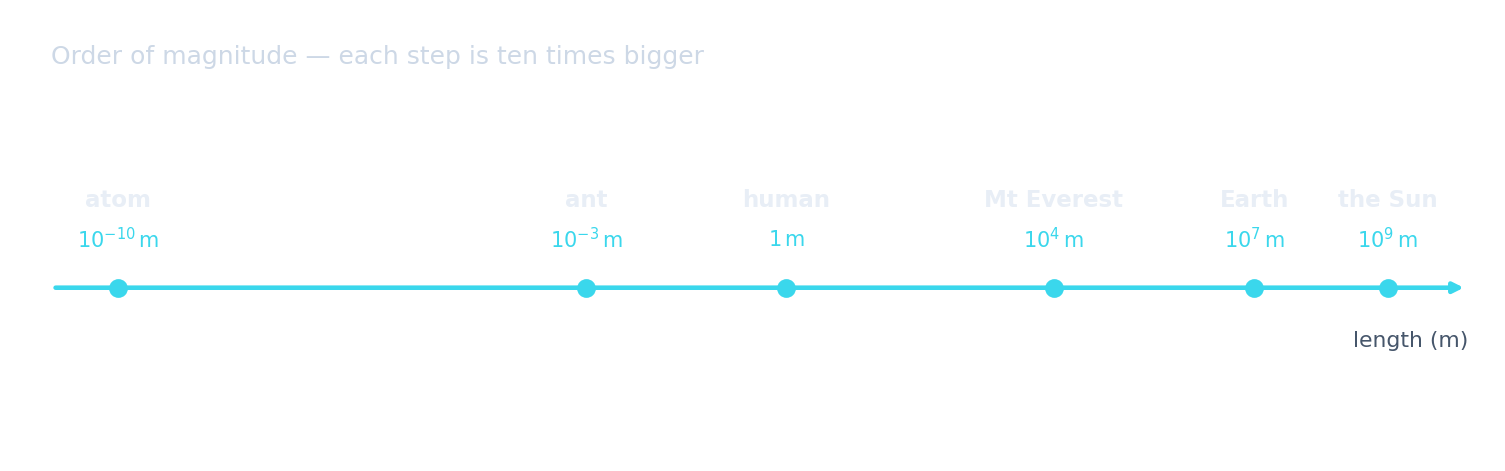
- The same idea runs from an atom to the Sun.
- Each step along the line is ten times bigger.
宇宙的尺度
- 同样的想法,从一个原子一直延伸到太阳。
- 这条线上每走一步,尺寸就大十倍。
You've got it
- a physical quantity = a magnitude + a unit
- learn the standard estimates (human, apple, sound, light, $g$)
- a good estimate has the right order of magnitude
Next — the SI units these are all built from.
你掌握了
- 一个物理量 = 一个大小 + 一个单位
- 记住标准估计值(人、苹果、声音、光、$g$)
- 一个好的估计要有正确的数量级
接下来——构成这一切的 国际单位制(SI)单位。