SI units · SI 单位
| English | 中文 | Pinyin · 拼音 |
|---|---|---|
| SI system/ˌes ˈaɪ ˈsɪstəm/ | 国际单位制 | guó jì dān wèi zhì |
| base unit/beɪs ˈjuːnɪt/ | 基本单位 | jī běn dān wèi |
| derived unit/dɪˈraɪvd ˈjuːnɪt/ | 导出单位 | dǎochū dānwèi |
| homogeneous/ˌhɒməˈdʒiːniəs/ | 量纲一致 | liànggāng yīzhì |
| prefix/ˈpriːfɪks/ | 词头 | cítóu |
One language for science
- Long ago every place used its own units — feet, cubits, pounds.
- Science and trade were a mess of conversions.
- The SI system 国际单位制 fixes this: one shared set of units for everyone.
科学的统一语言
- 很久以前,每个地方都用自己的单位——英尺、腕尺、磅。
- 科学和贸易充满了各种换算,一团乱。
- 国际单位制(SI) 解决了这个问题:所有人共用同一套单位。
SI unit lab · SI 单位实验
Match common quantities to the correct SI unit family. · 将常见物理量与正确的 SI 单位族匹配。
The five base units 基本单位
- Every unit in physics is built from just five base units.
- Learn these first, then build the rest.
五个基本单位
- 物理里的每一个单位,都由 五个基本单位(base units) 搭建而成。
- 先记住这五个,再搭出其余的。
Select all · 所有 the SI base units. · 选择 所有 SI 基本 单位。
The five SI base units are the kilogram, metre, second, ampere and kelvin. The newton and joule are derived units, built from the base units. · 五个 SI 基本单位是千克、米、秒、安培和开尔文。牛顿和焦耳是 导出 单位,由基本单位构成。
Which of these are SI base units? Select all · 所有 that apply. · 以下哪些是 SI 基本单位?选择 所有 适用的选项。
The newton is derived: kg m s^-2, straight from F = ma. The five you need are the metre, kilogram, second, ampere and kelvin. · 牛顿是导出单位:kg m s^-2,直接来自 F = ma。你需要掌握的是米、千克、秒、安培和开尔文。
Fun fact: the kilogram
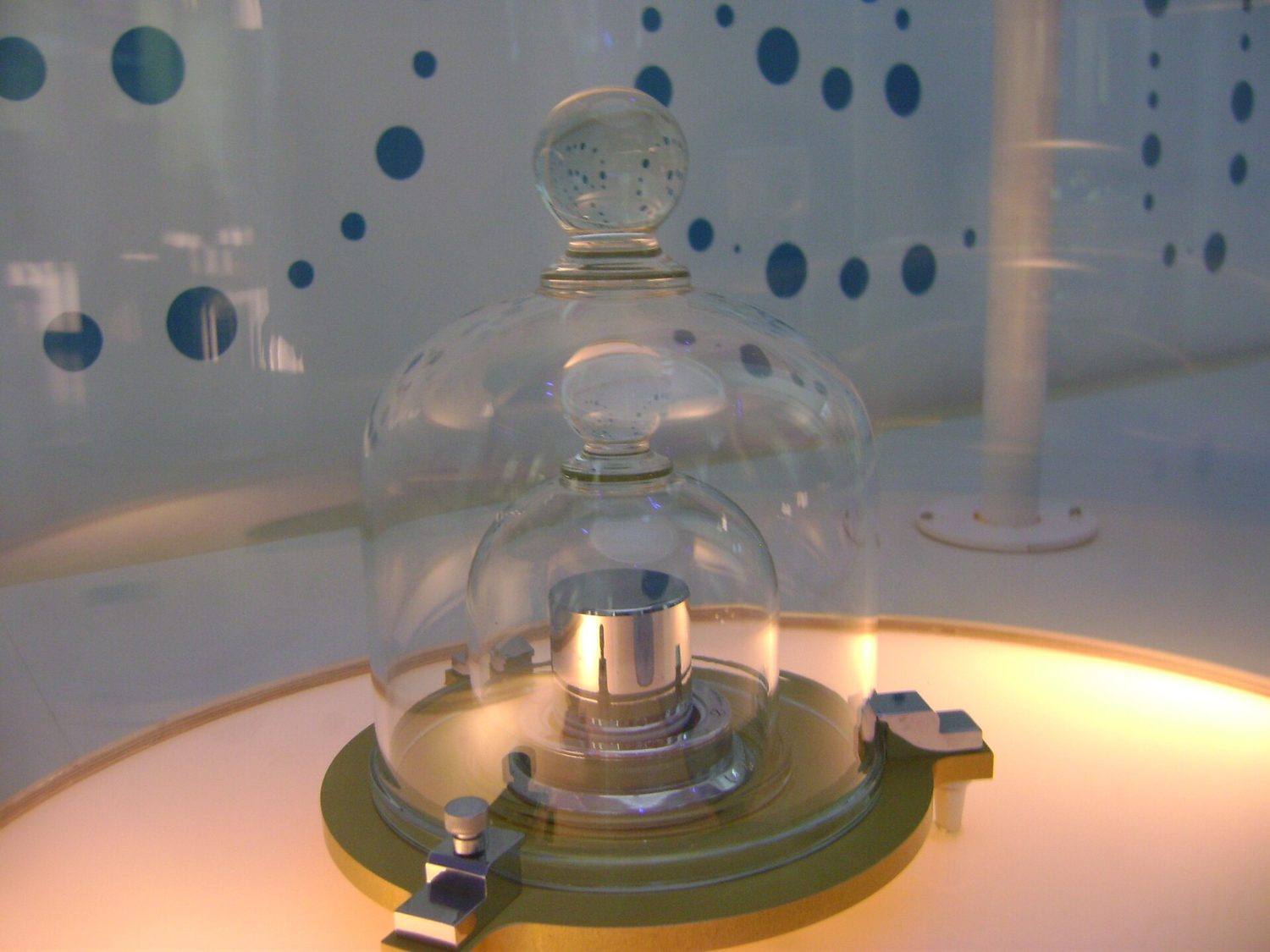
- Until 2019 the kilogram was a real metal cylinder kept in Paris.
- Now it is fixed by a constant of nature instead.
趣闻:千克
- 直到 2019 年,千克还是一个 真实的金属圆柱,保存在巴黎。
- 现在它改由一个自然常数来确定。
Build a derived unit 导出单位 from its equation
- A derived unit is base units multiplied or divided.
- Build it from the equation that defines the quantity.
- Simple ones: speed $= \dfrac{\text{m}}{\text{s}}$, acceleration $= \dfrac{\text{m}}{\text{s}^2}$.
从定义方程搭出导出单位
- 导出单位(derived unit) 就是基本单位相乘或相除得到的。
- 用定义该物理量的方程把它搭出来。
- 简单的例子:速度 $= \dfrac{\text{m}}{\text{s}}$,加速度 $= \dfrac{\text{m}}{\text{s}^2}$。
Match each derived unit to its form in SI base units. · 将每个导出单位与其在 SI 基本单位 中的形式匹配。
Each comes from its defining equation: force gives the newton, energy the joule, power the watt, and pressure the pascal. · 每个单位都来自其定义方程:力导出牛顿,能量导出焦耳,功率导出瓦特,压强导出帕斯卡。
Put the method for finding a derived unit in base units in order. · 将推导单位用基本单位表示的方法按顺序排列。
This is why the equation matters more than memorising: the watt comes out of P = E/t and the joule out of W = Fd, every time. · 这就是为什么理解方程比死记硬背更重要:瓦特来自 P = E/t,焦耳来自 W = Fd,每次都是如此。
Worked example: the watt in base units
- power = energy ÷ time, so $\text{W} = \dfrac{\text{J}}{\text{s}}$.
- Put in the joule: $\dfrac{1}{\text{s}} \times \dfrac{\text{kg}\cdot\text{m}^2}{\text{s}^2}$.
- Simplify: $\dfrac{\text{kg}\cdot\text{m}^2}{\text{s}^3}$.
例题:用基本单位表示瓦特
- 功率 = 能量 ÷ 时间,所以 $\text{W} = \dfrac{\text{J}}{\text{s}}$。
- 代入焦耳:$\dfrac{1}{\text{s}} \times \dfrac{\text{kg}\cdot\text{m}^2}{\text{s}^2}$。
- 化简:$\dfrac{\text{kg}\cdot\text{m}^2}{\text{s}^3}$。
Checking equations: homogeneity
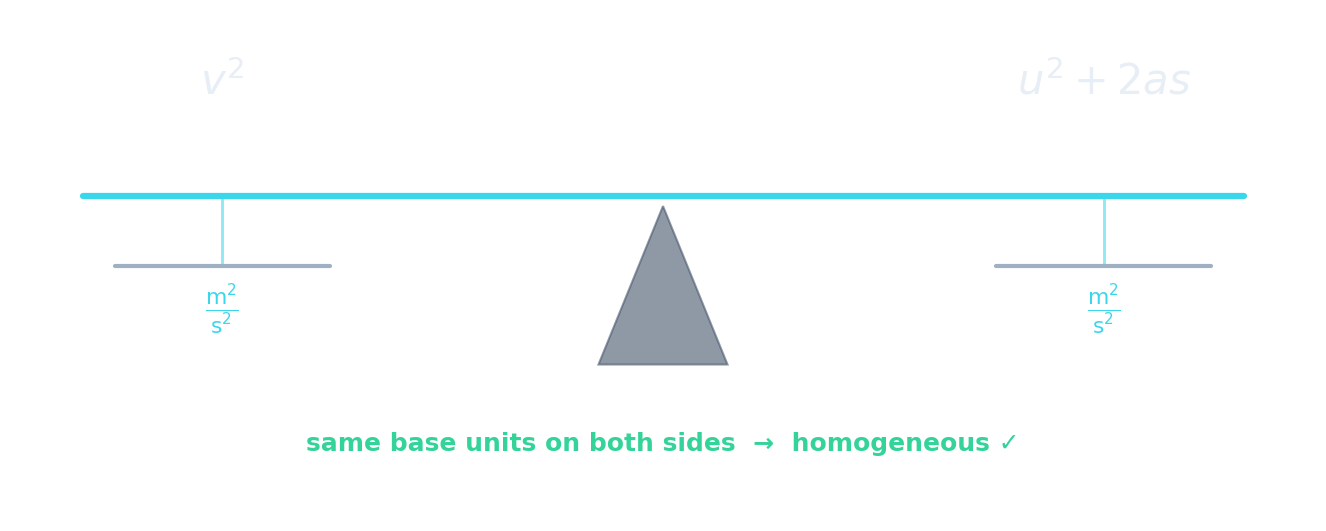
- An equation is homogeneous 量纲一致 when both sides have the same base units.
- In $v^{2} = u^{2} + 2as$, every term works out to $\dfrac{\text{m}^2}{\text{s}^2}$ — so it balances.
检验方程:量纲齐次
- 当一个方程两边有 相同的基本单位 时,它就是 齐次的(homogeneous)。
- 在 $v^{2} = u^{2} + 2as$ 中,每一项都化为 $\dfrac{\text{m}^2}{\text{s}^2}$——所以两边平衡。
Is the equation $v = u + at$ homogeneous? · 方程 $v = u + at$ 是否量纲一致?
Yes — every term is a speed. $v$ and $u$ are $\dfrac{\text{m}}{\text{s}}$, and $at = \dfrac{\text{m}}{\text{s}^2} \times \text{s} = \dfrac{\text{m}}{\text{s}}$. · 是的——每一项都是速度。$v$ 和 $u$ 是 $\dfrac{\text{m}}{\text{s}}$,且 $at = \dfrac{\text{m}}{\text{s}^2} \times \text{s} = \dfrac{\text{m}}{\text{s}}$。
An equation is homogeneous when every term has the same ____ units. · 当每一项具有相同的____单位时,方程才是量纲一致的。
A homogeneous equation may still be wrong, because a missing factor of one half carries no units. But a non-homogeneous equation is certainly wrong. · 量纲一致的方程仍可能是错的,因为缺少因子二分之一并不改变单位。但非量纲一致的方程肯定是错的。
Matching units do not prove an equation is right — the number could still be wrong. But if the units don't match, it is wrong for sure.
单位相符并不能证明方程是对的——数字仍可能错。但如果单位不相符,那它一定是错的。
Using base units, which equation is not · 不 homogeneous (so must be wrong)? · 使用基本单位,哪个方程不是齐次的(因此一定是错误的)?
In $v = u + a$, $a$ is $\dfrac{\text{m}}{\text{s}^2}$ but $u$ is $\dfrac{\text{m}}{\text{s}}$ — the units do not match, so it cannot be right. The other three are homogeneous. · 在 $v = u + a$ 中,$a$ 是 $\dfrac{\text{m}}{\text{s}^2}$ 但 $u$ 是 $\dfrac{\text{m}}{\text{s}}$ —— 单位不匹配,所以它是不正确的。其他三个是齐次的。
Prefixes 词头
- A prefix scales a unit by a power of ten.
- You must know the ten in the syllabus, from pico to tera.
词头
- 词头(prefix) 把单位按十的幂缩放。
- 你必须记住大纲里的那些,从皮(pico)到太(tera)。
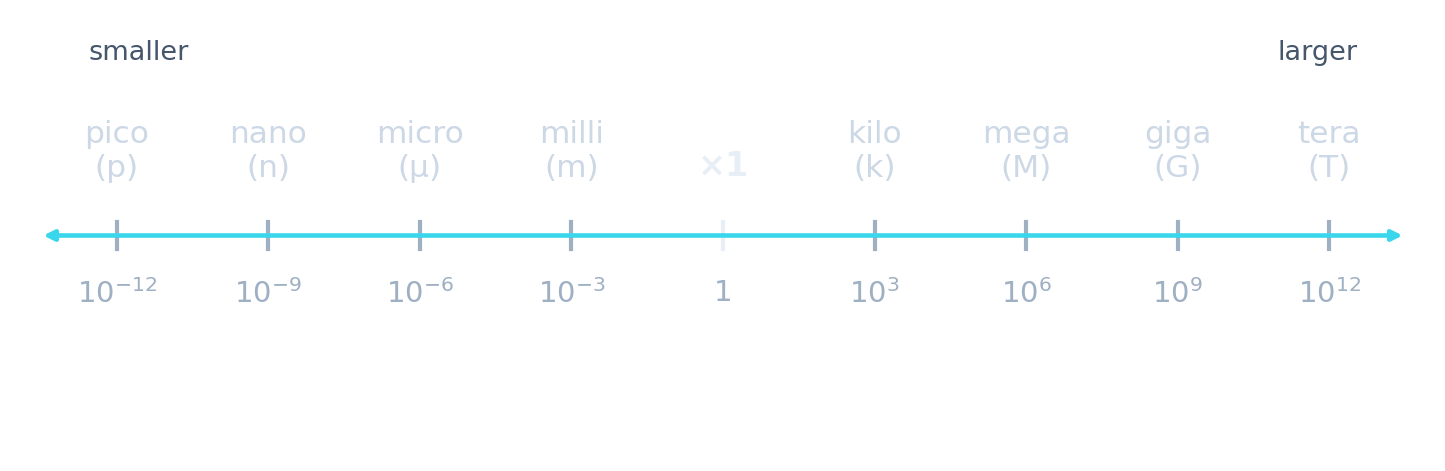
Put these prefixes in order, smallest factor first. · 将这些前缀按顺序排列,从小到大。
In order of size: nano, micro, milli, then kilo, mega. Each step up this list is a larger power of ten. · 按大小顺序:纳、微、毫,然后是千、兆。列表中的每一步都是更大的十进制幂。
A square has sides of 5.0 cm. What is its area in square metres, in units of 1e-3 m^2? · 一个正方形边长为 5.0 cm。它的面积是多少平方米?以 1e-3 m^2 为单位。
0.050 m squared is 2.5e-3 m^2. Converting after squaring, or dividing by 100 instead of 10000, is the classic area-prefix error. · 0.050 m 的平方是 2.5e-3 m^2。在平方后转换,或除以100而不是10000,是经典的面积前缀错误。
Converting a prefixed unit
- Replace each prefix with its power of ten, then simplify.
- kilo $=10^{3}$, so $2\ \text{kN} = 2 \times 10^{3}\ \text{N} = 2000\ \text{N}$.
换算带词头的单位
- 把每个词头换成它的十的幂,再化简。
- 千(kilo)$=10^{3}$,所以 $2\ \text{kN} = 2 \times 10^{3}\ \text{N} = 2000\ \text{N}$。
A force is $2\ \text{kN}$. How many newtons is that? · 一个力是 $2\ \text{kN}$。这相当于多少牛顿?
kilo means $\times 10^{3}$, so $2\ \text{kN} = 2 \times 10^{3}\ \text{N} = 2000\ \text{N}$. · 千意味着 $\times 10^{3}$,所以 $2\ \text{kN} = 2 \times 10^{3}\ \text{N} = 2000\ \text{N}$。
Watch the squares
- For a squared unit like $\text{mm}^2$, square the factor too.
注意平方
- 对于像 $\text{mm}^2$ 这样的平方单位,也要把那个因子一起平方。
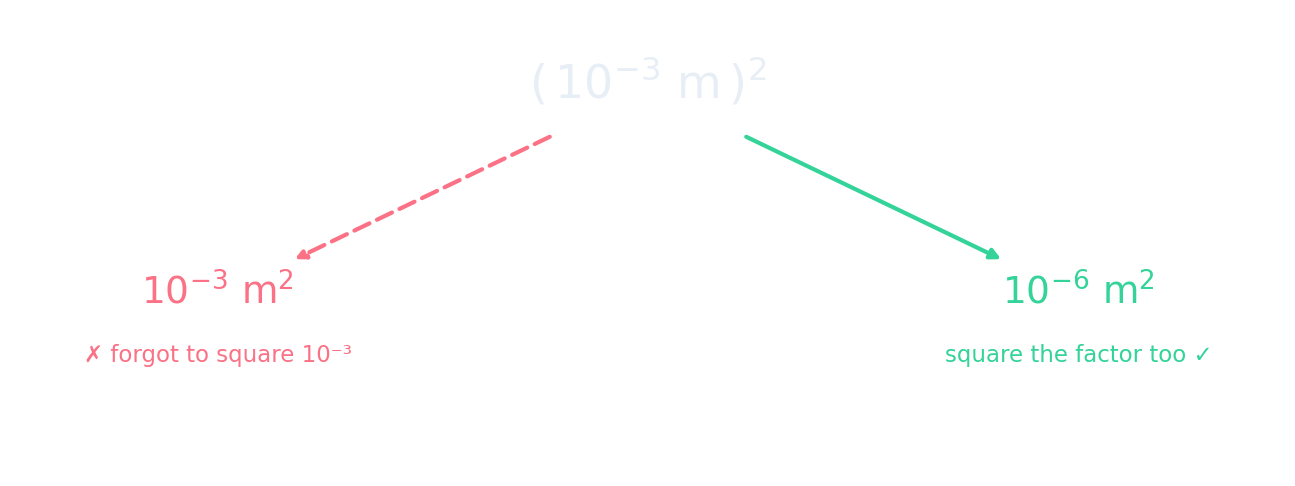
$(10^{-3}\ \text{m})^{2} = 10^{-6}\ \text{m}^{2}$, not $10^{-3}\ \text{m}^{2}$.
$(10^{-3}\ \text{m})^{2} = 10^{-6}\ \text{m}^{2}$,而不是 $10^{-3}\ \text{m}^{2}$。
What is $(10^{-3}\ \text{m})^{2}$, written in $\text{m}^2$? · $(10^{-3}\ \text{m})^{2}$ 用 $\text{m}^2$ 表示是多少?
Square the factor too: $(10^{-3})^{2} = 10^{-6}$, so $(10^{-3}\ \text{m})^{2} = 10^{-6}\ \text{m}^2$ — not $10^{-3}$. · 也要对系数进行平方:$(10^{-3})^{2} = 10^{-6}$,所以 $(10^{-3}\ \text{m})^{2} = 10^{-6}\ \text{m}^2$ ——而不是 $10^{-3}$。
You've got it
- every unit is built from the five base units: kg, m, s, A, K
- a derived unit comes from the equation that defines it
- check an equation with homogeneity — and when a prefix is squared, square its factor too
你掌握了
- 每个单位都由 五个基本单位 搭成:kg、m、s、A、K
- 导出单位 来自定义它的方程
- 用 量纲齐次 检验方程——而且当词头被 平方时,把它的因子也一起平方