| English | 释义 | 拼音 |
|---|---|---|
| normal distribution/ˈnɔːml ˌdɪstrɪˈbjuːʃn/ | 正态分布 | zhèng tài fēn bù |
| continuous variable/kənˈtɪnjuːəs ˈveərɪəbl/ | 连续变量 | lián xù biàn liàng |
| standardize/ˈstændədaɪz/ | 标准化 | biāo zhǔn huà |
| approximate/əˈprɒksɪmət/ | 近似 | jìn sì |
| continuity correction/kɒntɪˈnjuːɪti kəˈrekʃn/ | 连续性校正 | lián xù xìng jiào zhèng |
The curve behind heights, masses and errors
- Measure the heights of 1000 students, the masses of apples, or the errors in a machine: the values pile up in a symmetric bell shape.
- The normal distribution 正态分布 models continuous variables 连续变量 like these. In Paper 5 it is in almost every exam, usually for 6 to 10 marks.
- This lesson covers the four question types: finding a probability, finding a value, finding $\mu$ or $\sigma$, and approximating a binomial.
The normal distribution
- $X\sim N(\mu,\sigma^2)$ has mean $\mu$ (the centre) and variance 方差 $\sigma^2$ (the spread). The curve is symmetric about $\mu$, and the total area under it is 1.
- Trap: the second number is the variance. $X\sim N(50,16)$ has standard deviation $\sigma=4$, not 16.
- For a continuous variable, probability is area. $P(X=50)=0$, so $P(X<58)$ and $P(X\le58)$ are the same.

About 68% of values lie within one standard deviation of the mean, 95% within two and 99.7% within three.
The normal distribution curve is:
难度 1/5 · 今日首次完成可获 100 金币及少量额外奖励
It is the symmetric bell-shaped curve centred on the mean μ.
Approximately what percentage of values lie within 1 standard deviation of the mean?
难度 1/5 · 今日首次完成可获 100 金币及少量额外奖励
The 68-95-99.7 rule: ~68% within 1σ, ~95% within 2σ, ~99.7% within 3σ.
X ~ N(30, 36). What is the standard deviation of X?
难度 2/5 · 今日首次完成可获 140 金币及少量额外奖励
The second number is the variance, 36, so σ = √36 = 6.
Standardising and the Φ table
- Every normal variable can be changed into the standard normal 标准正态 $Z\sim N(0,1)$:
- $z$ counts how many standard deviations a value is from the mean: $x=58$ in $N(50,16)$ gives $z=\dfrac{58-50}{4}=2$.
- The table gives $\Phi(z)=P(Z<z)$, the area to the left of $z$, for $z\ge0$ only. So $P(X<58)=\Phi(2)=0.9772$.
X ~ N(50, 4) means μ = 50, σ = 2. Standardize x = 56: what is Z = (x − μ)/σ?
难度 2/5 · 今日首次完成可获 140 金币及少量额外奖励
Z = (56 − 50)/2 = 6/2 = 3.
If Z = 2, Φ(2) = 0.9772. What is P(Z < 2) (to 4 dp)?
难度 2/5 · 今日首次完成可获 140 金币及少量额外奖励
P(Z < 2) = Φ(2) = 0.9772 from the standard normal table.
X ~ N(100, 25) means μ = 100, σ = 5. Standardize x = 90: Z = (90 − 100)/5. Find Z.
难度 2/5 · 今日首次完成可获 140 金币及少量额外奖励
Z = (90 − 100)/5 = −10/5 = −2.
Complete the standardising formula: Z = (X − μ) / ______.
难度 1/5 · 今日首次完成可获 100 金币及少量额外奖励
Z = (X − μ)/σ converts any normal variable to the standard normal N(0, 1).
Four kinds of probability
- Always sketch the curve and shade the area first. Then turn it into areas the table gives:
| You want | Use |
|---|---|
| $P(Z<a)$ | $\Phi(a)$ |
| $P(Z>a)$ | $1-\Phi(a)$ |
| $P(Z<-a)$ | $1-\Phi(a)$ (symmetry) |
| $P(a<Z<b)$ | $\Phi(b)-\Phi(a)$ |
- Example: $X\sim N(50,16)$. Find $P(X<45)$.
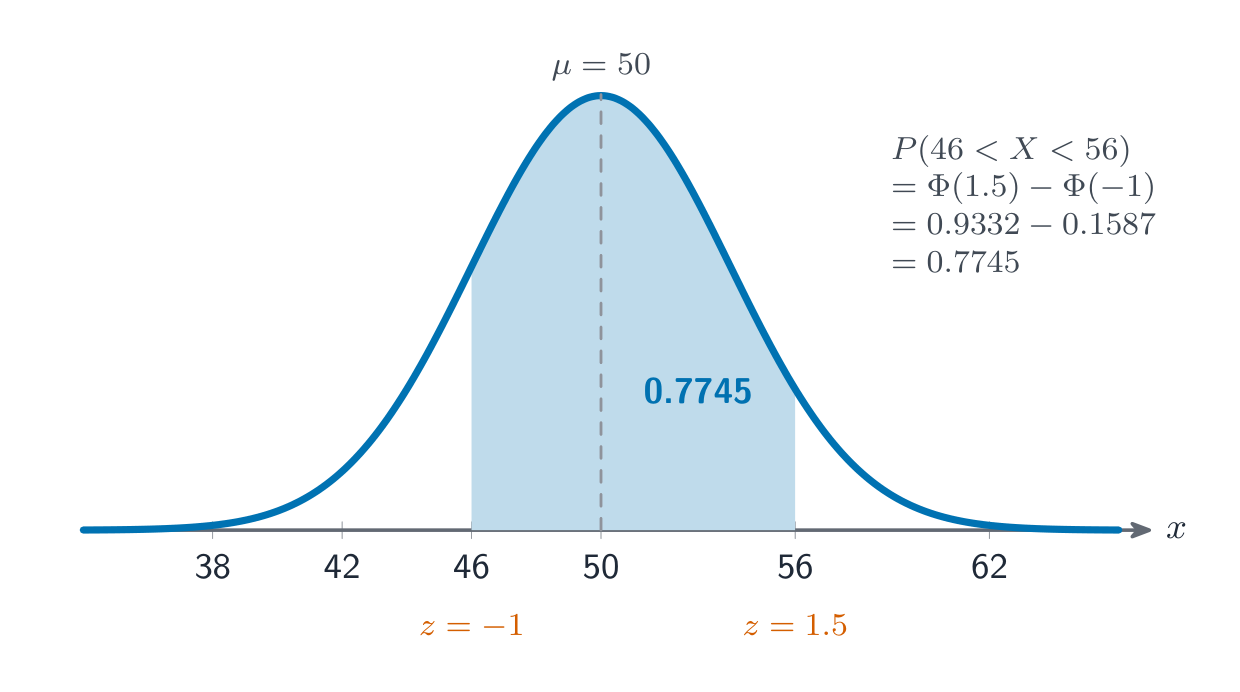
Method: sketch, standardise both ends, then subtract the smaller area from the larger. $\Phi(-1)=1-\Phi(1)=0.1587$.
从原始数值到正态模型概率
$z=(x-\mu)/\sigma$
把本课原始数值、标准化边界和正确的阴影区域联系起来。调整模型并不能证明真实数据服从该模型。
X ~ N(50, 16). Find P(X > 55), to 4 decimal places. (Φ(1.25) = 0.8944)
难度 2/5 · 今日首次完成可获 140 金币及少量额外奖励
z = (55 − 50)/4 = 1.25, and P(Z > 1.25) = 1 − 0.8944 = 0.1056.
X ~ N(100, 25). Find P(95 < X < 110), to 4 decimal places. (Φ(1) = 0.8413, Φ(2) = 0.9772)
难度 2/5 · 今日首次完成可获 140 金币及少量额外奖励
z-values are −1 and 2. Φ(2) − Φ(−1) = 0.9772 − (1 − 0.8413) = 0.8185.
Working backwards: find the value
- Sometimes you are given the probability and must find $x$. Find $z$ from the table backwards (or from the critical values below the table), then solve $x=\mu+z\sigma$.
- Check the sign: if the area to the left is less than 0.5, $x$ is below the mean, so $z$ is negative.
- Example: $X\sim N(50,16)$, and 10% of values are below $x$. $\Phi(1.282)=0.9$, so $z=-1.282$ and $x=50-1.282\times4=$ 44.9. If 5% lie above $x$: $z=1.645$, so $x=50+1.645\times4=$ 56.6.
X ~ N(200, 64). 90% of values are less than x. Find x, to 3 significant figures. (Φ(1.282) = 0.9)
难度 2/5 · 今日首次完成可获 140 金币及少量额外奖励
z = 1.282 and σ = 8, so x = 200 + 1.282 × 8 = 210.3, which is 210 to 3 s.f.
Worked exam question: find μ and σ
Question (5 marks). The lengths of a type of fish are normally distributed. 10% are shorter than 45 cm and 20% are longer than 62 cm. Find the mean and standard deviation.
- Turn each fact into a $z$-value. $P(X<45)=0.1$, so $\dfrac{45-\mu}{\sigma}=-1.282$. $P(X>62)=0.2$ means $P(X<62)=0.8$, so $\dfrac{62-\mu}{\sigma}=0.842$. (B1 B1 for $\pm1.282$ and $0.842$.)
- Write two linear equations: $45-\mu=-1.282\sigma$ and $62-\mu=0.842\sigma$. (M1 for standardising with $\sigma$, not $\sigma^2$.)
- Subtract: $17=2.124\sigma$, so $\sigma=8.00$; then $\mu=45+1.282\times8.00=$ 55.3. (M1 for solving, A1 for both answers.)
Why answers lose marks: using $+1.282$ for the lower value (it lies below the mean, so $z$ is negative), or putting a probability such as 0.8 into the equation instead of its $z$-value.
15% of a normal population lies below 40. Which equation is correct? (Φ(1.036) = 0.85)
难度 1/5 · 今日首次完成可获 100 金币及少量额外奖励
Less than half the area lies below 40, so 40 is below the mean and z is negative. Use σ, not σ², and a z-value, not the probability.
X ~ N(μ, σ²). P(X < 20) = 0.1 and P(X > 35) = 0.05. Find μ and σ. (Φ(1.282) = 0.9, Φ(1.645) = 0.95)
Each fact gives one equation; subtract to remove μ.
Approximating the binomial
- If $X\sim B(n,p)$ with $np>5$ and $n(1-p)>5$, use $Y\sim N(np,\ np(1-p))$. State both checks in your answer: they earn a mark.
- $X$ counts whole numbers, but $Y$ is continuous, so each whole number $k$ becomes the interval from $k-0.5$ to $k+0.5$. This is the continuity correction 连续性校正:
| Binomial | Normal |
|---|---|
| $X\le k$ | $Y<k+0.5$ |
| $X<k$ | $Y<k-0.5$ |
| $X\ge k$ | $Y>k-0.5$ |
| $X=k$ | $k-0.5<Y<k+0.5$ |

Each bar stretches 0.5 either side of its whole number. That is where the 0.5 comes from.
When the normal distribution approximates the binomial, a continuity correction of 0.5 is applied.
难度 1/5 · 今日首次完成可获 100 金币及少量额外奖励
Replacing a discrete variable with a continuous one needs a ±0.5 continuity correction.
X ~ B(100, 0.4) is approximated by Y. Which probability matches P(X < 35)?
难度 1/5 · 今日首次完成可获 100 金币及少量额外奖励
X < 35 means X ≤ 34, which covers up to 34.5 on the continuous scale.
Worked exam question: the approximation
Question (5 marks). 30% of the seeds in a large batch fail to grow. 60 seeds are planted. Use a suitable approximation to find the probability that at least 22 fail.
- Check and set up: $np=18>5$ and $n(1-p)=42>5$. $\mu=18$ and $\sigma^2=60\times0.3\times0.7=12.6$, so $Y\sim N(18,\ 12.6)$. (B1)
- Continuity correction: "at least 22" is $X\ge22$, so use $P(Y>21.5)$. (M1)
- Standardise: $z=\dfrac{21.5-18}{\sqrt{12.6}}=0.986$. (M1, with $\sqrt{12.6}$, not 12.6)
- Answer: $1-\Phi(0.986)=1-0.8379=$ 0.162. (M1 for the correct side of the area, A1)
Common slips: using 22.5 (that would mean "more than 22"), or dividing by the variance 12.6 instead of the standard deviation 3.55.
X ~ B(50, 0.5). Using a normal approximation, find P(X ≤ 28) to 3 decimal places. (Φ(0.990) = 0.8389)
难度 2/5 · 今日首次完成可获 140 金币及少量额外奖励
μ = 25, σ² = 12.5, so σ = 3.536. P(Y < 28.5): z = 3.5/3.536 = 0.990, so the answer is 0.839.
You've got it
- $X\sim N(\mu,\sigma^2)$: the second number is the variance; standardise with $Z=\dfrac{X-\mu}{\sigma}$
- $\Phi(z)=P(Z<z)$; $P(Z>a)=1-\Phi(a)$; $P(Z<-a)=1-\Phi(a)$; $P(a<Z<b)=\Phi(b)-\Phi(a)$; sketch first
- find a value: $z$ from the table backwards, then $x=\mu+z\sigma$; $z<0$ below the mean
- two facts give two equations $\dfrac{x-\mu}{\sigma}=z$: solve them simultaneously for $\mu$ and $\sigma$
- $B(n,p)\approx N(np,\ np(1-p))$ when $np>5$ and $n(1-p)>5$; always use a continuity correction
Which step is wrong? "X ~ N(40, 9), so z = (46 − 40)/9 = 0.667."
难度 1/5 · 今日首次完成可获 100 金币及少量额外奖励
N(40, 9) gives the variance 9, so σ = 3 and z = 6/3 = 2.