| English | 释义 | 拼音 |
|---|---|---|
| discrete random variable/dɪˈskriːt ˈrændəm ˈveərɪəbl/ | 离散型随机变量 | lí sàn xíng suí jī biàn liàng |
| expectation/ekspɪkˈteɪʃn/ | 期望 | qī wàng |
| variance/ˈveərɪəns/ | 方差 | fāng chà |
| probability distribution/ˌprɒbəˈbɪlɪti ˌdɪstrɪˈbjuːʃn/ | 概率分布 | gài lǜ fēn bù |
| binomial distribution/baɪˈnəʊmɪəl ˌdɪstrɪˈbjuːʃn/ | 二项分布 | èr xiàng fēn bù |
| trial/ˈtraɪəl/ | 试验 | shì yàn |
| geometric distribution/ˌdʒiːəʊˈmetrɪk ˌdɪstrɪˈbjuːʃn/ | 几何分布 | jǐ hé fēn bù |
The loaded die
- A fair die gives each face probability $\dfrac{1}{6}$. But what if the die is loaded? Each outcome still has a probability, but they're no longer equal.
- A discrete random variable 离散型随机变量 assigns a probability to each possible outcome — the foundation of statistical modelling.
Discrete random variables
- A discrete random variable $X$ takes separate values, each with a probability (they sum to 1).
- Expectation 期望 (mean): $E(X) = \sum x\,P(X = x)$.
- Variance 方差: $\text{Var}(X) = \sum x^2\,P(X = x) - \big(E(X)\big)^2$.
Worked example. $X$ takes values 1, 2, 3 with probabilities 0.2, 0.5, 0.3. $E(X) = 1(0.2) + 2(0.5) + 3(0.3) = 0.2 + 1.0 + 0.9 = 2.1$. $E(X^2) = 1(0.2) + 4(0.5) + 9(0.3) = 0.2 + 2.0 + 2.7 = 4.9$. $\text{Var}(X) = 4.9 - 2.1^2 = 4.9 - 4.41 = 0.49$.
Probabilities must sum to 1. Before calculating expectation or variance, always check that $\sum P(X = x) = 1$. If it doesn't, the probability distribution 概率分布 is invalid.
二项分布
X ~ B(n, p)
每个条形是 k 次成功的机会。改变 n 和 p,看平均数 np 移动。
在一张概率分布表中,概率的和必须为 1。
难度 1/5 · 今日首次完成可获 100 金币及少量额外奖励
一个有效的分布所有概率的和为 1。
X 取值 1、2、3,P = 0.2、0.5、0.3。E(X) = ΣxP(X=x)。求它。
难度 2/5 · 今日首次完成可获 140 金币及少量额外奖励
1(0.2) + 2(0.5) + 3(0.3) = 0.2 + 1.0 + 0.9 = 2.1.
如果 E(X) = 2.1 而 E(X²) = 4.9,Var(X) = E(X²) − (E(X))²。求它。
难度 2/5 · 今日首次完成可获 140 金币及少量额外奖励
Var(X) = 4.9 − 2.1² = 4.9 − 4.41 = 0.49。
把每个二项分布的概念与它的结果配对。
难度 2/5 · 今日首次完成可获 140 金币及少量额外奖励
二项分布有固定的 n 次试验和恒定的 p;均值是 np,方差是 np(1−p)。
The binomial distribution 二项分布
- Binomial $X \sim B(n, p)$ — number of successes in $n$ independent trials 试验:
- $P(X = r) = \dbinom{n}{r}p^r(1-p)^{n-r}$
- $E(X) = np$, $\text{Var}(X) = np(1-p)$.
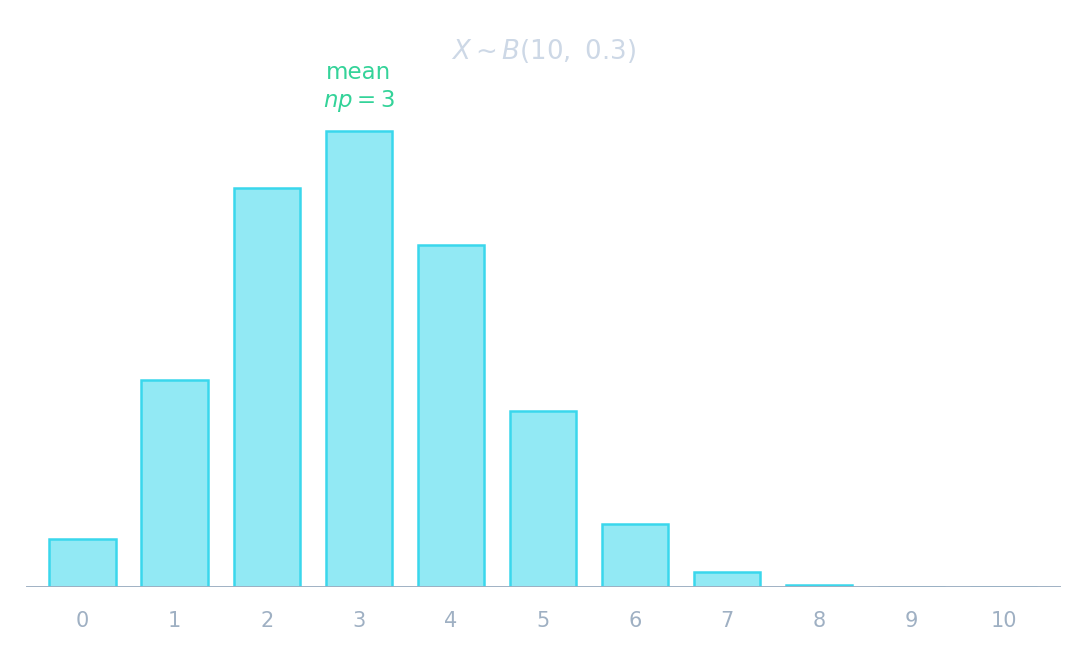
Each bar is P(X = r) for B(10, 0.3); the distribution peaks at the mean np = 3.
对 X ~ B(10, 0.3),E(X) = np 是多少?
难度 2/5 · 今日首次完成可获 140 金币及少量额外奖励
E(X) = np = 10 × 0.3 = 3。
对 X ~ B(10, 0.3),Var(X) = np(1−p) 是多少?
难度 2/5 · 今日首次完成可获 140 金币及少量额外奖励
Var(X) = np(1−p) = 10 × 0.3 × 0.7 = 2.1。
The geometric distribution 几何分布
- Geometric — the trial number of the first success:
- $P(X = r) = (1-p)^{r-1}p$
- $E(X) = \dfrac{1}{p}$.
对一个 p = 0.2 的几何分布,E(X) = 1/p。求它。
难度 2/5 · 今日首次完成可获 140 金币及少量额外奖励
E(X) = 1/p = 1/0.2 = 5。平均而言,第一次成功发生在第 5 次试验。
Worked example — binomial
- $X \sim B(10, 0.3)$. Find $P(X = 2)$ and $E(X)$.
- $P(X = 2) = \dbinom{10}{2}(0.3)^2(0.7)^8 = 45 \times 0.09 \times 0.0576 = 0.233$.
- $E(X) = np = 10 \times 0.3 = 3$.
You've got it
- $E(X) = \sum x\,P(X=x)$; $\text{Var}(X) = \sum x^2 P(X=x) - (E(X))^2$
- binomial $B(n,p)$: $E = np$, $\text{Var} = np(1-p)$
- geometric: first success on trial $r$, $E = \dfrac1p$
Write from the data: find the binomial mean
- A binomial distribution has n = 10 and p = 0.2.
- Find the mean and the variance.
对于参数 n = 10 且 p = 0.2 的二项分布,其均值和方差分别是多少?
10 乘以 0.2 等于 2。2 乘以 0.8 等于 1.6。
平均值是多少?
难度 1/5 · 今日首次完成可获 100 金币及少量额外奖励
np 为 2,且 np(1 - p) 为 1.6。