Differentiation (Further Pure 2) · 微分(Further Pure 2)
| English | 中文 | Pinyin · 拼音 |
|---|---|---|
| polynomial/ˌpɒlɪˈnəʊmɪəl/ | 多项式 | duō xiàng shì |
| Maclaurin series/məˈklɔːrɪn ˈsɪəriːz/ | 麦克劳林级数 | mài kè láo lín jí shù |
| differentiation/ˌdɪfəˌrenʃɪˈeɪʃn/ | 微分 | wēi fēn |
| hyperbolic/ˌhaɪpəˈbɒlɪk/ | 双曲 | shuāng qū |
| coefficient/ˌkəʊɪˈfɪʃənt/ | 系数 | xì shù |
| interval of convergence/ˈɪntəvl ɒv kənˈvɜːdʒəns/ | 收敛区间 | shōu liǎn qū jiān |
| diverge/daɪˈvɜːdʒ/ | 发散 | fā sàn |
How does a calculator find eˣ?
- Your calculator can't "do" $e^{0.7}$ directly — there's no button-press that knows it.
- Instead it adds up a few terms of a polynomial 多项式 that mimics $e^x$ near zero.
- That polynomial is a Maclaurin series 麦克劳林级数 — and building one starts with repeated differentiation 微分.
一个计算器如何求 eˣ?
- 你的计算器不能直接"做" $e^{0.7}$——没有一个按键知道它。
- 相反,它把一个多项式的几项加起来,这个多项式在零附近模仿 $e^x$。
- 那个多项式是一个麦克劳林级数(Maclaurin series)——而构建一个从反复求导开始。
New derivatives to know
- Further Pure 2 adds derivatives of the hyperbolic 双曲 and inverse functions:
| function | derivative |
|---|---|
| $\sinh x$ | $\cosh x$ |
| $\cosh x$ | $\sinh x$ |
| $\sin^{-1}x$ | $\dfrac{1}{\sqrt{1-x^2}}$ |
| $\tan^{-1}x$ | $\dfrac{1}{1+x^2}$ |
- You can also find $\dfrac{d^2y}{dx^2}$ for implicit and parametric curves.
Each extra Maclaurin term hugs e^x over a wider range
要知道的新导数
- Further Pure 2 增加了双曲(hyperbolic)和反(inverse)函数的导数:
| 函数 | 导数 |
|---|---|
| $\sinh x$ | $\cosh x$ |
| $\cosh x$ | $\sinh x$ |
| $\sin^{-1}x$ | $\dfrac{1}{\sqrt{1-x^2}}$ |
| $\tan^{-1}x$ | $\dfrac{1}{1+x^2}$ |
- 你也能为隐式(implicit)和参数(parametric)曲线求 $\dfrac{d^2y}{dx^2}$。
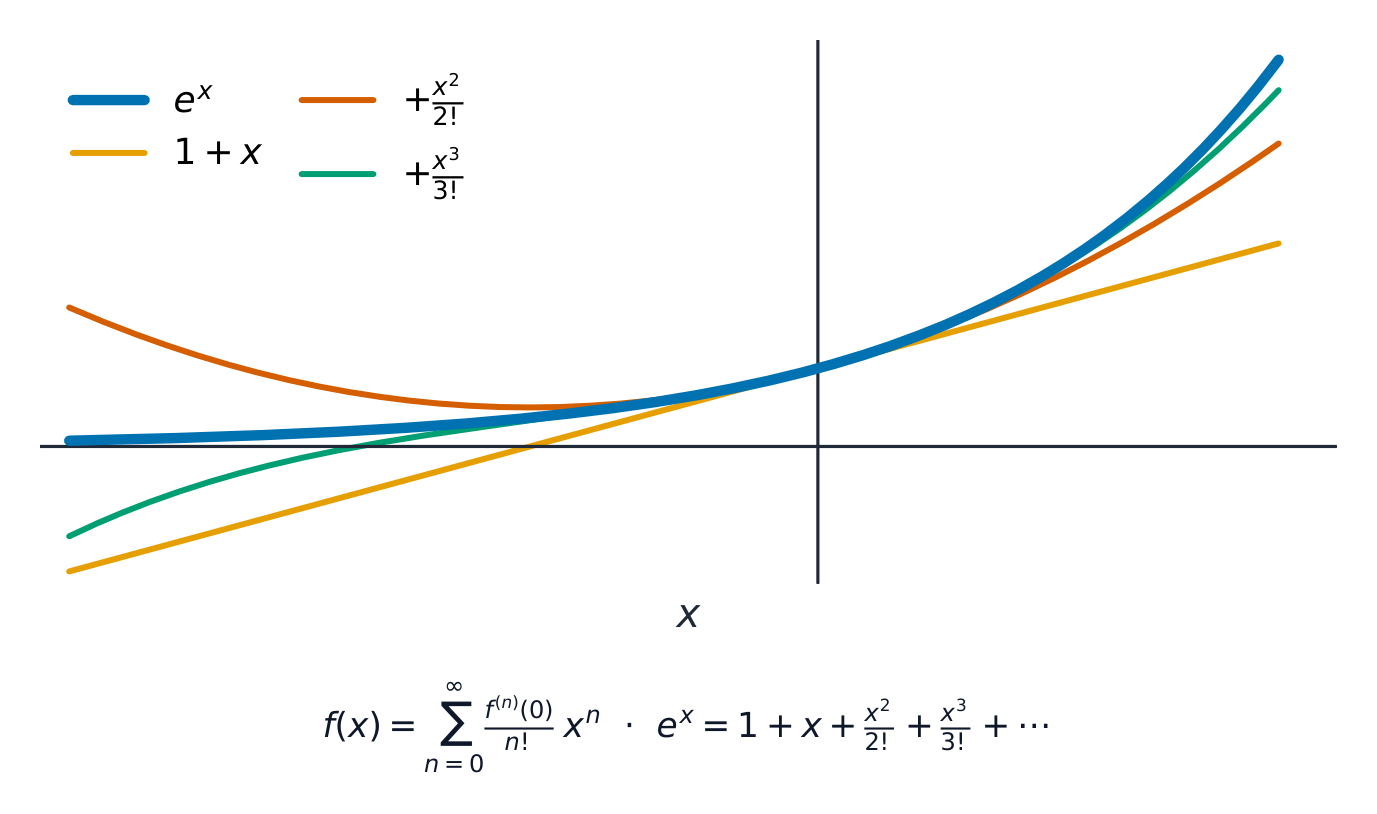
每一个额外的麦克劳林项在更宽的范围上贴合 e^x
The gradient at a point · 一点处的梯度
gradient = dy/dx
The derivative is the slope of the tangent · 相切, however exotic the function. · 无论函数多么奇异,导数都是切线的斜率。
The derivative of sinh x is: · sinh x 的导数是:
d/dx(sinh x) = cosh x (and d/dx(cosh x) = sinh x). · d/dx(sinh x) = cosh x(以及 d/dx(cosh x) = sinh x)。
The derivative of tan⁻¹x is 1/(1+x²). What is its value at x = 0? · tan⁻¹x 的导数是 1/(1+x²)。它在 x = 0 处的值是多少?
1/(1+0²) = 1. · 1/(1+0²) = 1。
Match each function to its derivative. · 把每个函数匹配到它的导数。
The hyperbolic pair swap (no minus sign, unlike sin/cos); the inverse trig derivatives are the standard rational/surd forms. · 双曲对互换(没有减号,不像 sin/cos);反三角导数是标准的有理式/根式形式。
Maclaurin's series
- A Maclaurin series rebuilds a function as an infinite polynomial using its derivatives at $0$:
- Each coefficient 系数 needs the next derivative, evaluated at $x = 0$.
麦克劳林级数
- 一个麦克劳林级数用一个函数在 $0$ 处的导数把它重建为一个无穷多项式:
- 每个系数需要下一个导数,在 $x = 0$ 处求值。
In a Maclaurin series, the constant term is f(0). For f(x) = eˣ, what is f(0)? · 在一个麦克劳林级数中,常数项是 f(0)。对 f(x) = eˣ,f(0) 是多少?
e⁰ = 1, so the constant term is 1. · e⁰ = 1,所以常数项是 1。
In the Maclaurin series, the coefficient of xⁿ has n-factorial (written n!) in the ______. · 在麦克劳林级数中,xⁿ 的系数在______中有 n 的阶乘(写作 n!)。
The xⁿ term is f⁽ⁿ⁾(0)/n! · xⁿ — the n! is in the denominator. · xⁿ 项是 f⁽ⁿ⁾(0)/n! · xⁿ——n! 在分母中。
Worked example — the series for eˣ
- For $f(x) = e^x$, every derivative is $e^x$, and $e^0 = 1$. So every coefficient is $\dfrac{1}{n!}$:
Each extra term bends the polynomial closer to $e^x$ near $x = 0$ — exactly how a calculator works.
More standard series. $\sin x = x - \dfrac{x^3}{3!} + \dfrac{x^5}{5!} - \cdots$ and $\ln(1+x) = x - \dfrac{x^2}{2} + \dfrac{x^3}{3} - \cdots$ (valid for $|x| < 1$).
例题——eˣ 的级数
- 对 $f(x) = e^x$,每个导数都是 $e^x$,而 $e^0 = 1$。所以每个系数都是 $\dfrac{1}{n!}$:
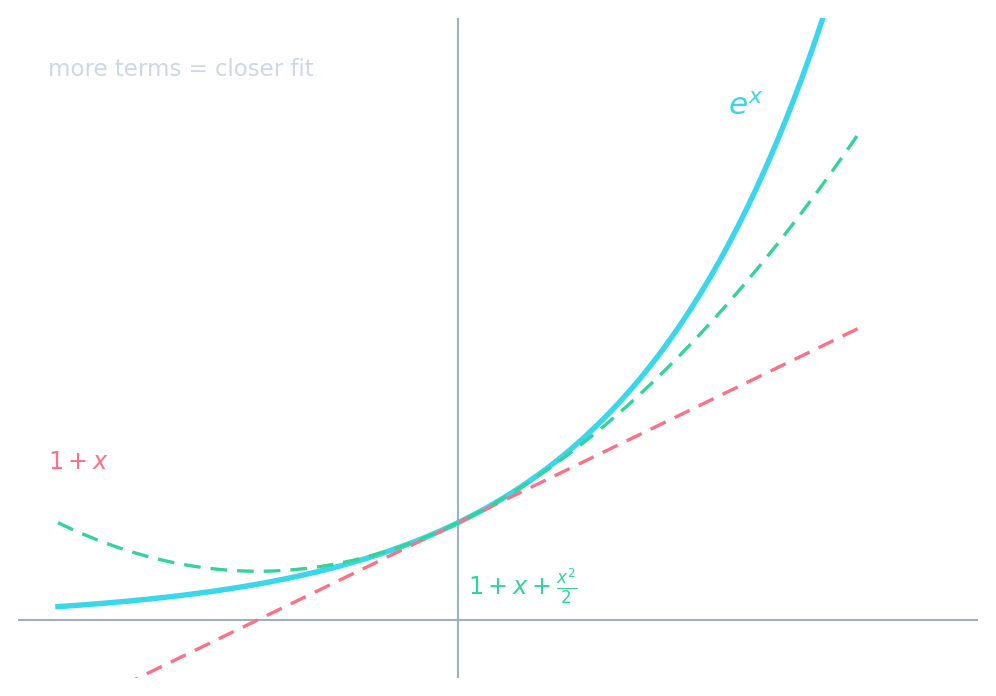
每一个额外的项把多项式弯得在 $x = 0$ 附近更接近 $e^x$——正是计算器的工作方式。
更多标准级数。 $\sin x = x - \dfrac{x^3}{3!} + \dfrac{x^5}{5!} - \cdots$ 和 $\ln(1+x) = x - \dfrac{x^2}{2} + \dfrac{x^3}{3} - \cdots$(对 $|x| < 1$ 有效)。
The Maclaurin series of eˣ begins: · eˣ 的麦克劳林级数开始于:
eˣ = Σ xⁿ/n! = 1 + x + x²/2! + x³/3! + …
Where the series is valid
- A Maclaurin series only matches the function within its interval of convergence 收敛区间.
- $e^x$, $\sin x$, $\cos x$ converge for all $x$; but $\ln(1+x)$ only for $-1 < x \leq 1$.
Check convergence before you trust it. Far outside the valid interval the polynomial diverges 发散 wildly from the function — more terms make it worse, not better.
- Differentiate hyperbolic functions and inverse functions, and relations given implicitly or parametrically.
级数在哪里有效
- 一个麦克劳林级数只在它的收敛区间(interval of convergence)内匹配函数。
- $e^x$、$\sin x$、$\cos x$ 对所有 $x$ 收敛;但 $\ln(1+x)$ 只对 $-1 < x \leq 1$。
在你相信它之前检查收敛性。 在有效区间外很远的地方,多项式与函数剧烈发散——更多的项使它更糟,而不是更好。
- 对双曲函数(hyperbolic functions)和反函数求导,以及对隐式(implicitly)或参数式(parametrically)给出的关系求导。
The Maclaurin series for ln(1+x) is valid for every value of x. · ln(1+x) 的麦克劳林级数对 x 的每个值都有效。
It only converges for −1 < x ≤ 1; outside that interval it diverges. · 它只对 −1 < x ≤ 1 收敛;在那个区间外它发散。
You've got it
- new derivatives: $\sinh x \to \cosh x$, $\tan^{-1}x \to \dfrac{1}{1+x^2}$, $\sin^{-1}x \to \dfrac{1}{\sqrt{1-x^2}}$
- Maclaurin: $f(x) = f(0) + f'(0)x + \dfrac{f''(0)}{2!}x^2 + \cdots$
- $e^x = 1 + x + \dfrac{x^2}{2!} + \cdots$ — more terms fit better, within the interval of convergence
你掌握了
- 新导数:$\sinh x \to \cosh x$,$\tan^{-1}x \to \dfrac{1}{1+x^2}$,$\sin^{-1}x \to \dfrac{1}{\sqrt{1-x^2}}$
- 麦克劳林:$f(x) = f(0) + f'(0)x + \dfrac{f''(0)}{2!}x^2 + \cdots$
- $e^x = 1 + x + \dfrac{x^2}{2!} + \cdots$——更多的项贴合得更好,在收敛区间内