The circular flow and the multiplier · 循环流转与乘数
| English | 中文 | Pinyin · 拼音 |
|---|---|---|
| injection/ɪnˈdʒekʃn/ | 注入 | zhù rù |
| multiplier/ˌmʌltɪˈplaɪə/ | 乘数 | chéng shù |
| national income/ˈnæʃənl ˈɪŋkʌm/ | 国民收入 | guó mín shōu rù |
| withdrawals/wɪθˈdrɔːlz/ | 漏出 | lòu chū |
| marginal propensity to consume/ˈmɑːdʒɪnl prəˈpensɪti tə kənˈsjuːm/ | 边际消费倾向 | biān jì xiāo fèi qīng xiàng |
How one dollar becomes many
- Spend a dollar at a shop; the shopkeeper spends part of it; the next person spends part of that. One injection 注入 ripples through the economy.
- This multiplier 乘数 effect means a change in spending raises national income 国民收入 by more than the original amount.
一美元如何变成许多
- 在一家店花一美元;店主花掉它的一部分;下一个人花掉那部分的一部分。一个注入在经济中泛起涟漪。
- 这个乘数(multiplier)效应意味着支出的一个变化把国民收入提高超过原始数额。
The circular flow, revisited
- Income circulates between households and firms, with injections (I, G, X) adding in and withdrawals 漏出 (S, T, M) leaking out.
Injections (investment, government spending, exports) feed the loop; withdrawals (saving, taxes, imports) drain it.
Income circulates between households and firms, with injections and leakages
循环流转,重温
- 收入在家庭和企业之间循环,注入(I、G、X)加入而抽出(S、T、M)漏出。

注入(投资、政府支出、出口)喂养循环;抽出(储蓄、税收、进口)排干它。
The circular flow and the multiplier · 循环流转与乘数
Income circles between households and firms. An injection (e.g. investment) is re-spent again and again — the multiplier effect. · 收入在家庭和企业之间循环。一个注入(例如投资)被一次又一次地再支出——乘数效应。
Which is an injection into the circular flow? · 哪个是对循环流转的一个注入?
Injections are I, G, X; saving, taxes and imports are withdrawals. · 注入是 I、G、X;储蓄、税收和进口是抽出。
The multiplier
- Each round of re-spending depends on the marginal propensity to consume 边际消费倾向 (MPC):
Worked example. If MPC = 0.75, the multiplier $= \dfrac{1}{1 - 0.75} = \dfrac{1}{0.25} = 4$ — so £1bn of extra spending raises national income by £4bn.
One injection multiplies into a larger rise in income
乘数
- 每一轮的再支出取决于边际消费倾向(marginal propensity to consume,MPC):
例题。 如果 MPC = 0.75,乘数 $= \dfrac{1}{1 - 0.75} = \dfrac{1}{0.25} = 4$——所以 10 亿英镑的额外支出把国民收入提高 40 亿英镑。
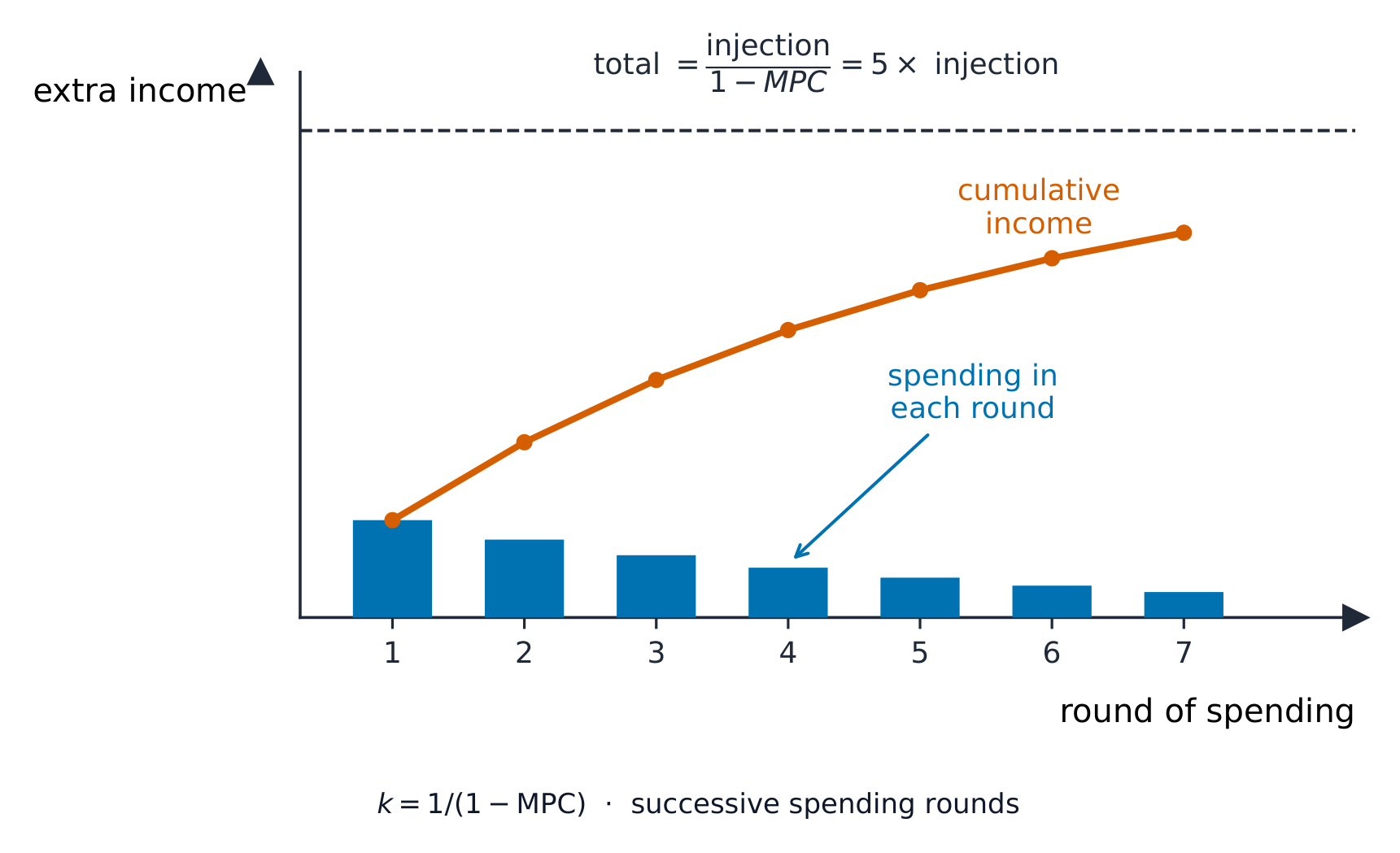
一个注入倍增为收入的一个更大上升
The multiplier, round by round · 一轮一轮看乘数
Drag the injection and the MPC, then press Play — each spending round is MPC times the last, and the total settles at k × the injection. Bigger leaks, smaller ripple. · 拖动注入额和 MPC,然后按播放 — 每一轮支出都是上一轮的 MPC 倍,总量收敛于 k × 注入额。漏出越大,涟漪越小。
If the marginal propensity to consume is 0.75, what is the multiplier = 1/(1 − MPC)? · 如果边际消费倾向是 0.75,乘数 = 1/(1 − MPC) 是多少?
1 / (1 − 0.75) = 1 / 0.25 = 4. · 1 / (1 − 0.75) = 1 / 0.25 = 4。
With a multiplier of 4, by how much does national income rise if spending increases by 2 billion? · 在一个为 4 的乘数下,如果支出增加 20 亿,国民收入上升多少?
4 × 2 billion = 8 billion. · 4 × 20 亿 = 80 亿。
The multiplier equals 1 / (1 − ______). · 乘数等于 1 / (1 − ______)。
Multiplier = 1/(1 − MPC). · 乘数 = 1/(1 − MPC)。
What weakens the multiplier
- The bigger the withdrawals (high saving, taxes, or import spending), the smaller the multiplier — more leaks out each round.
Actual output around its potential, showing output gaps
什么削弱乘数
- 抽出越大(高储蓄、税收或进口支出),乘数就越小——每一轮漏出更多。

实际产出围绕其潜在产出,显示产出缺口
A higher rate of saving or imports reduces the size of the multiplier. · 一个更高的储蓄或进口率减小乘数的大小。
More leaks out of the flow each round, so re-spending — and the multiplier — is smaller. · 每一轮从流动中漏出更多,所以再支出——和乘数——更小。
You've got it
- an injection ripples through re-spending — the multiplier effect
- multiplier $= \dfrac{1}{1 - MPC}$ (MPC 0.75 → multiplier 4)
- bigger withdrawals (saving, tax, imports) → smaller multiplier
你掌握了
- 一个注入通过再支出泛起涟漪——乘数效应
- 乘数 $= \dfrac{1}{1 - MPC}$(MPC 0.75 → 乘数 4)
- 更大的抽出(储蓄、税、进口)→ 更小的乘数